What's helping turn?
Aid shifts are defined as the use of external forces to enable drivers to complete the transition with less force. It was initially applied to some large vehicles, and it was not too hard to make the transition easy. It is now widely used on various models, making driving easier, faster and, to some extent, safer. The shift to the power source can be divided into hydraulic and electric aids。
Mechanical hydraulics turn
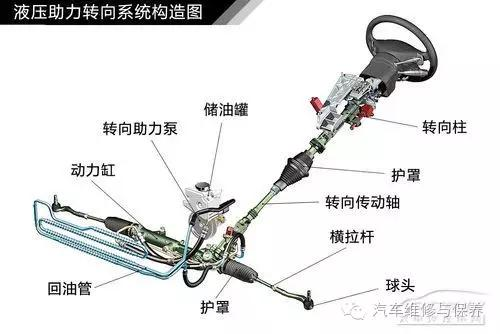
Mechanical hydraulic aid systems consist mainly of two components of gear gear transfer structure and hydraulic system (hydrovoltage booster pumps, hydraulic cylinders, pistons, etc.). The working method is to provide oil pressure boosters through hydraulic pumps (led by motor belts), which in turn generate auxiliary forces to drive the switch to pull and to support the wheel。
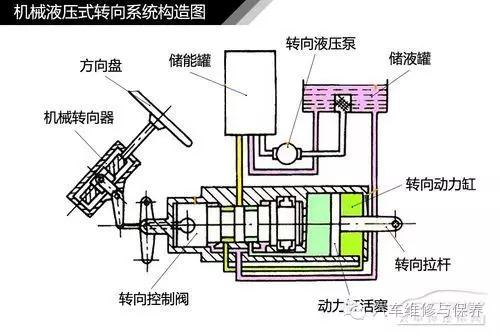
How does that work? In the first place, the mechanical valve (which can be rotated with the shift column) is located on the steering wheel, where it remains in place, with the same pressure on both sides of the piston and in a balanced state. When the steering wheel turns, the turn-over valve opens or closes accordingly, with the fluid on one side flowing directly back to the storage tank without passing through the hydraulic tank and the fluid on the other continuing to be injected into the tank, so that the pressure differentials on both sides of the piston are pushed, which in turn creates a auxiliary push towards the pull pole, making the shift easier。
In hydraulic transition systems, such as the intense beating of wheels and non-autonomous turnover of tyres due to pit plume surfaces, vibrations transmitted to the wheel can be significantly reduced by the effect of hydraulic pressure on the piston to provide a good buffer and absorb the vibration. Mechanical hydraulic aids are mature, stable, reliable and widely applied. However, the structure is more complex and maintenance costs are higher. It is also difficult to reconcile the different needs of pointing to precision when travelling at low speed and at high speed with the incoherence of purely mechanical hydraulic aid systems。
Electronic hydraulics turn
The structural principles of electron hydraulic aid are broadly the same as those of mechanical hydraulic aid, with the greatest difference being that the driver of the oil pump is different. The hydraulic pumps of mechanical hydraulic aid are directly driven by motor belts, while the electron hydraulic aid uses electrically driven electronic pumps。
Electronic pumps of electro-hydrovoltage help, which do not consume the power of the engine itself, and which are controlled by the electronic system and do not need to be diverted, are closed to further reduce energy consumption. An electronic control unit for the electronic hydraulic aid shift system, using information processing of sensors such as speed sensors, direction sensors and so forth, can alter the size of the transition force by altering the flow of electronic pumps。
The electric power is turning
Electric aids are mainly made up of sensors, control units and auxiliary power units, without hydraulic pumps, hydraulic piping, rotor valves, etc. Of hydraulic aid systems and very simple structures。
The main working principle is that, when steering the wheel, the rectangular sensor, located in the directional column position, transmits the moving signal to the controller, which provides the electric generator with an appropriate voltage by computing corrections and drives the electric motor. The twisting of the motor output is enhanced by the speed-reducing mechanism, which drives the shift to the column or to the puller, thus providing a diversionary force. The electro-assisted switch system can change the size of the help at speed, allowing the wheel to be lighter at low speed and more stable at high speed。
There are two ways in which electric power can be turned, one being to assist in the shift column, by connecting the auxiliary powerer directly to the shift column after slowing it up and twisting it, and by putting the auxiliary twist of the power output directly on the shift column, which is the equivalent of the electric power directly helping us to turn the wheel. The other is to assist with the switch pole, which is to be installed on the switch pole, and which is to drive the wheel. The latter is more compact and easily organized and is currently used more extensively。
What's going to happen with speed?
The shift to velocity variable power means that the size of the shift power can change as the speed of the vehicle changes. What good is this? While it is true that it is convenient to move at low speeds, such as parking in garages, when the wheel turns light, it is a hazard when the wheel turns too light when travelling at high speed, because it does not contribute to the stability of the speed of vehicle movements。
This can be done with a shift in speed-variable enablers, which can provide significant help when the vehicle moves at a low speed, ensuring light and flexible steering; when the speed of the vehicle is higher, it will provide less help to enhance the safety and stability of the vehicle。
What is the variable shift relative to the system (active shift system)
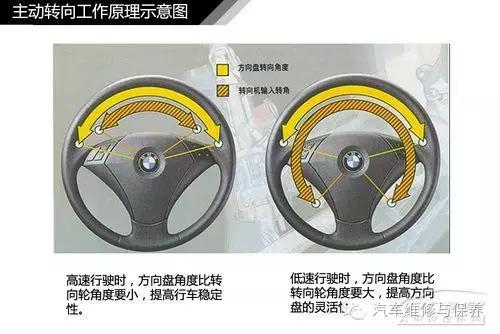
The so-called variable shift ratio can be understood simply as the ratio between the angle of the wheel and the corresponding angle of the wheel. The shift to a system of speed-variable enablers, as mentioned earlier, can be changed only by force strength, i. E., only by the force of the wheel, but the shift is irreversible, and the shift system of the variable shift ratio can only change the force of the shift, and in different cases the directional turn angle of the wheel can change。
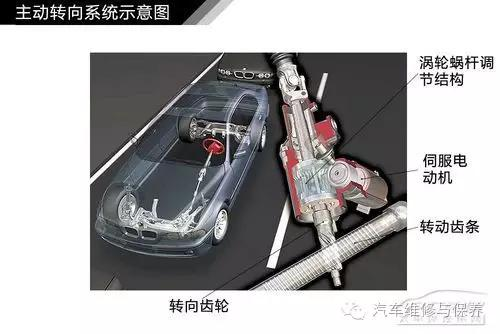
For example, in the active shift system in the above chart, where an electro-controlled mechanical unit is installed between the wheel and the wheel, the overall direction of the wheel is no longer just that of the driver entering the wheel, but rather the additional angle of the snail regulator. The movement ratio of the moving system can then be altered by the use of electrically motivated controls over snails。
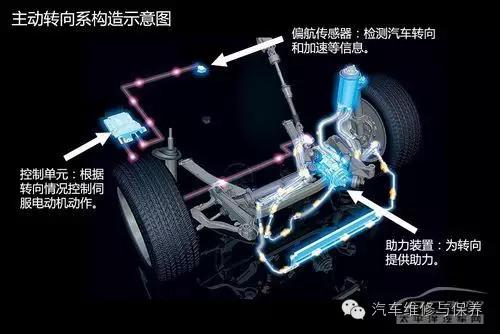
What good would that do? At low speed, the use of electric motors to make snail regulators the same direction as the driver turns the wheel can reduce the need for diversion. On the other hand, at high speeds, the snail-regulator agency, by means of electric motors, is in the opposite direction as the pilot turns the wheel, reduces the angle of the front wheel and increases the stability of the shift。