As a way of sharing information, the content of the letter is based on a wide audience, a small audience, a public caller and a twitter platform. This paper provides an in-depth analysis of product design, the impact on users and the business opportunities of the micro-credit platform。
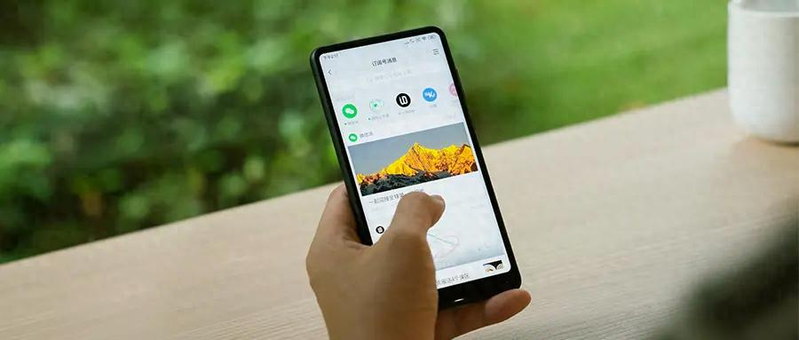
Let's go on today and see if we can still say something new like the previous ones
Turning on the tweets — found — to look at the top title, there is only one page sign: a friend. And moving down, it's true that around 5 screens are preceded by tweets from friends who are watching public articles。
Sou-suk is curiously continuing to decline
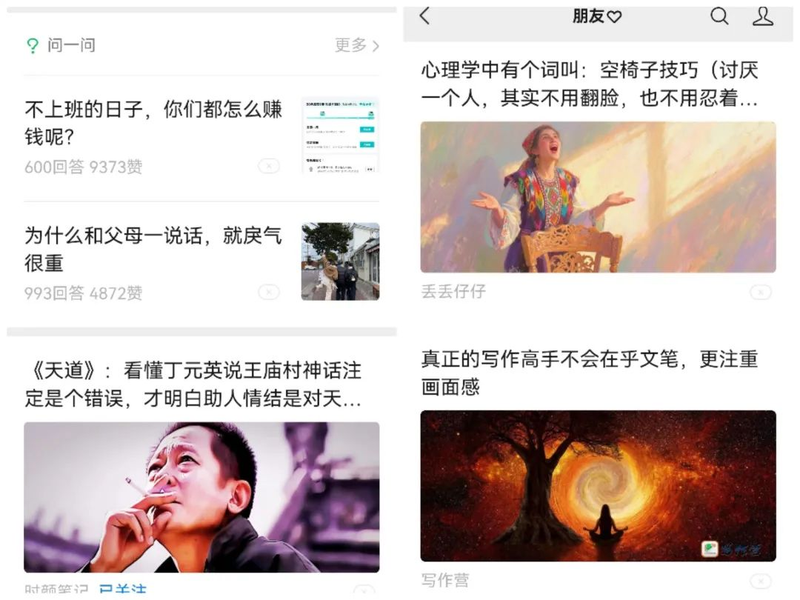
It includes the sub-module "question" in the last article, and the public number i've been looking at, as well as some other public article recommended by algorithms。
All right, here's the background, and we're going to go into the design analysis of soya-sama's product。
The content [see] is based on the quartet, with a mass audience (demand side), a small audience (share side), a public call author (supply side), and micro-credit (platform side)。
User side
First of all, in terms of the type of content, the present [look at] only the type of graphics such as news or public article are kept; secondly, in terms of the seo algorithm (in which the term is not understood, the left-hand reading of a microletter [search], a new search method), the sorting of information is considered in a way that socialized recommendation is recommended as the primary + algorithm。
You don't know what you're thinking? Soyuzumi thought about the old paper paper. It's been a while since you've read a newspaper, but there's still a need for newspaper content. It's just that we may have changed to a public call to see the public, to see the wikileaks, to meet this need。
Go on, tell me, what's changed about the sharers? Before [seeing], for sharing users, it is generally done by forwarding to friends, or in the circle of friends. This approach may have to bear more concerns before and after forwarding to some of those who fear it. Now it's time to click on the button, which means you like it and you can be seen by friends. This clearly weakens shared concerns before and after sharing。
Supply side
Soya su-kun himself is also the author of a public call, and he also takes the initiative to click on what he thinks is a better article, so that the article can enter [see] and be seen by more people。
So this platform gives creators an extra stage to show themselves. One more chance to get on stage. I looked at our reading statistics, and there were a few readers。
Platform side
A function of micro-credit to attract users of micro-credit. Last one we said, "search a search" -- this is a function that requires the user to ask questions to return the information. And for users, it's passive feeding。
It's kind of like a short video stream of shivering/wiss. When it's open, the user just needs to keep going down and open. But it is true that there is no sense of guilt (after all, it feels more like learning) of “kill time” when looking at a short video。
Wireless gets the user's screen stop time by [seeing]. By way of ai, shuu-chung deliberately checked that the daily use of micro-intelligence has now lasted more than three hours per person. The longer the user stays on an ap, the more business opportunities the platform will have。
User influence and platform business opportunities
Having said this, let's move on to the impact on users and the business opportunities that we bring to the twitter platform。
Public users can learn what friends like and have an extra social conversation. It's a way to open yourself, like taking friends to their study。
Users will also have the next and next passive control of a short video. At this point, user awareness is more controlled by algorithms。
Recommend the use of tips: open it when you're free to see what your friend has recently been interested in, and set himself a three-screen slide limit. It would be useful to look at the interest, which would help to broaden its profile. That's what you really care about。
The current profitability of micro-intelligence, which accounts for more than 200 billion people in 24 years, has been carefully examined by soyuzun, with advertising accounting for 35 per cent. The portals of these users to passive access to information are sources of advertising revenue。
The more time a user spends on twitter, the more it accumulates the preferences of each user for more information to browse, which in turn can lead to more accurate advertising and even to the creation of a list, which in turn can generate electricity。
I just got a message from an online reader: these platforms are as black as ever. To be honest, it might be reasonable to say so only in the light of the short-term interests of individual users. But, please ask, is everyone using twitter, and is it that, for the most part, in addition to network traffic charges, they use their functions free of charge
If a company does not earn money, it cannot be long-term. There's nothing to be ashamed of about business opportunities, but about cheating users. Most users can use it free of charge only if the platform makes money. They're also stinging the wool of a few high-value users