(the essence of the hole effect is that when the current in a solid material moves in the magnetic field, the trajectory is deflected by the influence of the lorenzian force, and the charge accumulates on both sides of the material, forming an electric field vertically in the direction of the current, which ultimately balances the lorenzian force to which the carrier is exposed with the electric field, thus creating a stable power difference, or the hall voltage, on both sides
The hole coefficient, measured by the hole effect experiment, allows for the determination of important parameters such as the conductive type of semiconductor material, the flux concentration and the transport rate of the carrier。
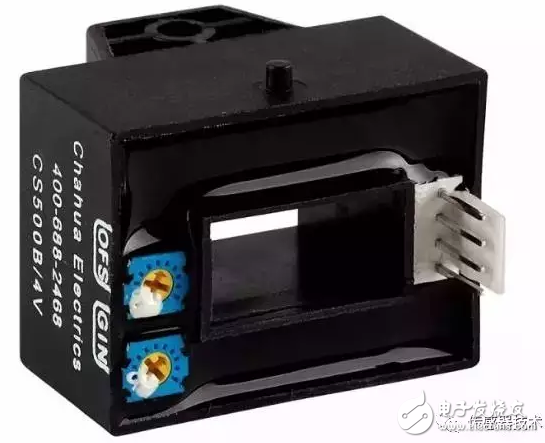
Because of the small power differentials generated by the hole element, the hole element is usually integrated into the amplifier circuits, temperature compensation circuits and voltage power circuits on a chip called the hole sensor. The hole sensor, also known as the hole integrated circuit, has a smaller shape, as shown in the figure below:
620)this. Width=620; "syle=cursor:point"/
Hall sensor
Advantages and uses of the hole sensor
Many know that the higher the automation of cars, the more microelectronic circuits, the greater the fear of electromagnetic interference. On the other hand, there are many lamps and electrical appliances in cars, in particular high-power front-lights, air-conditioning electric units and rain-scrapers, which generate wave currents, electric arcs from mechanical switches and high electromagnetic interference signals。
The introduction of power hal switch circuits can reduce these phenomena. By detecting magnetic field changes, the hole device is transformed into a telecommunications output, which can be used to monitor and measure changes in the operational parameters of individual parts of the vehicle。
For example, position, shift, angle, angular velocity, rate of rotation, etc., can be revariated with these variables; measurable pressure, mass, fluid level, flow speed, flow, etc. The output of the hole device is directly interfaced with the electrical control unit and automatically detectable。
The current hole device can withstand a certain amount of vibration, can work within a range of 40°c to 150°c below zero, and is completely sealed free of water and oil contamination and fully adapted to the bad working environment of cars。
Hall sensors can measure currents and voltages of any wave shape, such as straight currents, communication, pulse waveforms, etc., or even transient peaks. The side current faithfully reflects the wave shape of the side current. It's not comparable to a common sensor. It's usually only for measuring 50 hz sines. Wave
There is a good electrical separation between the original and the secondary circuits, with a barrier of up to 9,600 vrms
High accuracy: accuracy is better than 1% in the working temperature area, which is suitable for any wave-form measurement; hole switches are non-attractive, non-painted, with clear output wave shape, non-diversity, no back-up, high position repetition precision (at the level of dharmm)。
Broadband: the current sensor with high bandwidth can rise at less than 1 metres; however, the voltage sensor has a narrower bandwidth, generally within 15 khz, and the high voltage sensor with 6,400 vrms has increased at approximately 500us and the bandwidth at about 700 hz。
The range of measurements is wide: current measurements can be up to 50ka and voltage measurements up to 6400 v。
Strong structures, small size, light weight, long life, easy to install, low utility, high frequency (up to 1 mhz), shock resistance, and protection from pollution or erosion from dust, oil pollution, water vapour and salt fog。
620)this. Width=620; "syle=cursor:point"/
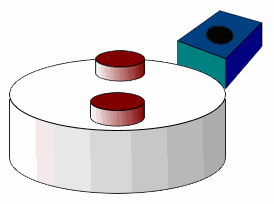
The figure above is a typical hall sensor for positioning applications -- two magnets on a wheel passing through the hole effect sensor. The wheels in the diagram, with a magnet with two equal ranges, will peak twice in a period of time on the sensor。
It is usually used to measure the speed of wheels and axes, e. G., when the internal combustion engine ignites (in time) or on the rotation schedule. It is used without a straight current motor to detect the position of the permagnet。
Hole sensors are widely used in facilities requiring quarantine detection of currents, such as variant-frequency modulation devices, reverse-modification devices, ups power sources, communications power sources, welders, electric motor vehicles, transformers, numerically controlled machine beds, electrolyte plating, micromechanical monitoring, grid monitoring, and emerging solar, wind and underground orbit signals, and automobile electronics。
Main characterization parameters of the hole sensor
The hole sensor was described as a magnetic field sensor based on the hole effect, with the following main characterization parameters。
(1) enter electrical resistance r
Two direct current resistance elements of the hole sensor component are referred to as input resistance. Its values range from several to a hundred euros, depending on the shape of the components。
The temperature rises and the input resistance becomes smaller, which increases the input current and eventually causes changes in the electrical power of the hole sensor. In order to reduce this impact, it is advisable to use a constant stream as a source of incentives。
(2) output electrical resistance r
The electrical resistance between the power output end of the two hole sensors is called the output resistance, which is in the same order of magnitude as the input resistance. It also changes with temperature. The selection of appropriate load resistance can be matched to minimize the movement of water and electricity during the process due to temperature。
(3) maximum incentive current i - hall sensor parameters
As the power of the hole sensor increases with an increase in the incentivation of currents, it is always desirable in applications to use a larger incentive of 1m but to stimulate an increase in currents, an increase in the efficiency of the cipher elements, and an increase in the temperature of the element skin, leading to an increase in the temperature of the hole sensor's presence, the corresponding maximum incentivation of currents is provided for in several pieces of each model, with values ranging from several milligrams to several hundred millimetres。
(4) sensitivity k
Sensitivity kh = eth/ib, with values around 10 mv (ma. T)。
(5) maximum magnetic sensitivity bm--hall sensor parameters
When magnetic induction is greater than bm, the non-linear error in the electrical power of the hole sensor increases significantly, with the ts pick (t) forming thousands of goss (1gs = 104t)。
(6) equal power
In rated electric current f, when added to the magnetic field at zero, it is caused by errors caused by asymmetrical geometric dimensions of the four cantonment poles。
(7) hole sensor relay temperature coefficient
The value of 6m is typically referred to as the open voltage between the output end of the zero point hole sensor as the differential power, which is more often compensated by the use of a bridge method to compensate for the fact that, at a certain magnetic induction strength and incentivizing currents, the percentage change in the power of the hole sensor is less than the temperature coefficient of the hole sensor's power temperature for each temperature change of 1°c, which relates to materials of the hale sensor component。