Protein quantification is one of the most basic but vital experimental steps in life science research. Whether it is a western blot, protein purity or enzyme activity analysis, accurate protein concentration determination is a prerequisite for ensuring the reliability of experimental results. Among the many protein quantification methods, the bca protein quantification reagent box has become a routine protein quantification tool for laboratory use because of its high sensitivity, good linear scope and the resistance of anti-disruptives. This paper will provide a comprehensive presentation of the principles, characteristics, operating processes, application scenarios and frequently asked questions of the bca approach, helping researchers to better understand and apply this important tool。
1 rationale and technical characteristics of bca proteomics
1. 1 the chemical reaction principles of the bca method
Core technical principles of bca proteomics based on bicinchoNinic acid, bca) and copper ions react specifically in the alkaline environment. This process involves two key steps:
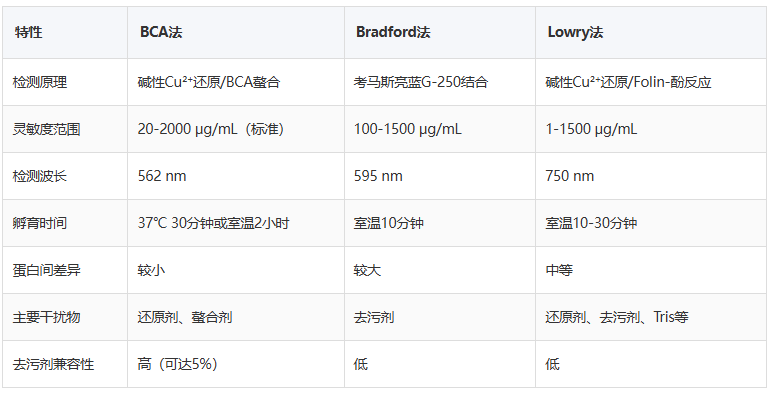
The bca act has a unique advantage over the lowry and bradford acts: it has a smaller coefficient of variation for different proteins, which means that the measurements for different proteins are more consistent and compatible with higher concentrations of defouling agents in samples, which is particularly important when dealing with complex samples such as cell fibrosis。
1. 2 technical advantages and limitations of the bca act
The main advantages of bca protein quantification are as follows:
However, there are limitations to the bca law:
2 bca protein quantification reagent box composition and operations
2. 1 standard composition of reagent cartridges
The commercially available bca protein quantitative reagent box usually contains the following basic components:
2. 2 standard operating procedures
2. 2. 1 work fluids production
The total bca work fluid required is calculated on the basis of the number of samples to be tested (including standard curve points and re-holes for samples to be tested). A mixture of work fluids according to the ratio of 50 volume reagent a to 1 volume reagent b. For example, a 5 ml solution a is added to 100 ml solution b and is fully mixed until the solution is evenly green apples. The work fluids in the new formulation can stabilize for 24 hours under room temperature closed conditions。
2. 2. 2 standard curve preparation
The bsa standard to be provided is diluted by gradient, usually with 6-8 concentration points. For example, the 96-pore plate test allows the setting of gradients of 0, 2, 4, 8, 16, 24, 32, 40 μg/pore. To ensure accuracy, each concentration point should be perforated and the standard curve should cover the expected concentration range of the sample to be measured。
2. 2. 3 sample testing and data analysis
On the basis of the expected concentration range of the sample, the test may be based on either a test tube or a micro-pore plate method:
After incubation, spectrophotometers or enzyme markers are used to determine the suction values at 562 nm wavelengths. All samples should be read within 10 minutes to avoid errors due to continued reaction。
Finally, a standard curve is drawn with a standard protein suction to concentration, which calculates the protein concentration of the sample to be measured based on the curve equation。
3 bca protein quantification applications in different experimental scenarios
Bca protein quantification techniques are widely used in various fields of biomedical research, including:
3. 1 proteomics studies
In proteomics studies, bca legal quantities are often used for:
3. 2 easeology and dynamics studies
In enzyme activity analysis, the bca method can be used to:
3. 3 biopharmaceuticals and quality control
The bca also plays an important role in the biopharmaceutical field:
3. 4 drug development and screening
4 comparison of the bca method with other protein quantification methods
In order to better understand the characteristics of the bca method, the following table compares it with two commonly used protein quantification methods:
5. Examination of experimental techniques and frequently asked questions
5. 1 optimizing strategies to detect sensitivity
If the concentration of protein in the sample is low, the detection sensitivity can be increased by:
It needs to be noted that increased sensitivity is accompanied by a reduction in the detection range, ensuring that sample concentrations do not exceed the standard curve。
5. 2 common problems and solutions
5. 3 identification and treatment of jammers
The bca act is more clearly disturbed by:
If interference cannot be avoided, the following strategies may be considered:
6 concluding remarks
The bca protein quantification reagent box has become one of the technologies indispensable for modern life science research as a reliable, sensitive and operational protein quantification tool. Its unique principles of chemical reaction, its high tolerance for de-fouling agents and its wide range of applications make it possible to provide accurate protein quantitative data in various experimental systems. By understanding its rationale, familiarizing itself with operational processes and optimizing conditions according to specific experimental needs, researchers can take full advantage of this technology and provide a solid foundation for high-quality scientific research。
As technology continues to evolve, a wide range of improved bca reagent boxes are available on the market, such as fast, high-sensitivity and anti-disturbation models, further expanding their application landscape. The mastery of bca protein quantification techniques, both for newcomers to laboratories and for experienced researchers, is a fundamental endeavour worth investing。