What difference does it make between two four valves and two five valves? A lot of people probably don't know, even some new engineers don't know what they mean by a few electromagnetic valves, and today we'll get this straight:
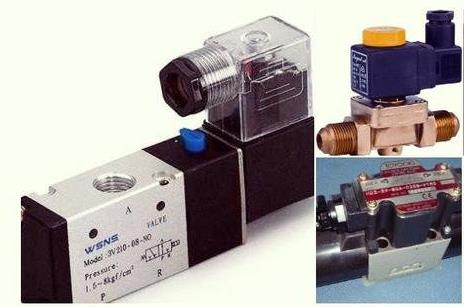
What's an electromagnetic valve
Electromagnetic valves (electromagnetic valves) are industrial equipment controlled by electromagnetic means, are automated basic elements used to control fluids, are an implementer and are not limited to hydraulics, gas. The direction, flow, speed and other parameters of the medium are adjusted in the industrial control system. Electromagnetic valves can match different circuits to achieve the desired control, while the precision and flexibility of control can be assured。
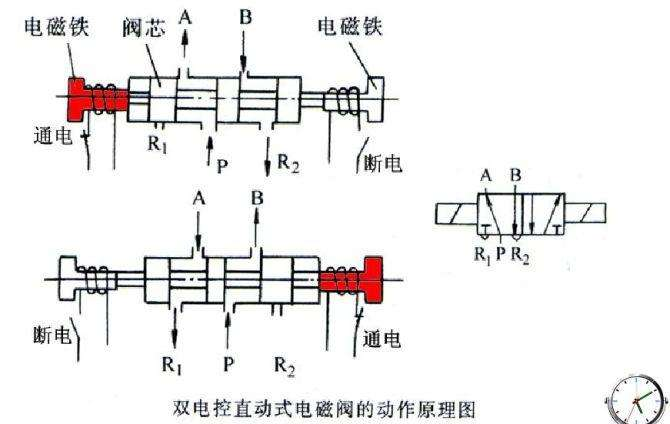
The work of the electromagnetic valve
The electromagnetic valves have closed cavities, open holes at different locations, each of which is connected to a different pipeline, with a piston between the cavity, two electromagnetics on both sides, which side of the magnet wire is attracted to, and which side of the convection turns on or off the different vents by controlling the movement of the valves, while the vents are frequently open, the hydraulic fluids enter different discharges, and then push the pistons of the tank through pressure from the oil, which then push the piston poles, which then drive the pistons, which drive the pistons, which drive the pistons. Mechanical motion is thus controlled by the control of electro-magnetic circuits. The same is true of electromagnetic valves for gas-dynamic systems, except that they are applied in different working media and may differ in product design and therefore not universal。
What are the electromagnetic valves used in production
The two electromagnetic valves, two 2-bit general-purpose valves, two-bit 3-bit valves, two-bit 4-bit, two-bit 5-bit valves, etc., which we use in production; the difference between two-bit 4-bit and two-bit 5-bit valves is understood first:
Meaning of "bit" and "through" of electromagnetic valves:
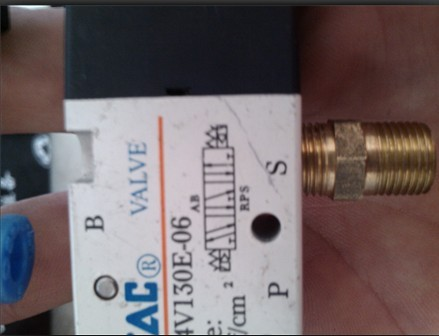
The concepts of “bit” and “through” are important for aerodynamic conversion to electromagnetic valves. Different “through” and “bits” constitute different types of aerodynamical conversion to electromagnetic valves. Commonly referred to as “two valves”, “three valves” means two or three different working positions for the core of the valves to be converted. The so-called “two valves”, “three valves” and “four valves” are two, three or four interfaces on the valves to which the valves are transposed that are not connected to the different pipelines or gases in the system, which can only be communicated between the different channels/airways through the switch on the valves at the time the valves move; the “severals” in front of you can be described as several if the valves work in a number of working conditions, and it is better understood if there are a symbol of aerodynamic components, and several are the squares that represent the valves on the drawings (with arrows or a t-line inside). And the latter “twices” represent several points in one of the squares (the intersection of the arrow line and the t-line) or several。
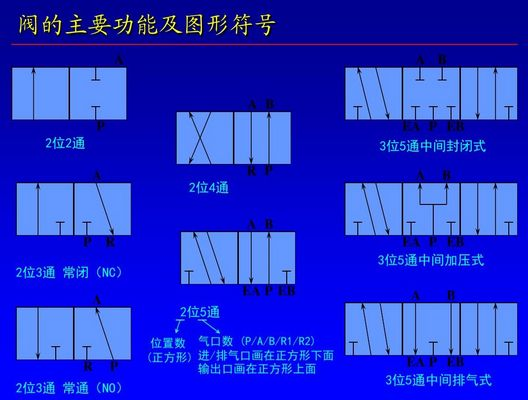
Graphical symbols of electromagnetic valves generally have the following meanings:
1. The location of the valves is shown in boxes, with several boxes indicating a few “bits”;
An arrow in the box indicates that the oil road is connected, but the arrow direction does not necessarily indicate the actual direction of the flow;
3, with the symbol “sing” or “sing” in the box indicating that the route is not accessible;
4 there are several interfaces with external connections to the box, which means a few “passing”;
In general, valves are shown in letters p for oil/gas intakes connected to systems for oil or gas routes; valves are shown in return gas/gas vents connected to systems for gas/gas routes (sometimes in o) and valves are shown in a, b, etc. In some cases, l is used for oil spills on graphic symbols;
6. The switch valves each have two or more working positions, one of which is a normal position, i. E., where the core is not manipulated. The median of the graphic symbol is the normal level of the three valves. The two valves that use spring repositioning are the normal position of the route in the box near the spring. When drawing the system, the oil/airways shall normally be connected to the normal position of the switch valve。
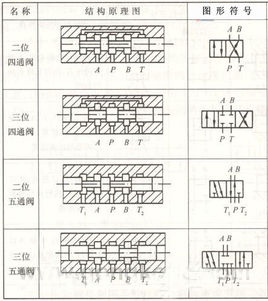
What's the difference between two four valves and two five valves
Two fours and two fives are functionally consistent, with some differences in application:
One, two, four-bit swap valves are usually used for hydraulic control to collect oil, while two five-bit valves are usually used for gas control, compressed air is not recycled and can be released at will。
Two or two four-way swap valves are usually used for mechanical valves and manual valves; when electromagnetic control is used, the five-ton valve structure is generally used because of limited electromagnetic power and therefore the requirements for switching need to be achieved with minimal core action, and the design of a five-ton valve structure will make it easier to achieve a shift in the small range of core actions。
Two vents of three or two five-digit electromagnetic valves mean that flow control valves can be installed to control the bi-directional motion speed of the cylinder (the switch speed can be adjusted for each) or to reduce the flow noise and shock of the cylinder。
For example, two of the five two electro-controlled electromagnetic valves operating principles: the powering of the positive action wire, the right action airway is connected (the right action gas hole is breathing), and even if the right action circuit is still connected after the right action circle has been cut, it will be maintained until the back action wire is wired. The powering of back-action circuits is followed by back-action air circuits (reactive gas holes, gas), even if the back-action circuits are still connected after the back-action loop has been cut, and will remain open until the back-action loop is reached. This is equivalent to “self-lock”. Based on this feature of the two two electro-controlled electromagnetic valves, the electromagnetic valves can be operated for 1 to 2 seconds in the design of electrical control circuits or plc programs, thus protecting them from damage。
Two fives, two fours, one single and two-power:
What's the difference between single and double
An electromagnetic valve is called a single charge controlled by only one electromagnet. The position of the slide valve corresponds to the "electricity"。
An electromagnetic valve is called a double charge controlled by two electromagnets. The position of the slide valve corresponds to the telecommunications number received by the last electromagnetic wire ring。
Single control valves: the wire is electrocuted in a state (referred to as state “1”); the two valves are “autonomously” restored to their original state (“0” state) when the wire is out of power. —note: an “automated” reset in case of power failure。
Two-bit valves of a two-wire circle: ``enabled' in the first circle and `enabled in the second circle', the two-bit valves shall be in the first state; `enabled in the second circle', the two-bit valves shall correspond to `0' in the second state when `enabled in the second circle', and the two-bit valves shall remain in the state before `maintained in the first state'. There is no " autoreset " function。
The former does not have “maintain” functions, while the latter does not have “automated” functions. Two valves with different control characteristics should be selected for different use requirements. (in the two-wire electromagnetic valves, two wires are not allowed to receive electricity at the same time, which can be limited by chaining in the control circuit
You are welcome to add to the commentary what you think is wrong or missing, so that the next reader will learn more, and you know exactly what you need。