Channel u is a platform for the matching of achi's well-known online advertising resources, bringing together 100,000 high-quality advertisers and service providers at home and abroad, providing resources such as media openings and proxy operations, and helping to achieve an efficient interface between parties ab and ab。
Recently, we talked to zhang, who did b2b software。
He's in hangzhou, where their home website's core key word, crm software, has been on top of the 100-degree search。
But since the second half of last year, he has found a problem:
"twenty times a day, only five or six. The website still ranks first, but how did the traffic drop?"
He also tried to increase his search advertising input, but the cpc soared, and the cost of getting a customer increased from $500 to $1,000, a business that was impossible to do。
He was also puzzled by several new brands, the low ranking of websites and the low level of advertising, but the growth of business was rapid。
He learned more about these new brands a few years ago and was frequently mentioned in the ai search。
He was thinking, "what the hell is this?"
A cruel reality is:
If you're still hoping to get paid by the traditional seo, it's getting harder。
The age of ai search is approaching, and 90 per cent of businesses are fighting a new war with old rules。
01
From seo to geo: not an upgrade, a switch
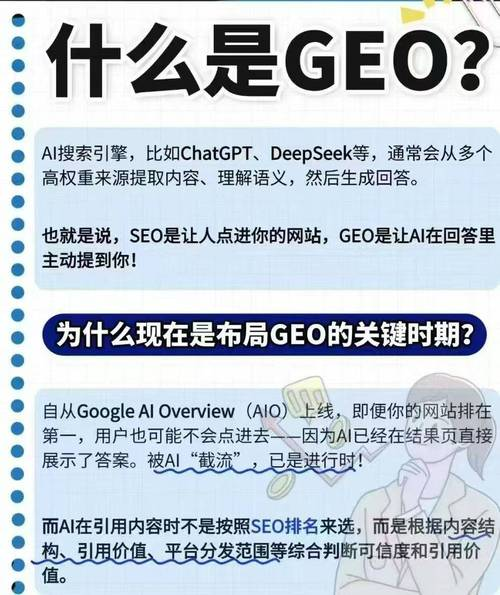
Many people interpret geo (generic engine optimization) as an upgraded version of seo, a fatal error。
Seo (survey engine optimization) and geo (generating engine optimization) are not linear evolutions, but two completely different client logics。
Core one: from "rank competition" to "trust competition."
Traditional seo era:
Ia search age:
What does that mean
In the era of seos, you can rapidly raise your ranking by "technical means" -- stacking keywords, buying external chains, optimizing page structure。
As soon as it's ranked, the flow will come。
But in the geo era, these "technologies" were all gone。
Ai doesn't trust you because of your keywords, or because you have multiple chains。
Ai trusts only what is truly valuable, authoritative and endorsed。
Core difference two: from showdown to recommendations
Traditional seo era:
Ia search age:
What has changed
In the era of seo, you can capture the mind of the user by "show frequency" -- though ranked third, every time a user looks at you, they'll remember you。
But in the geo era, if your brand is not mentioned by ai, the users have no idea you exist。
It's like a closed room in which you scream and no one hears, because the door is open。
Core three: from static to dynamic
Traditional seo era:
Ia search age:
What does that mean
In the era of seo, you can reap long-term benefits through one-time optimization。
But in the geo era, you need to maintain your competitive advantage by continuously exporting high-quality content, building up trust assets and continuously monitoring ai references。
02
90% of companies did three things wrong
Many of the employers came to us for advice, during which i found that 90 per cent of the companies had made the following three mistakes when they were setting up geo:
Error one: thinking about seo as geo, falling into a "keyword trap."
Many business owners think, "isn't geo an upgrade of the seo? Then i'll just keep making keywords."
And so they're so crazy about the key words "geo optimum," "beijing geo," "specialized geo service provider," that they expect ai to "take" to them。
But the result is that ai is not convinced。
Why
Because ai doesn't judge content by "keyword matching"。
Ai is judged by semantic understanding。
When the user asks, "who's geo works well," ai analyzes:
If your content is just a collection of keywords, there's no real value, ai won't believe it。
Correct practice:
Focus on content values rather than keyword density。
Error two: seeking quick results, ignoring trust accumulation
Many business owners expect, "i've done the geo optimization, and i can see it next week?"
When they are told that "geo optimization takes 1-3 months to see visible results", they tend to give up and turn to the pseudo-geo companies that promised "7 days on the front page"。
But the result was that it cost money and didn't work。
Why
Because the core of geo optimization is trust accumulation。
Ai wasn't "smart for a moment," but "learning for a lifetime."。
It will continuously retrieve information from the entire web and update its knowledge base。
If you publish a high-quality article today, you'll be accepted by ai tomorrow. You'll be lucky, but in the long run, ai will become less and less receptive to some of the information just released。
Geo optimizes the path:
Correct practice:
Geo optimization is considered a long-term investment rather than a short-term marketing activity。
Error three: only content production, ignoring the "trust asset" layout
Many business owners think, "geo optimization is writing, right? Then i'll find a team to write more."
So they're crazy about producing content, and they're publishing 100+ articles a month。
But the result is that there is a lot of content, and ai rarely quotes it。
Why
Because ai's not only concerned with the content, it's more concerned with the asset。
What's a "trust asset"
These "trust assets" are an important basis for ai to judge your credibility。
It's hard for ai to believe if your content is simply posted on your own official network, public domain, without external endorsement。
Correct practice:
The content production + confidence asset layout is two-pronged。
03
Geo optimization of the three core indicators
How can the geo optimization be assessed? I propose to focus on the following three core indicators:
Indicator i: number of brand references in ai responses
Definitions: frequency of branding referred to in ai responses to relevant keywords
Calculation: number of references to brands in ai responses / total ai responses
Target: 50 per cent increase in 3 months and 100 per cent increase in 6 months
Indicator ii: first recommended occupancy rate for ai
Definitions: number of brands ranked first in the ai response to the relevant keyword
Calculated: number of brands ranked first / number of total ai answers
Target: 30 per cent within 6 months and 50 per cent within 12 months
Indicator iii: percentage of ai recommended flows
Definitions: percentage of flows from ai recommended to total flows
Calculation: ai recommended traffic / total traffic
Target: 10 per cent within 6 months and 20 per cent within 12 months
At the end
From seo to geo, not upgrade, switch。
A new track, new rules, new wars。
I'm searching for traffic dividends. You've got 1-2 years。
Ninety per cent of businesses are still fighting a new war using the old rules, which means that competition is not yet intense。
If you start setting up geo optimizes now, there's still a chance to get ahead of you。
When everyone realizes the importance of geo and the red sea is formed, it will cost 10 times as much to think of breaking up。
From seo to geo, not upgrade, switch。
A new track, new rules, new wars。
Now, it's not too late。