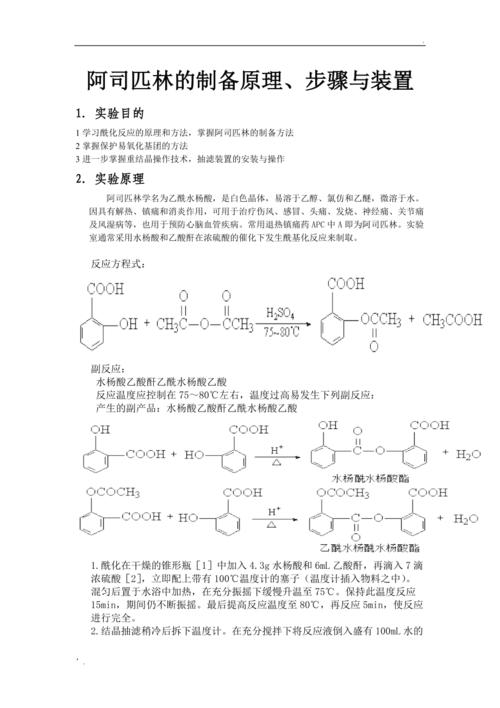
Aspirin's rationale for preparation, aspirin's method of preparation2 for preservation of the oxidation matrix3 and further mastery of re-crystaling techniques are white crystals, soluble in ethanol, chloroform and ether, and microsolvable in water. It is also used for the prevention of cardiovascular diseases, as well as for the treatment of strokes, flu, headaches, fever, nervous pains, joint pains and rheumatism, for example, as a result of the dermal, pain and inflammation. Aa of the apc, which is commonly used as analgesic, is aspirin. Laboratories usually use aqueous acid and acetic anhydride to react to hydride under the catalytic effect of thiosulfate. Response equation: side reaction: acetic anhydride aqueous acid the acetyl acid reaction temperature should be controlled at about 75 ~80 °c and the following by-products are likely to occur at a high temperature: 7 drops of sulphuric acid are produced, immediately fitted with a plug with a 100 °c thermometer (thermometer is inserted into the material). The mixing is followed by heating in the water bath, slowly rising to 75°c with full vibration. The temperature was maintained to react to 15min, and it continued to vibrate. Finally, the reaction temperature is increased to 80°c and re-reactive to 5min to complete the reaction. The reaction fluid is poured into a cup filled with 100 ml water, with full mixing, and then the ice water cools and is filtered when the crystal is fully distilled. Breads are washed twice with a small amount of cold water and then pressed dry and transferred to the 100 ml cup. % ethanol, heated up in a water bath at 45-50°c and rapidly dissolved. If the product is not fully dissolved, 35% ethanol solution may be added as appropriate. It is then static to room temperature, cooled by cold water and filtered when the crystal is fully distilled. Breads are washed twice with a small amount of cold water and pressed dry. The crystal is transferred to the surface vessel, which is naturally dryed, and calculates the production rate. 35% of the ethanol solution is used to re-introduce it. Its operating processes are as follows: (250ml), scales, glue drip tubes, bathing pots, thermometers (100°c), glass bars, bush funnels, vacuum pumps, cups (200ml, 100ml), reflow condensing tubes, cone bottles (50ml or 100ml), test tubes, pallets, flasks, cups, (s), acetic anhydride (l), sulfate acid (98%), ice blocks, acetic anhydride (l), boiling stones