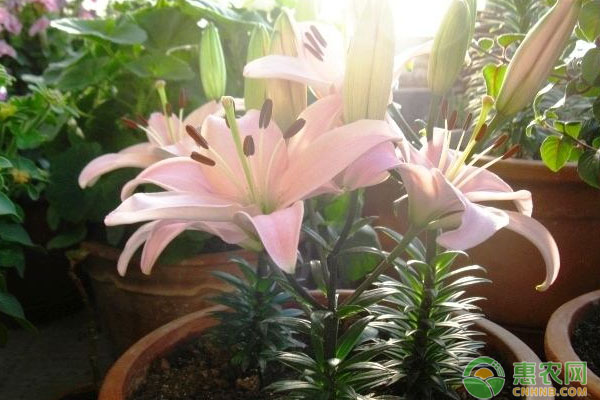
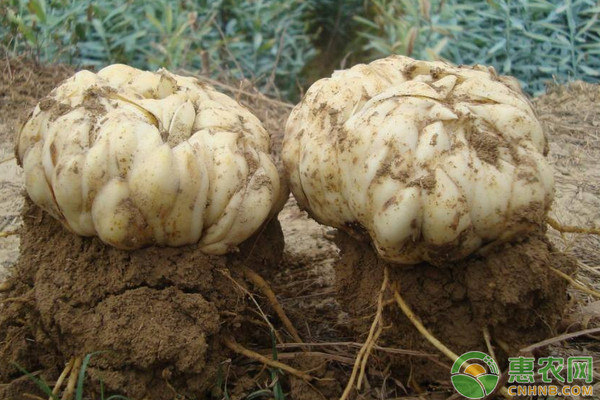
What difference does it make between lilies and lilies? The difference between edible lilies and lilies is that some species are edible, and we often say edible lilies, and lilies are edible lilies. The lilies referred to in the high-yield cultivation techniques of khoshan county, which are studied below, are the lilies for food。
1 varieties and mother seed selection
High-quality, disease-resistant, high-yielding, adaptable and commercially good food lily varieties are selected. Select a single lily of less than four sprouts with the characteristics of the species, with a single stem weight of 25 to 40 g, disease free, insectless eye, undecomposed, sprout flattened, rounded, white piece of plastered, holding tight, even-sized。
Land selection
In the selection of the field, the field, which is preceded by a melon, pulse or herbal crop, is selected in the first instance, and is not associated with the limo, especially garlic. Second, attention should be paid to the selection of * deep-thick, organically rich, well-watered, disease-free micro-acid border* or sandy border*。
Three
In due course, till 18-20 cm. The gutter is made of the “three gutters” to make it dry. Zirconium width 1. 5~1. 6 m, zirconium face* loose, turtle back. It's 30cm deep, 30cm wide, 50cm deep, 30cm wide, 2030cm deep, 20cm wide。
4 fertilisation
Fertilisation should be combined with organic and inorganic fertilizers in fertilizer transportation using *formulation techniques, with nitrogen, phosphorus, potassium and microfertilizers combined for application。
4. 1. Base fat
45 t/ hm 2 (or pie fat 2 250 kg/ hm 2 or commercial biocofertilizer 2250 ~ 3000 kg/ hm 2) + 40% and above 3 element fertilizer 825 ~ 900 kg/ hm 2. Farmer fattening, pie fattening, or commercial organic fattening * in combination with whole-cropping, inorganic fatting is applied in a ditch, i. E. Opening a ditch between seeding lines, deep at 8-10 cm, immediately after application * must avoid direct contact between fertilizer and seeds。

4. 2 following fat
22. 5t/hm2 (or 22. 5t/hm2 after dilution, or 1% urea dilution 15 t/hm2) + 40% above 3 element formulations 375 ~ 450 kg/hm2 and inorganic fertilizer application. Around mid-april, when new petals were formed, gutters or caves were applied to potassium fertilizer 75kg/hm2. In mid-may, 2 to 3 sprayings of potassium phosphate and 0. 3 per cent of urea mixed leaf surfaces were used at intervals of 10d。
5 seeding
Seeding in late september to mid-november should not be too late, using 3,000 to 4,500 kg/hm 2. Before seeding, 20-30-min is disinfected with 50 per cent methyl tobuzim 600-fold or 75 per cent enzymes 800-fold impregnated, and dry surface water is then sowed。
The first of these is to open the first ditch at the end of the plume, then to drain the lily from the side of the puddle, then to line the second ditch, and then to cover the first ditch with a puddle of puddles*, and then to proceed on a step-by-step basis, with the lilies bearing around * 8 cm。
Cultivation density is around 150,000/hm2, 25-28 cm range and 15-18 cm range. After seeding, 5850 ~ 6000 kg/hm2 covered with 3 ~ 4 cm thick to protect the heat from grass。
6 field management
6. 1 cultivation
At 10 cm tall (little 8-10 leaf) tilling, so as to be shallow, thin, smooth and fine, and so as to prevent space,* sapling and damage to roots. After entering may, the surface of the land can be covered with grass to reduce the temperature of the border*。
6. 2 picking the roof to the bud
The pre-formation of the buds, the removal of lilies and buds following the drying of the barometer, the control of reproductive growth and the promotion of the growth of the tubers. The extraction should be based on actual field growth. The removal of the top can be delayed when the disease is heavier or weaker. Spraying 1:1:250 ~300 bordos in front of the pick-up for protection. The pick of 10d should be followed by the appearance of purple brown beads in the lilies. If the bud matures, the lily plant base should be struck with a bar in the clear sky, and the bud can fall off itself。
6. 3 drainage drainage
It is necessary to clear the trenches in a timely manner so that the rain stops drying and the trenches have no light water。
7 insect and grass disease prevention
7. 1 principles and measures for prevention
The principle of prevention as an integrated approach is upheld. The selection of disease-free rods for planting, pre-plant seed treatment, care to switch, application of non-hazardous organic fertilizers, increased phosphorus and potassium fertilizer. (c) strengthen field management, with attention to improving ventilation and light conditions in plantations, avoiding over-planting, ploughing in a timely manner and draining trenches after rain. (c) the timely removal of disabled tissues, the concentration of deep burials or compost, the protection of sprays prior to the occurrence of the disease and the preferential treatment of pesticides at the onset of the disease. The application of pesticides is prohibited before collection。
7. 2 main diseases
Most of the disease occurred in may-june, which is warm and wet. 1 stereocosis prevention and treatment, with the selection of non-sensor-free tubers, the timely removal of strains found in the field and a reasonable rotation. 2 asymptomosis control, 50 per cent of which is initially used as an amphibian suspension 600 ~ 1200 ml/hm2, 40 per cent of an amoellamine suspension 750 ~ 1,050 ml/hm 2 or 50 per cent of a corrodant 600 ~ 750 g/hm 2 spray. 3 anthrax prevention, with 25 per cent of mesh cream 1500 ~ 1800 ml/hm2 or 50 per cent of polybacterium superpluent 1500 ~ 1800 g/hm2 spray at the beginning of the disease。
When sprayed, the mobile backpack dispenser passes to water 225 ~ 300 kg/hm 2, the manual backpack sprayer passes to water 600 ~ 900 kg/hm 2, and the flier is flat on both sides, all of which can only be used once。
7. 3 major pests
1 蛴螬 老虎 老虎 老虎 老虎 老虎 老虎 蛴螬 after lithoporium seedlings, application or strip application was evenly distributed with 1. 1% of the bitter alkaline powder 30 kg/hm2。
2 aphid control, use and protection of natural enemies, cedar booby traps in the field, with 10 per cent of aphids of humid powder spray 225g/hm2 used when the yield rate was 25 per cent. Modular backpack aerosol dispenser to water 225 ~300 kg/hm2, manual backpack sprayer to water 600 ~ 900 kg/hm 2, flat spray。
7. 4 weed prevention
Artificial protection is strongly promoted, with minimal or no use of herbicides. If chemical weeding is necessary, it should be closed* after seeding and until weeds are out. 48% fluorine cream 2250 ml/hm2 or 50% acetamine emulsion 1200 ~ 1800 ml/hm2, hand-back sprayer to water 600 ~ 900 kg/hm2。
8 harvest and storage
The lilies can be harvested with the atrophy and maturity of their stem. Select the weather to be clear, dig it all, remove the rods, swipe the root, mud* the stench, and pack the rods in time to avoid strong light. Instruments used in harvesting, distribution, transport and storage are clean, hygienic and non-polluted。