The creative development of the 100th anniversary dates back to the writings of the american wiii iam whitney in 1908. Its proposal to use steel balls and ball nests as alternatives to the rotor-carrying arc-rolling principle has led to a full-blown leap forward, even though wiiiiam's ideas are ahead of his time and patents are not being produced, they are still a piece of color in the history of fast-forward development。
In 1923, based on the idea of inheriting wiiiiam whitney, the carl weiss overcome the "uncertain position of the steel ball in the same axis orbit" by developing a ball fork at a speed of 10,000-way, but with its own disadvantage: the angle of the allwich is about 30 degrees。
In 1927, ford engineer alfred rzeppa introduced assistive control devices for steel ball orientations, which were directed through cages with semi-pole controls, i. E. The spherical spherical speed of 10,000-way. It is worth noting that rzeppa's doctrine did not reach the point of “breakthrough” and continued to carry with it the downside of whitney's alley, until 1933, when bernard stuber improved the size of a ball cage at a speed of one-way, which resulted in an intersection between the inside and the inside of the rolling ball's heart, and the subsequent advent of rzeppa's entanglement to 45°。
In 1934, robert bouchard developed a double-connected tiger manor for the 15cv front drive. And that led him to produce the idea of a three-market equivalent in 1949。
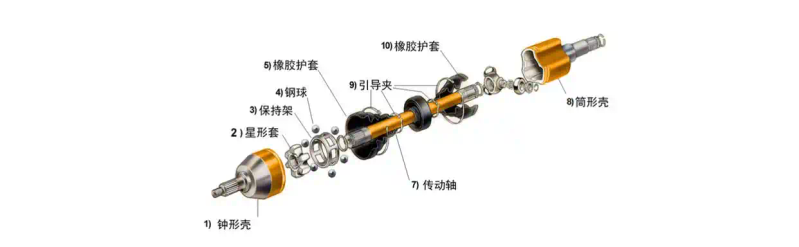
In modern cars, the lichen is agglomeration is made up of speeds of 10,000-way, drive-axis and support. It connects the two axes at the speed of 10,000 knots and transmits the movement at the same angle. Common structures in cars are ... Double-connected, weiss, rzeppa, three poles。
There were essentially two types of work at all speeds: one based on the principle that the two-crossed-one-velvet can be achieved at equal speed, reducing the number of the intermediate transmission axes to a double-thirty-thirty-thirty; and the other based on the principle that the one-thirty-thirty-thy-thirty-thy-thy-thyllical fork and cage-thirty-thirty-thym。
The speed of the all-way movement by work time can be divided into fixed and scalable speeds: the fixed schematic swaths include a curved trough fork, ball cage, tricution and duplex, with a relatively large turn between the two axes, which can be as large as 30° ~ 50°, but with no axle moving between the main and the axle axes; the scalable swaths include a trough fork, a two-linked forklift, etc., which is characterized by a relative axle movement between the two axes, but not too large for the allowed for the two axes, which generally does not exceed 20°。
Modern sedans are typically a scalable type, which is used in combinations of constant and fixed speeds. It is used both to solve motor problems and to reduce noise, vibration and slide resistance. Modern sedans mostly take the form of a pre-engineer, pre-wheel-drive overall configuration, with the front wheel being both a steering wheel and a wheel, which requires it to be able to move at will within the maximum corner, and as a driving wheel, which requires uninterrupted transmission of power from the main brake to the driving wheel as the driving axis moves in the direction of the wheel and the wheel relative to the main brake. As a result, its driving axis cannot be formed as a whole and requires a multi-way connection to accommodate changes in the intersections of the driving axis. In order to ensure that the speed of both angles of the drive axis is even, it must be able to achieve an equal speed transfer (cvj)。