Five new-century songs, all of them
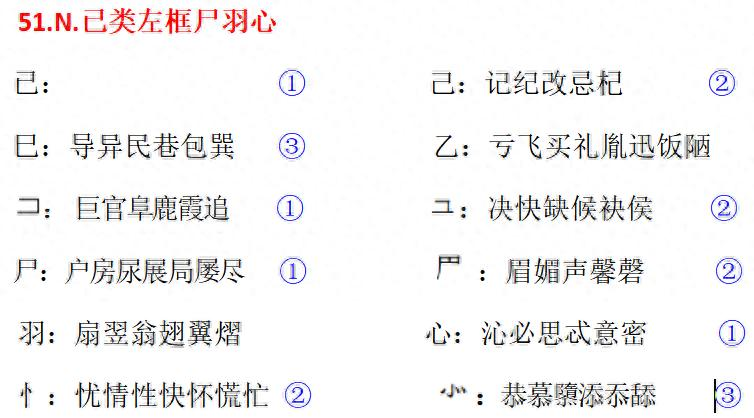
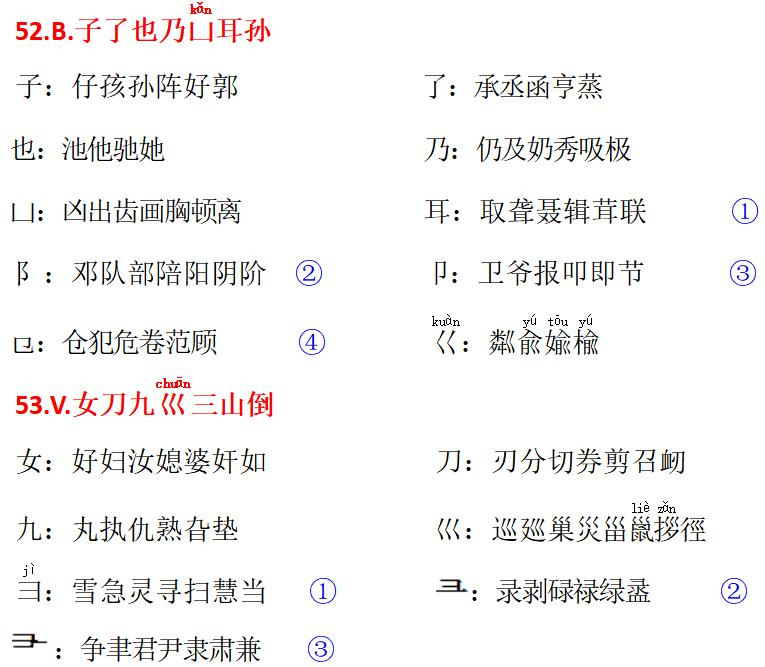
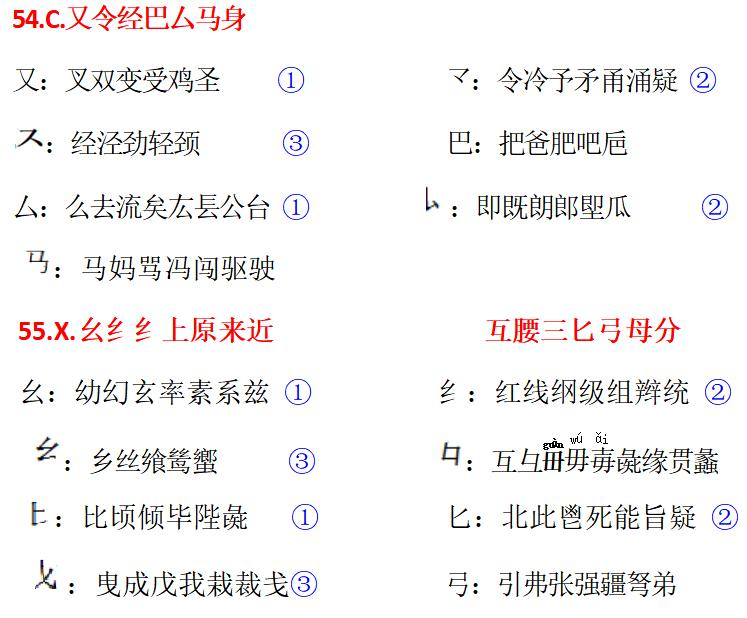
(5). The qualifier: “the son and the son of a son” can be understood as “the mother of a son and son”. “women's knife is down”, “women's knife is breaking into the world and i can do it”。
Iii. Basic knowledge
(i) composition of the chinese word
Hu, ming, chang, jie and so on, can see that they are made of smaller pieces. These “small squares” such as ancient, sun, moon, bow, long, taxi, mouth, etc., are the basic units that make up the chinese word. These “small squares” are called “roots” as the very essence of the chinese word. What makes a root? It's written in a pen, and it's written in a pen。
Decomposition of chinese characters: how can china sea, published in 1994, include 85568 chinese characters, computer input devices keyboards, with only dozens of letters? This will require the decomposition of the chinese characters into their roots, such as the “grain” into “wood, earth, earth”, the “photo” into “days, knives, mouths, hair, etc.”, and the fact that there are only 218 characters in the five characters of the new century, thus turning the problem of entering tens of thousands of chinese characters into the problem of entering them. As simple as the method of entering several letters into an english word。
Decomposition of chinese characters: the decomposition of chinese characters is done according to a certain rule, i. E. The whole word is decomposed into the root, which is then decomposed into the pen, if necessary。
(ii) the writing of the chinese
(1) definition of writing: in 1984, prof. Wang yongmin defined the writing as a continuous line when writing chinese characters。
(2). Two writings may not be called drawings, such as “tens, mouths”, but only the drawing structure
(3) a coherent pen cannot be dealt with in several paragraphs. For example, the division of the word “seng” into “single, field, plum, etc。
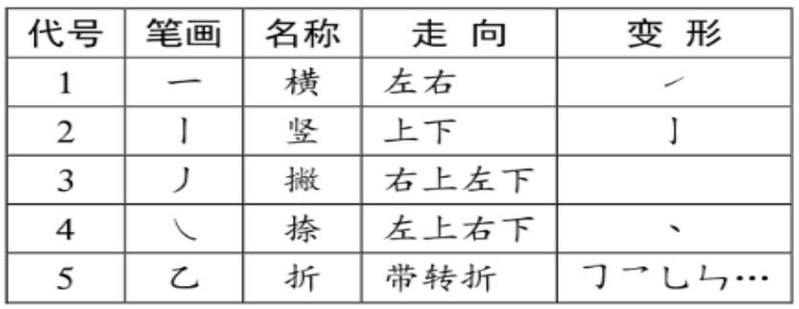
(4). The basic drawings of the chinese words, which divide the types of drawings according to the direction of writing, are only the five shown below, the first four are single-directed drawings, and the word “discounts” represent all pens with turn and turn. In order to facilitate memory and sequencing, the five drawings were named 1, 2, 3, 4 and 5 respectively。
Five drawings in han and their code names
. . . . . . . . . . . . . . . . . . . . . . . . . . . . . . . . . . . . . . . . . . . . . . . . . . . . . . . . . . . . . . . . . . . . . . . . . . . . . . . . . . . . . . . . . . . . . . . . . . . . . . . . . . . . . . . . . . . . . . . . . . . . . . .
The word “point” is equal to the word “single” and the word “single” in the words “village” is attributable to the word “single”
"standing left hook" equals "stretching" and the vertical pen of the word "din" refers to "twig" in the left band
The rest of the pens with turns and turns, however they are, how they are folded, how they are bent and how they are turned, are always identified as “b”, and their brush numbers are five。
(iii) three fonts for han
The chinese word is a flat text, the same roots, the same order, the different places, the different fonts, the different words。
♪ like, honk-only bar-town ♪
Oh, my god
The location relationship of the visible root is also an important feature of the chinese word, a " font" information that is useful in the subsequent "five fonts" encoding to distinguish "identify" information from "heavy"。
Depending on the location between the words that make up the chinese word, we can put thousands of squares
The words are divided into three fonts and are ordered to be digitally coded according to the order in which the characters are owned。
Type 1: the word "right-and-right " , organized around the root and code 1
Type 2: the " upper and lower " han, arranged top and bottom, code 2
Type 3: the word "composite" cannot be separated from the root or, although the root can be divided, the word between the block and the block does not have a clear relationship between the left and the right, with the codename being 3。
Iii font columns
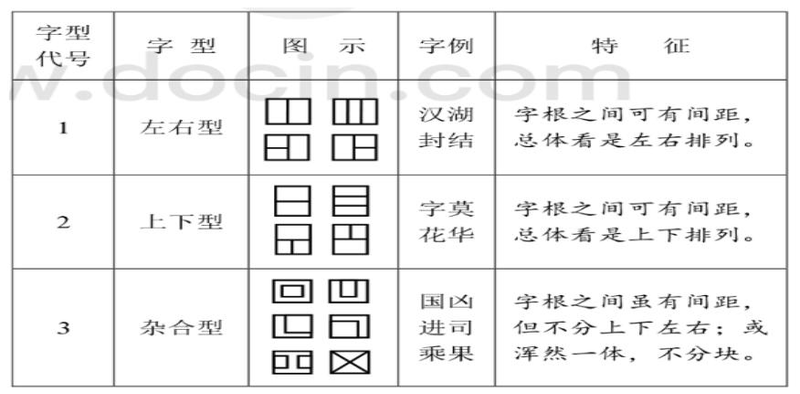
It's also included in the "right and left" structure
Example: = = + + +
Tree = wood plus inch。
The term “middle-to-middle, font” is also included in the “middle-to-down” structure。
Example: buddha = 立 + + + + 。
♪ i'm sorry ♪
While the font and its designator are very useful when encoded in han, it should also be clear that, in the king code, only those words that consist of two or three roots need to be concerned about the word “type”, which consists of four or more roots, such as the word “crawling” in the code no longer count the type. This is because they can “dismantling” into many roots for the code, and their “information volume” is sufficient, so there is no need to care about the word “type”。
(iv) definition and application of root text
The root is a relatively fixed form of several basic cross-sections of drawings and is the basic unit for the chinese characters in the five font input methods. Brushes, roots, whole-words are the three basic levels of the chinese-word structure. When " root " or " parts " are used for encoding, they can also be called code blocks, meaning the elements of the code。
(1). The chinese word consists of the root (or code) of the word: the root can be used to combine the entire chinese word and vocabulary as a building block, or a spelling game。
(2) conditions for selecting the root:
And can make up many words, such as the great woodwork of the king, and japan, and so forth
The terms of the composition are particularly common, such as "white" and "west"
... A large number of the root numbers are the top of the dictionary, i. E., humans, mouths, hands, gold, wood, water, fire, earth, etc., and, on the contrary, a significant proportion of the top is not selected as the root, i. E., pi, vice, wind, air, debt, bull, dow, household, dragon, business, birds, caves, abdomen, leather, old, bean, soy, foot, horn, wheat, food, leather, bone, ghost, sound, fish, falcon, deer, nose, etc.
(3) zoning of the root
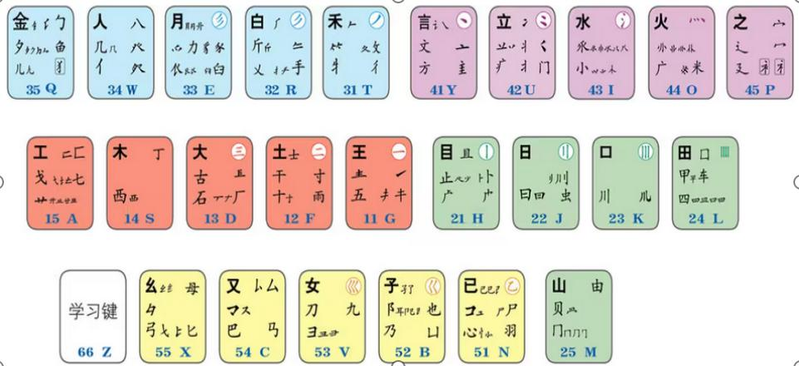
" five fonts " root keyboard: five fonts enter han characters with a maximum of 4 keys per vocabulary using 26 letters from a standard english keyboard. The basic root of the "five fonts" (which contains five drawings), also known as "class", follows the type of their first drawing, each corresponding to a section of their first drawings, and each section takes into account as much as possible the second drawing of the root and divides it into five places, forming a five-bit, or 5 x 5 = 25-bit, typed keyboard, which is arranged in two orders from the middle to the left of the keyboard, which is the "five fonts" font of the partitioning。
(4). Texting patterns:
As can be seen above, this is a well-ordered root keyboard, designed and organized by the " five fonts " keyboard:
The root "area number" corresponds to the "first code"
... The root of the pen with the first codename of the first block, "the great woodwork king":
... The root of the pen is erected with the initial code 2 in sector 2 - “ishiguchiyama”
... The beginning of the code number 3 for the third sector - the “blank moon gold”
... The root of the pen is lit and the first code for the fourth sector - “standing fire”
... The pent-in root, in the fifth sector - the first code for “child again” is 5。
2. Place numbers are largely consistent with the root secondary code
(c) general length, length, sidesliding, folding, in the order of i, ii, iii, iv and v. For example, earth, dry, taxi, ten, their pens are all vertical; so they're on the second key in the zone; big, dog, factory, they're all on the third key in the zone, so they're all on the third key in the zone, which is called "the law of the zone."。
The “number” of a single painting corresponds to the number of the place
For example, one, two, three; one, two, three, four; one, two, three; one, two, three; one, two, three, four; one, two, three, three; one, two, three; one, three; one, three; one, two, four; one, two, three, four, one。
“reading” bits at root
In accordance with the above-mentioned three patterns, the root “first two drawings” can be immediately “read directly” the root bits (i. E. The two first drawings are read together, i. E. The number)。
Example: s-s-s-s-s-s-s-s。
厶: the first pen is a discount (5) and the second pen is a point (4), so the word 厶 is in the fourth place (54, c) of zone 5。
Large: the first one is cross (1) and the second one is set (3), so the “large” is in the third place (13, d) of district 1。
彡: the first one is set (3) and the second one is set (3), so the word “tits” is in third place (33, e)。
(to be continued)