The mains of the tube are not missing in the hydraulic system because they are detached links between the pipeline and the pipeline, the pipeline and the hydraulic component. It should meet the requirements of strong connections, secure seals, small fluid resistance, compact structures, and ease of disassembly。
The mains are in a number of forms, in the direction of the mains, in the form of direct access, straight angles, triplets, quadruplings, etc., and in the manner they are connected to the pipelines, in the form of extension, carding, welding, compression etc. The connections between the tube and the body are commonly made by cone screws and ordinary fine tooth screws. When connected with a conical screw, leakproof fillings should be added; when connected with a common fine tooth screw, a combination of seals (a combination of pre-cooked aluminium alloys and oil-resistant rubber) should be used and a small plane should be processed on the connected。
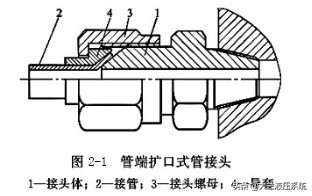
Large-blown hydraulic tube end amplifier
1. Pyramid amplifiers
The method of operation of the extended tube interface at the end of the tube is as shown in figure 2-1 and is suitable for the connection between the copper tube and the thin wall steel pipe. Takeover 2 was first extended to the horn (about 74° ~ 90°) and then the reins 4 together with the takeover 2 were pressed to form a seal on the joint. The tightness of the assembly is converted to the tightness of the axis by the connex 3 and transmitted by the guidance kit 4 to the part of the tube that is taken over, resulting in contact pressure between the extended cone and the cone of the cone 1 sealed face. The rigid sealing function is accompanied by a connection and the axial fracturing between the conjunction and the taking over from the internal fluid pressure of the tube. The maximum pressure of this pipe is generally less than 16 mpa。
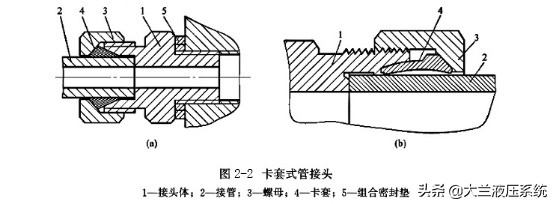
Dalan's hydraulic card set for the bow
2. Card-set wiring
As shown in figure 2-2, the basic structure of the cascading tube is composed of three basic parts, namely, beams 1, set 4 and nut 3. The carton is a metal ring with a sharp edge at the end of the inner circle, which is fitted with a connection and sealing function due to the connection of the blade to the man。
The assembly begins with the placement of the nuts 3 and 4 on the receiver 2 and then inserts the pipeline into the inner hole of the cone 1 (tightly) of the cone, and installs the carton within the gap between the cone and the pipe in the cone of the cone, and closes the nuts 3 to the cone 1 and rotates to the 86° of the cone at the end of the 90° card. Before tightening the screws with the wrench, it is important that the connected end of the pipeline be exposed to the nozzles, and then the hand-turning of the pipeline on one side of the wheel, which, when the pipeline is unable to move, indicates that the carp has begun to choke the pipeline under the propeller's push and squeezing of the cone, continuing to tighten the shelve by one to four thirds, so that the blade of the carp is cut into the man's pipe, forming a seal between the carpenter and the casket, and the surface of the front end of the card is exposed to the ball formed between the cone and the cone of the cas。
Pipelines with a pressure of up to 40 mpa that are reliable and easy to unseparate are generally not more than 42 mm in diameter, but the manufacturing process for the cartons is more demanding。
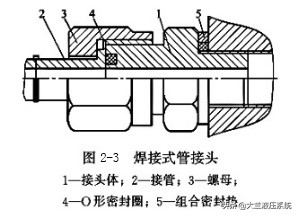
Daland hydraulic welding tubes
Welded pipes head
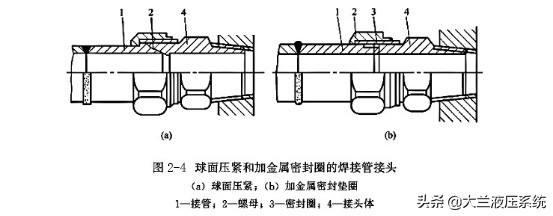
As shown in figures 2-3, welded receivers are one of the types of pipes that connect the end of the tube to the second of the tube, and are then linked to other piped elements by the screws of the pipe, 3 and 1 respectively. The seal between the joint 1 and the take-over 2 can be sealed using the o-container 4 shown in figure 7. 4. In addition to this, it may be sealed by spherical pressure or by metal sealing. The tube interface may also be compacted with the sphere shown in figures 2-4 (a), or with a metal seal, which may be sealed by the method shown in figures 2-4 (b). The latter two methods of sealing are less pressurized, and it is more difficult to process the spherical sealing. The joint is connected to the component, using the cone screws shown in figure 5 or the fine tooth cylindrical screws (as shown in figure 4), with a combination of sealed gaskets 5 to prevent leakage。
Welded steel pipes have simple, easy-to-construct, high-pressure (32 mpa) and good sealing. The disadvantage is that welding quality requirements for steel pipes and takeovers are high。
Daland hydraulic welding tubes
4. The hoses
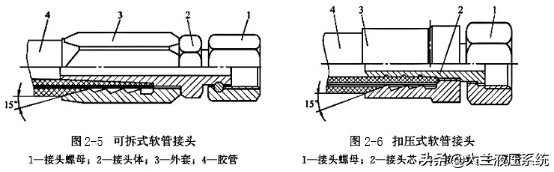
The hoses are generally used in conjunction with the steel wired high-pressure rubber hoses, which can be broken down and buttoned. Figure 2-5 shows open hoses. It consists mainly of connex 1, contour 2, jacket 3 and tubes 4. The piping is in between, which, when tightened, compresses part of the piping, thereby connecting and sealing. The buttons are shown in figures 2-6. It consists of connex 1, concrete 2, condense 3 and tubes 4. Before assembly, strip off an external glue on the duct, and then put a joint covering on the duct that removes the duct and inserts it into the congeal, and then squeeze the convulsion with a pressure on the pressurized bed, so that the ring teeth on the cone inside the cone are firmly connected and so that the outer cone of the convulsion is compacted with the inner duct for sealing purposes。
Note that the specifications of the hoses are based on the internal diameter of the hoses, while the metal pipes are based on the external diameter of the tubes。
Daland hydraulic hose
5. Fast contact
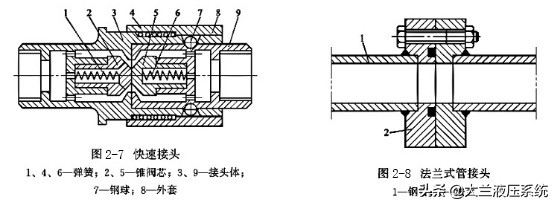
Fast-tracking is a pipeline interface that does not require any tools to achieve rapid or unconnected connections and is suitable for hydraulic pipes that need to be removed frequently. The structure of the fast-track interface is illustrated in figures 2-7. The parts in the figure are located at the point where the oil road is connected. It has two contours, 3 and 9, which are connected to the pipe at both ends. The jacket places three or eight steel balls on the concourse 3 in a v-shaped slot on the concourse 9 and connects the two conversations. The cone cores 2 and 5 squeezed each other to make the oil road accessible. When the oil route is to be broken, the jacket may be moved hard to the left and pull out of the concourse 9 at which point the spring 4 will take the jacket back eight times. The cone cores 2 and 5 stretch out with the effect of springs 1 and 6, respectively, and close the oil trails to valves 3 and 9 of the concourse, and keep the oil in the tube on both sides closed to no outflow。
Quick-on-the-francian tube. Head
6. French pipes
The french pipe is connected to the french 2 with one welding of the pipe, which is then linked with a screw, and is sealed between the two french in o-shaped seals, as shown in figures 2-8. This tube interface is robust, reliable and resilient; however, it is large in size and applies to high-pressure, high-flow pipes。