What's the harm of beet moths
Beet night moths are dominated by larvae hazards。
Its larvae are five years old, its older larvae are 24 to 28 mm long, its first-creasing larvae gather on the back of the leaf, spit on the web, eat the meat, leave a skin of the leaf, have a small hole in transparency, spread it out after three years of age, eat the leaves into holes or space, and when it is severe, it eats only the veins and leaves, leading to the death of the seedlings。
After three years of age, they enter a fast food season, become more resistant, larvae are falsely dead, and when the insect is too dense, they kill each other, often during the day, in the earth's sews, in the tops of the earth or in the plant base and in the leaves of the heart。
In addition, larvae over the age of 3 can drill sweet peppers, tomato fruit, onions, corn females, etc., and remove large amounts of faeces, contaminating fruit, ears, and causing fallews and spoils。
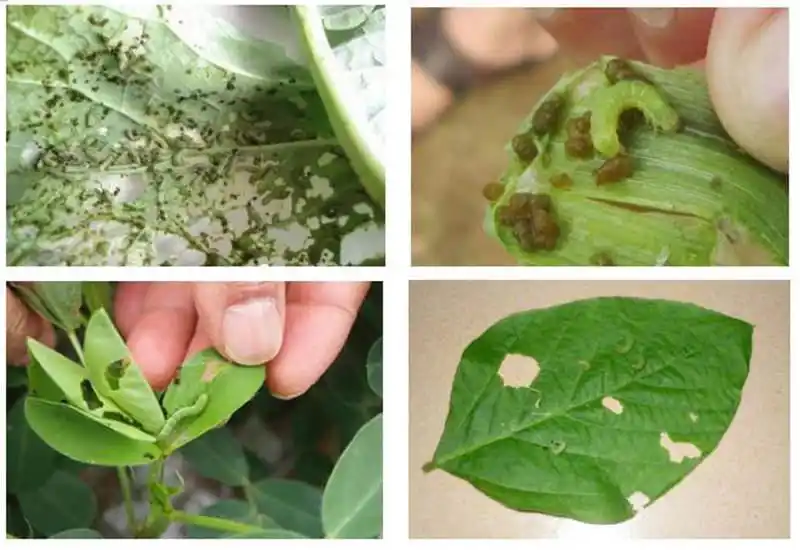
Symptoms of beet night moths (photos from the web)
How to combat beet moths
1. Forecast forecasts
Monitoring of field insect activity using beet night moth baits, selection of representative vegetable fields for field system surveys of eggs and larvae, prediction of the period of beet moth occurrence, and determination of prophylactic time。
Agriculture
(c) rational organization of the layout of crops and vegetables and the introduction of a condominium or rotational pattern。
(c) the timely removal of leaves and weeds from the vegetable fields and the concentration of buried or fattening. Watering and raising the humidity of the field in due course will facilitate the parasites of pathogenic microorganisms to pests。
In the period between the peak of spawning and the onset of incubation, especially when the first generation of larvae occurs in a more integrated manner after the planting of vegetables, the artificial removal of ovulations and the accumulation of leaves by young larvae is greater。
3. Physical control
Black lights can be placed in the fields, and beet night moths can be used to trap。
Biological control
The natural enemies of beet night moths are mainly grasshoppers, spiders, stepnails, etc。
5. Chemical control
The larvae stage of beetling night moths, especially the peak or early larvae stage of incubation, is a critical period for prevention。
The application should be appropriate in the evening or in the morning, the spray should be balanced, the plant should be fully utilised and the application and safety interval should be strictly controlled。
In the field, eggs hatched to their peaks of 1 and 2 years of age, with 15-20 ml per acre to water 45-60 kg, flat spray, or 10% to tetrachloride 50 ml to water, and four days to water, the resistance to beetling night moths remained at more than 90%. The spray generally chose to be administered at evenings, sprayed with plaster fluids and sprayed on the right side of the leaf。
20% suspension agent 1000-2500 times liquid spray in case of serious occurrence. Or 3% methaline suspension 2000 times + 20% thoryl fluoride 1,500 times the fluid, or 20% thiram suspension 2000 times the fluid, or 30% thiram cavity aerosol 1,000 + 3. 2% sulfide, cyanide emulsifiable concentrate 2000 times the spray, and 3% + 15% thiram adhesive 1,000 times the fluid。
More than 100 million farmers in the country are directly engaged in vegetable production, with vegetable cultivation and production being among the highest in the world. The vegetable industry plays a very important role in farmers ' income generation, agricultural efficiency and rural development. Vegetable pests are the main contributing factors to the decline in vegetable production and quality. Thus, the prevention and control of vegetable pests is a matter of national livelihood, social stability and health。
Author: tang jinjin (graduate studies at the faculty of life sciences of hubei university)
Scientific clearance: xu luttien (associate professor, ph. D. Teacher, hubei university)