Regulation, rigour and accessibility: complete analysis of the current chinese motor vehicle driving permit system
Based on ministry of public security decree no. 172, " regulations for the licensing and use of motor vehicles " , china's motor vehicle driver's licence examination system is based on the application of a system of national uniform standards, graded management and process regulation, which combines driving skills, safety awareness and rule of law development and is an important source management tool for ensuring road traffic safety. The current system has been fine-tuned on several occasions and has been continuously undergoing reforms based on rigorous appraisals, leading to a chain-wide examination model of “theory + site + road + civilization”。
I. Core examination framework: three main subjects, four-level examination
Officially it is clear that the driving examination is divided into subjects i (theory), ii (field skills), iii (road skills + safety civilization commons) and three core subjects, popularly known as “subject iv”, which is actually the safety civilization commons test for subject iii, not an independent subject. All subjects are scheduled for examination in sequence, and the first subject is eligible for entry into the next subject. The entire process is based on a unified national examination management system, which ensures fairness and fairness through random assignment of examiners, random selection routes and sound and video surveillance。
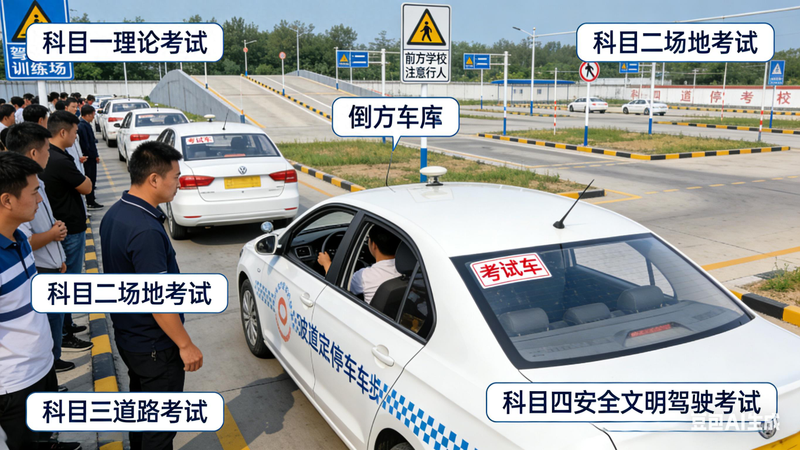
Ii. Qualitative content and criteria
Subject i: examination of road traffic safety laws, regulations and related knowledge
As an introductory examination, the subject focuses on the basics of the rule of law and theoretical commons. The examination covers rules of road passage, traffic signs marking, violations and accident handling, driving permits and motor vehicle management, as well as basic driving operations. The examination was based on a computer-on-board model, with a random selection of 100 test questions, which were judged and selected, with 100 points and 90 points and above. The certificate of study driving is issued on the day of eligibility and is valid for a period of three years, and candidates are required to complete the examination for the remaining subjects during the period of validity and the overdue certificate is cancelled。
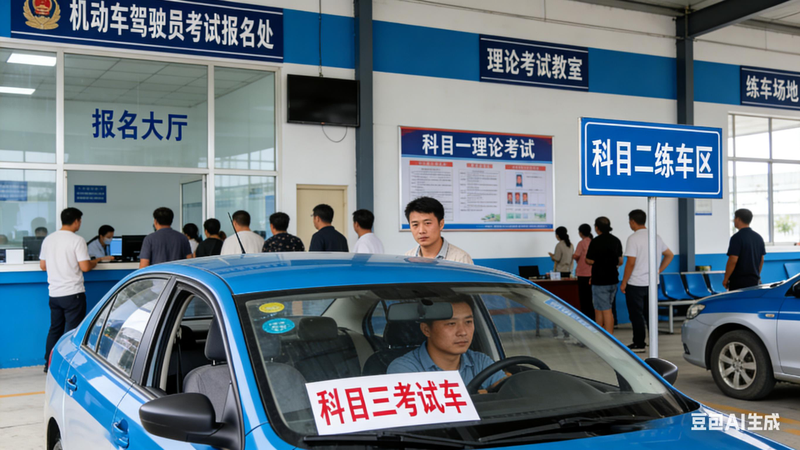
Subject ii: site driving skills examination
Focus on basic manipulation and site adaptability, examination of precision driving skills within closed sites, differential settings for different quasi-driving projects:
- c1 (manual blocking of small vehicles): reverse parking, ramp stop and start, side stop, curve travel, straight-angle turn five
- c2 (autonomous block vehicles): eliminating ramp stop and start-up, with only four entries to fit the automatic block-of-vehicle scene
- large- and medium-sized passenger vans: more stringent tests are being carried out for the creation of complex scenarios, such as simulations of high speed, tunnels and rain and fog。
100 points, 80 for small vehicles, 90 for medium-sized and large passenger trucks, electronic evaluation of the entire course, and no artificial interference。
Subject iii: examination of road driving skills
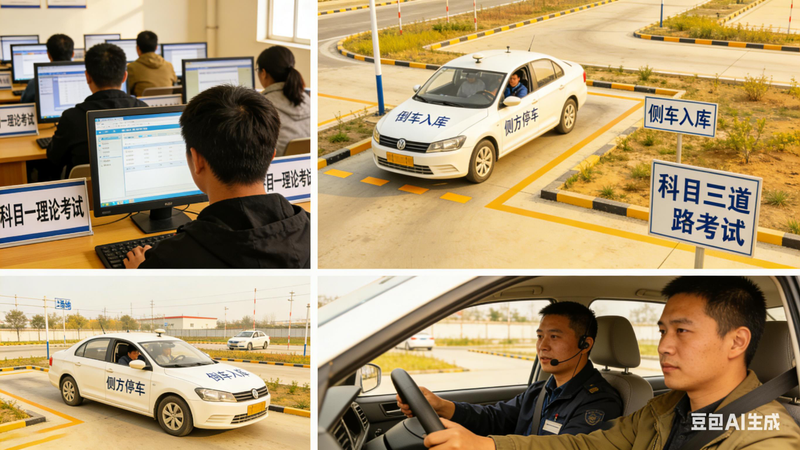
The core examination of physical road driving and emergency disposal capabilities is a key link between the examination site and the actual road situation. The small car examination, which is not less than 3 kilometres away and the medium-sized and large passenger vehicle is not less than 10 kilometres away, consists of preparation for a car ride, simulation of night lights, start-up, straight-line travel, additional blockage, change of lanes, 16 basic operations, such as crossing/school/bus station, parking by side, simultaneous simulation of pedestrians in real road situations, non-motorized traffic scenes and testing of safety awareness and compliance of candidates with rules. 100 points, 90 points and above。
Course iii. Safety civil aviation commons examination
As a driving examiner, focus on civilized driving and emergency response, covering practical knowledge such as bad weather driving, emergency handling such as flat tires, first aid to the wounded, prevention of secondary accidents, and civil comity. The examination was for 50 computer tests, consisting of singles, judgments and multiples, with 100 points and 90 scores, which did not affect the achievement of adopted road skills and could be filled directly。
Iii. Rules of equipment and people's initiatives
1. Rules for catch-up examinations and appointments: one examination per subject and one additional examination per subject; re-arrangement is required for non-conforming examinations, with an interval of more than 10 days between subjects ii and iii. For the duration of the study driving certificate, the number of examinations for subjects ii and iii may not exceed five, the fifth is still not qualified and all successful subjects have been invalidated。
2. Expatriate examination facilities: support for national alien sub-curricular examinations. Candidates may apply to change the place of examination to no more than three times, breaking geographical limits and meeting the needs of the mobile population。
3. Simplified and streamlined driving: c2 additional c1 and motorcycle-like additions, with waivers for subjects i and iv only for subjects ii and iii; shorter time intervals for large and medium passenger trucks to improve the efficiency of examinations。
Special group guarantees: the right to legal driving is guaranteed by means of a “triple force test” (memory, judgment, reaction) for cars of older persons over the age of 70 years; and a project for the optimization of auto-stop cars for persons with disabilities。
5. Process acceleration: subjects ii and iii can have simultaneous appointments and successive examinations; on the day of qualification, they can take the commons of safety civilization examination, receive a warning education, take an oath ceremony, on the day of adoption, issue a driver's permit, and e-driving permits are of the same national and equivalent effect as paper versions。
Iv. Core institutional values and directions for reform
The current system of driving exams has been adhered to. :: principles to reduce road safety risks from source by removing unqualified drivers through standardized testing. In recent years, adjustments have continued to be optimized by eliminating redundant projects, simplifying the driver's increase process and promoting e-services to make examinations more relevant to actual driving needs, while at the same time strengthening entrance control, publicly training pass rates and driver violations, forcing schools to upgrade the quality of training and eliminating “fast-take” “failure tests”。
From the theory of the rule of law to the manipulation of the site, from roadwork to civilization, china's current system of driving exams has established a comprehensive and multi-level driver's access system, which guarantees road traffic safety while taking into account the accessibility of mass examinations, achieving a rigorous management and organic integration of livelihood services, and is an important component of a modern transport governance system。