1 penicillin 800,000 u/bottles: 500,000 cycin with saline water dissolved to 4 ml; 200,000 u/ml
Take the liquid 0. 1 ml+ physiological salt water to 1 ml; (20,000 u/ml)
Take the liquid 0. 1 ml+ physiological salt water to 1 ml; (2,000 u/ml)
Take the liquid 0. 25 ml+ physiological salt water to 1 ml; (500 u/ml)
Take the fluid 0. 1 ml for a dermal test (i. E. 50 u)
2, 1g/bottle of ammonia sicillin, 1g/bottle of chlorine silin, 1g/bottle of ammonia silin sodium sodium sodium sodium silin, 1g/bottle of sodium sodium aluminum of alosilin:
The above drug requirements are dissolved to 4 ml with physicosaline water; (250 mg/ml)
Take liquid 0. 1 ml+physiosaline to 1 ml; (25 mg/ml)
Take the liquid 0. 1 ml+ physiological salt water to 1 ml; (2. 5 mg/ml)
Remove liquid 0. 2 ml+ physiological salt water to 1 ml; 0. 5 mg/ml)
0. 1 ml from the lifting fluid for a dermal examination (i. E. 0. 05 mg)
The results of the test are similar to penicillin。
3 the drugs required above 2g/bottle of sodium carbide silin are dissolved to 8 ml with physicosal water; (250 mg/ml)
4 medicinal and saline water for 1. 25 g sodium per bottle to 5 ml; (250 mg/ml)
5. Dissolved to 6 ml with physico-saline water for drugs above 1. 5 g/bottle of sodium sodium sodium at amosilin and 1. 5 g/bot of sodium sodium at perasilin; (250 mg/ml)
6 melosilin 0. 5 g/bottle, perasilin 0. 5 g/bottle, ammonia silin 0. 5 g/bottle and above, dissolved to 2 ml with saline water; (250 mg/ml)
7 and 1. 2 million u/bottles of chronic syrinn:
Long-acting silin + saline 5. 8 ml dissolved (200,000 u/ml)
Leather test (i. E. 50 u/0. 1 ml)
The results of the test are similar to penicillin。
8. Pruncain:
Prunkain 40 mg/score at 0. 25%
(b) the extraction of 0. 125 ml+ physiosaline water to 1 ml
0. 1 ml from the drop fluid for a derivation test (i. E. 0. 25 mg)
The results of the test are similar to penicillin。
9. Pioneer 1g/barrell, cape 1g/bottle:
Remove liquid 0. 2 ml+ physiological salt water to 1 ml; (0. 5 mg/ml) (500g/ml)
0. 1 ml (i. E. 50ug/0. 1 ml) during the test
The results of the test are similar to penicillin。
10, head plaster 0. 5 g/barrel, head fenthion 0. 5 g/bottle, head plaster sodium 0. 5g/bottle, head plasterone 0. 5g/bottle, head gilllin sodium 0. 5g/bottle:
2 ml (250 mg/ml)
11, 1. 5g/barrel of croquetone and 1. 5g/bottle of sodium chording chords of sodium chords of sodium/bottles dissolved to 6ml with physicosal water; (250 mg/ml)
12: zhubartan and above 0. 75g/bottle drug with physiosal water dissolved to 3 ml; (250 mg/ml)
13, tetanus antitoxin (tat) 1500 u/s:
Take the liquid 0. 1 ml+ physiological salt water to 1 ml; (150 u/ml)
0. 1 ml from the liquid for a pictorial test; (i. E. 15 u)
A 20-minute observation, if negative, is one-off and, if positive, de-sensitized。
Negative: partially free of red and red and non-abnormal reactions。
Positive: skin dunes are red and swollen, rigid diameters greater than 1. 5 cm, red dizziness range greater than 4 cm, sometimes hypocritical or itchy, and allergy is roughly the same as penicillin。
Method of de-sensitization:
First: injection of tat 0. 1 ml+ physiological salt water to 1 ml muscle
Second: injection of tat 0. 2 ml+ physiological salt water to 1 ml muscle
Third: injection of tat0. 3 ml+ physiological salt water to 1 ml muscle
Fourth: sequestration + physical salt water to 1ml muscle injection。
Injection is done every 20 minutes to closely observe the patient's response during the de-sensitization process. If the patient is in a state of impotence, pale, purple, measles and dizziness, heart rate, etc., the injection should be stopped and the doctor reported to the doctor。
14. C15mg/sub/2ml:
Cytochrome c0. 1 ml+ physiological salt water to 1 ml; (0. 75 mg/ml)
Pipe test (i. E. 0. 07 mg)
Local redness, greater than 1 cm in diameter, positive for those with rashes
15, 1g (1 million u/v):
1 million u+saline to 3. 5 ml (4 ml total) (250,000 u/ml)
Take the liquid 0. 1 ml+ physiological salt water to 1 ml; (25,000 u/ml)
Take the liquid 0. 1 ml+ physiosaline to 1 ml; (25 million u/ml)
0. 1 ml from the drop fluid for a test (i. E. 2500 u)
(pill test results judge penicillin. Comicin allergy shock rescue measures and penicillin allergy shock rescue measures can be combined with calcium chromium, thereby reducing or eliminating the toxic symptoms of the chaincin. So 10% of calcium glucose acid injections are required
16, pyramid 4000 u/pyramid 4000 u/barrel + physicosaline 5ml dissolved; (800 u/ml)
Take liquid 0. 5 ml+physiosaline water to 1 ml; (40 u/ml)
0. 1 ml from the drop fluid for a test (i. E. 4u)
(the aphrodisiac needs a skin test; the results of the test will judge penicillin
17, b1 injection fluid 10 mg/bottle/2ml takes the liquid 0. 1ml+physiosaline water to 1ml; (0. 5mg/ml)
Leather test (0. 05 mg/ml)
(pie test results judge penicillin)
18, nodule fungus 50u/swipe/ml lifting fluid 0. 1ml for a derivation (5u/ml)
The test is performed in the left hand with the test sensitivity and in the right hand with the biological salt water. 48-72 hours observation of negative:
The patient should be explained that the test is positive only to indicate that there were nodules
19 - iodine allergies testing (30% transphotamine)
A. Take 60% of the transphotamine (eunepek) 0. 5 ml with physicosal water to 1 ml slow intravenous injection。
B. 30 per cent of trans-polymphetamine (1ml) slow intravenous injections。
Watch closely for 15 minutes. Patients are positive if they are sick, vomiting, numbing their hands and feet and/or having measles。
20, 50 units (10 μg/ft) of calcium reduction fluid for salmon
1 and 1 ml syringe diluting from 0. 2 ml to 1 ml of liquid physiosaline water
2 take up liquid 0. 1 ml (i. E., 1 unit) under skin injection。
Watch the results for 15 minutes. The result is the same as penicillin。
21. Tetanus antitoxin (tat) 1,500 units/send 1, 0. 1 ml antitoxin plus 0. 9 ml sodium chloride injection fluid,2 and lifting fluid 0. 05 ml injected into the front side skin。
Watch the results for 30 minutes. Result judgement: negative: injecting areas with no visible reaction can be directly antitoxin-resistant under close observation. Positive: injecting areas there are increased pelvis, red and immersed, especially those who appear to be hypocritical or itchy。
Tetanus anti-toxin desensitization therapy:
(b) dilution of the original tat fluid from 0. 2 ml to 2 ml and several doses of subcutaneous injections of 30 minutes after each injection
(a) first: take the fluid and inject it under 0. 2 ml, and observe a second injection without violet, asthma, or a significant short-respiratory, pulse acceleration
Second: injections under 0. 4 ml taken from liquid, with a third injection if no response
Third: an injection of 0. 8 ml under the upper fluid, with a fourth injection if no response: all residual fluids (including the unreduced antitoxin full volume in the arctic) are injected under the skin or in muscle。
Persons who have an allergy or an allergy test positive should have their first injection and subsequent increments reduced appropriately and be injected in instalments to avoid violent reactions. Outpatients must be able to leave 30 minutes after injection。
Penicillin allergies:
Assessment:
1) ask carefully about allergies and if penicillin has allergies, stop the test. Other drugs have an allergy history or a history of reaction diseases should be used with caution。
2) used penicillin, repeated after three days (tat7 days) or, in the case of formulations with different batch numbers, re-examining to determine negative results for continued use。
2. Plan:
1) preparation for use: 0. 1% adrenaline, (other minor) required
2) patient preparation: a. Patients should not undergo a skin test in an empty stomach, which can be confused with allergies due to the dizziness, nausea, etc. Of an individual who injects drugs in an empty stomach. B. To inform the patient of the purpose of the injection and of the fact that he or she cannot leave at will during the observation period; to refrain from scratching or rubbing the parts of the body; and to inform the medical staff whenever the patient is unusual。
3. Implementation:
1) formulation method (slightly)
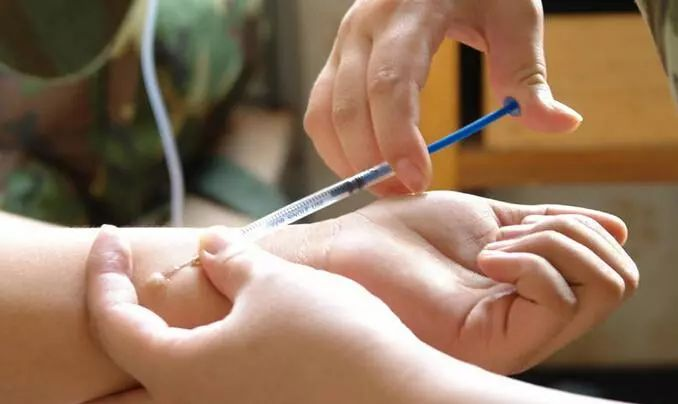
2) inner test: 0. 1 ml, 20 minutes to observe the results of the dermal test, injected within the outer side of the forearm. Results test:
Negative: no changes in the pelvis, no redness, no conscious symptoms。
Positive: picchus rise, have red faintness, have a diameter greater than 1 cm, and have a local itching feeling of pseudo-footing; in serious cases, they have dizziness, panic, nausea and even a sensitization shock。
3) anticin may not be used by a person who is positive for the results of the test and must be indicated on the medical records, medical orders, bedhead cards and injection lists, and the patient and his/her family are informed of the results. If there is doubt about the results of the test, 0. 1 ml of physicosal water should be injected into the side forearms to contrast the test results of penicillin as a negative drug。
First aid for allergic shock:
1. To stop the medication immediately and to lay the patient down。
An immediate injection of 0. 1 per cent of adrenaline 1 ml under the skin and a discretionary reduction of children. If the symptoms are not mitigated, the drug may be injected every half hour under the skin or intravenously to 0. 5 ml。
3. Inhalation of oxygen to improve oxygen deficiency symptoms. When breathing is inhibited, artificial respiration and respiratory stimulants should be used immediately. If the edema causes suffocation, the trachea should be removed as soon as possible。
Based on medical instructions for intravenous diaphragms 5-10 mg, anti-ballamine drugs such as isopropyl hydrochloride, etc。
5. 10% glucose solution or balance solution to increase blood capacity. Blood pressure is still not rising, and dopamine, etc., can be added on medical advice。
6. An immediate recovery is carried out if the heartbeat stops。
7. Close observation of the condition and recording of changes in the patient's breathing, pulse, blood pressure, mind and urine。