When you design a unique key button on your mobile phone, press the button, a machine can pile up the material and turn the virtual design into a hand-to-hand object; when a doctor customizes a patient's own prosthesis, without having to process a complex mould, 3d printers can fine-tune the contours of the human body — this is not a scene of a science-fiction film, but a day-to-day 3d printing technology. As one of the most subversive technologies in manufacturing, 3d printing (also known as enrichment production) is using the magic logic of “scatter-by-scatter” to break the boundaries of traditional manufacturing and penetrate all aspects of our lives. Let's talk about 3d printing today
I. What's a 3d printout? Breaking the paradigm of "reduced manufacturing"
To understand 3d printing, first of all, we have to jump out of our familiar "reduce-making" thinking. Traditional methods of processing, such as carving wood and cutting metals, are the means to obtain the desired shape through “the removal of excess materials”, as the carvinger draws a statue from a stone, not only wasting material but also making it difficult to achieve complex internal structures。
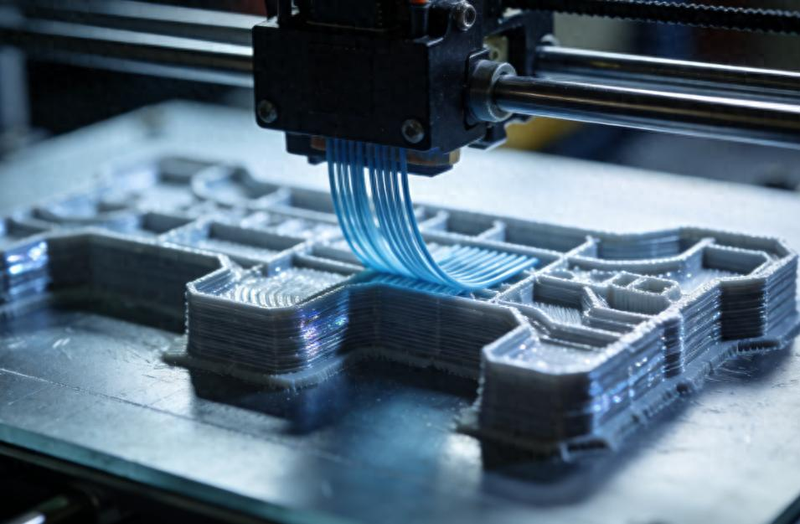
On the contrary, 3d printing follows the logic of “plus-manufacturing”: materials (plastics, metals, resins, etc.) are stacked by 3d printers, based on digital models, from nothing to “growth” of 3d entities. In short, just as we put together models with lego blocks, the 3d-printed “building blocks” are extremely small material particles or filamentary materials, each layer of thickness accurate to the micrometer level, eventually collating into complete objects。
Its core process consists of only three steps: the first step, using the design software (e. G. Cad) to produce a 3d digital model, which is equivalent to “drawing drawings” for printers; the second step, to import the model into the printer and set the print parameters (layers, speeds, temperature, etc.); and the third step, to build the printer by drawings, stacking material by layer and completing physical printing. The whole process, without the need for moulds or complex processes, can achieve both a quick prototype and individualized customizations that truly achieve “whatever you want”。
Ii. Mainstream 3d printing technology: each specialized and adapted to different scenarios
3d printing is not a single technology, but rather a family with multiple disaggregated technologies, with different technology principles, materials and application scenarios focusing on each other, five of which are most mainstream and cover the full range of scenarios from the consumer to the industrial levels。
Melting formation (fdm): the “entry money” of the most friendly population
This is our most accessible 3d printing technology and the least costly and easiest to operate. It is based on heating of thermal plastic materials (e. G. Pla, abs plastics) to a melting state, crowding out through the nozzle by the predefined path, and condensing after cooling the material. As with toothpaste, the vent “squeezed” the melting material, a layer piled into the desired shape。
The advantages of the fdm technology are that it is cost-effective, rich in materials and relatively simple to maintain and that it is well suited to small and medium-sized enterprises, educational institutions and individual users, such as printing toys, hand-held, teaching models, simple industrial prototypes, etc. Currently, most consumer level 3d printers use this technology, and prices have gone down to 2000-4,000 yuan, allowing 3d printing to enter ordinary homes and campuses. However, it also has limitations, and printing accuracy and surface smoothness are relatively general and require later grinding to achieve more aesthetic effects。
Stereolytic solidification (sla): “artist” pursuing extreme precision
If fdm is pursuing “practical”, then sla technology is pursuing “precision”. It uses ultraviolet laser exposure to liquid photo-sensitive resins, so that the resin is solidized into a solid model with a print accuracy of up to the micrometre level, with an extremely fine surface mass that perfects complex details and curves。
This technology is well suited to scenarios that require high accuracy, such as jewellery design (printing fine jewellery models), dental (customed dentures, steroids), aerospace (printing prototypes of high precision parts), etc. However, sla printers are costly, light-sensitive resin materials are relatively expensive, and are more suitable for use in the professional field because of the requirements of the working environment。
Selective laser sintering (sls): unsupported “structural master”
Sls technology uses lasers as a heat source to burn powder materials (e. G., nylon, metal, ceramics) into solid models. Its greatest feature is that there is no need to support structures, since uncombusted powders can provide support and can therefore print out complex internal structures, such as empty parts, staggered structures, which traditional manufactures cannot achieve。
In addition, the sls technology has a wide diversity of materials, both plastic parts and metal components, and print-out products of high intensity and durability, which are widely used in areas such as automobile manufacturing (printing vehicle accessories), medical treatment (printing medical implants), aerospace and aerospace. Compared to fdm and sla, sls achieves a better balance between precision and efficiency and is an important option for industrial applications。
Digital photoprocessing (dlp): fast and efficient “quantity helpers”
Dlp technology, similar to sla technology, is a photo fixation type, but it is printed faster. The dlp technology, by consolidating the entire layer at the same time through digital light sources (e. G. Projectors), rather than scanning points by point, as is the case with sla, can significantly increase printing efficiency and is particularly suited to scenarios requiring rapid bulk production of prototypes, such as modelling, rapid validation product design, etc。
It also has high print accuracy and smooth surfaces, and is widely used in areas such as medicine, creation, etc., such as printing individualized cosmetic casings, small crafts, etc。
Metal 3d printing: “hard nuclear power” in the industrial field
Metal 3d printing is a high-end branch of 3d printing technology, which melts and condenses metal powders layer by layer, mainly through technology such as selective laser melting (slm), electronic beam melting (ebm), and is capable of printing high-strength, durable metal components, which are core technologies in high-end fields such as aerospace, automobiles and medical。
In the aerospace field, for example, metal 3d printing enables the manufacture of key components such as engine blades and wing ribs of aircraft to achieve light quantitative design to reduce flight energy consumption; in the medical field, titanium alloy bone implants, artificial joints, etc., can be printed to fit the bone structure of the patient to improve the success of the operation. At present, china's national production rate for metal 3d printing equipment has increased to 60 per cent, with a maximum size of 20 metres, which represents a major technological breakthrough。
Iii. Ubiquitous 3d printing: from place of life to industrial innovation
Today, 3d printing is no longer a “black technology” in a laboratory, but it permeates all walks of life and changes quietly our way of life and production, and its application is far wider than we thought。
In the area of health care: precision customisation, preservation of health
The application of 3d printing in the medical field is an example of “specifically tailored”. Medical doctors can obtain physical data from patients through tests such as ct, mri, and use 3d printing techniques to produce a precise human model for pre-operative planning and to reduce the risk of surgery; for patients with prosthetics and artificial joints, 3d printing can tailor products to the patient's body profile, with a higher degree of compatibility and comfort and a significant improvement in the quality of life of the patient。
It is even more surprising that a major breakthrough has been made in bio3d printing, with clinical applications for liver transplants, with a cell survival rate of over 90 per cent, and the prospect of mass printing of artificial organs in the future, which will completely address the problem of organ transplant supply shortages. In addition, 3d-printed surgical guidance boards, dental prosthetics, etc., have been widely used in clinical applications to make medical services more accurate and efficient。
2. In industry: efficiency gains and breakthroughs
In industries such as aerospace and automobile manufacturing, 3d printing is becoming the key to “reducing efficiency gains”. In traditional industrial manufacturing, the production of complex parts requires the production of multiple sets of moulds with long life cycles and high costs, while 3d printing does not require molds, which can directly print complex parts, not only shorten production cycles but also reduce material waste (material utilization can be more than 90 per cent)。
For example, when a vehicle brand quickly completes the design validation of a new electric car shell using 3d printing technology, it takes only a few days from design to sample formation, significantly reducing the cost of research and development; in the aerospace field, components such as c919 wing ribs have already achieved 3d printing scaleing applications, which reduce the weight of parts while ensuring structural strength. According to statistics, china's industrial 3d printing market in 2025 was 42. 2 billion yuan, or 60. 3 per cent of the overall market, and was an important force for industrial innovation。
Life and creativity: personalized expression, rich experience
In everyday life, 3d printing makes “personalization” within reach. You can print exclusive mobile phone cases, key buttons, tablets, or even customize dolls with your own image; in the creative field, 3d printing can recaptulate objects, produce personalized creation products, and spread traditional culture in a more alive way; in the educational field, 3d printing can transform abstract mathematical, geometrical knowledge into physical models, helping students to better understand, while at the same time developing students ' innovative and hands-on skills。
4. Other areas: cross-border integration, creating possibilities
In addition to the above-mentioned areas, 3d printing continues to break ground in areas such as construction, food, space, etc. In the area of construction, 3d printers can print houses directly, not only at a fast pace, but also at a reduced rate of building debris suitable for remote areas, post-disaster reconstruction, etc.; in the area of food, they can print individualized cakes, chocolates, and even foods that customize nutritional matching; in the field of space, nasa uses 3d printing techniques to print parts in space, reduce the material load of the capsule and support deep space exploration。
Iv. Status of 3d printing industry in china: opportunities and challenges at the same time
In recent years, china's 3d printing industry has grown rapidly and has entered a new phase of “technology validation in parallel with scale applications”. According to statistics, china's print market for 3d in 2025 reached 70 billion yuan, an increase of 30 per cent over the same period, resulting in a “industrial-level and multidisciplinary parallel” market structure, with the industrial-level market accounting for 60. 3 per cent, the health-care market for 17. 1 per cent and the consumer-level market for 13. 6 per cent。
At the policy level, the country's “145” programme explicitly identified 3d printing as a priority area for intelligent manufacturing, and the ministry of industry and communications established a special fund for the formation of differentiated industrial clusters in the three main regions, namely, the long triangle, the pearl triangle and kyouta, which together contribute 78 per cent of the country's output. At the technical level, china has made breakthroughs in core components such as metal powder materials and lasers, with a significant reduction in the price of consumer-grade equipment and an increase in the national production rate of industrial equipment, and has promoted technology towards inclusive development。
At the same time, however, industry faces a number of challenges: the national production rate of core technologies (e. G., high-precision nozzles, bio-ink) is less than 40 per cent, and some key components remain import-dependent; the lack of cross-industry standards leads to poor compatibility between different equipment and materials; and commercialization in emerging areas such as bioprinting is slow and has yet to be implemented on a large scale。
Future deliverables: the next decade of 3d printing
The future of 3d printing is fraught with infinite possibilities as technology evolves and costs continue to decline. In 2026-2030, china's 3d print market size is expected to grow at a compound annual rate of 25-30 per cent, with a projected breakthrough of $180 billion by 2030。
In the future, 3d printing will move in the direction of “more accurate, faster, more materials and wider applications”: bioprinting will lead to more complex organ printing and radically change the pattern of the medical industry; metal 3d printing will lead to bulk production of key components, which will drive the upgrading of aerospace and car manufacturing to higher ends; consumer level 3d printing will become more widespread and become a “creative tool” for households and individuals; and the integration of 3d printing with technologies such as artificial intelligence, physical networking, etc. Will create an entirely new model of “smart manufacturing”, making production more efficient and flexible。
From technological exploration in laboratories to daily applications in thousands of households, the magic of 3d printing using “additional formulas” breaks down traditional manufacturing and redefines the meaning of “manufacturing”. It is not just a technology, but an innovative thinking — it leads us to believe that virtual creativity can be translated into the possibility of reality, if you dare to imagine it. Today, when science and technology are fast developing, 3d printing is driving change in all walks of life with an unstoppable momentum and will also bring more surprise to our lives。