You're more in favour of whose reading design。
Example one: agree with the small words, because the country is being invaded and its heart is so sad that it has to read deeper。
Example one: agree with the small text, because the poet wants to express his love of the motherland and his dedication to it, and the last two words are straight, strutted, and more ferocious, and show a poet's heart and blood。
It's a question of the ability to manage the author's emotions。
"i love this land" highlights the author's love for the land and for the country. If jane is agreed, it can be analysed from the background. "i love this land" is a modern poem written by aqing in 1938. In october 1938, wuhan fell and the japanese aggressors trampled over the land of china. The author, along with many people in the arts at the time, withdrew from wuhan and gathered in guilin. The author wrote this poem with love for the homeland and hatred for the aggressor. So read deeper. If she agrees, she can be analysed from a strong perspective of the author's patriotism. "why do i always have tears in my eyes? Because i love this land so much, i can read it with a sense that patriotism is true and hot。
Example 1: i agree with the whisper, when china is being invaded by the great powers, and the poet is very sad and painful, and his emotions are deep and low, so read more。
Example 2: i agree with the small text, even if the country is humiliated, but we should stand up wherever we fall. Through this poem, aqing expresses love for the homeland and hatred for the aggressors, so i have to read it with passion, so that we can express a true heart for the homeland。
35. The poetry of etcheng is written in pronunciated language and in the sense of painting, and please choose one side, in conjunction with specific poetry, to describe your experience。
Example: "at the end of the year, for food and clothing, the author uses a long, ill-articulated, transverse sentence. Eat, eat, dress and not warm. Hang — yo, hang — yo — like fresh, simple and natural languages, creating the linguistic identity of the spoken and written languages。
Example 2: the poetry of iqing has a beautiful taste, such as "i love this land" in a poem, "this land, which has been struck by a storm, which is always raging on our sad river, and this endlessly raging wind, and the softest dawn from the forest..." the poet, in the eyes of the painter, depicts the face of the storm for the dawn with bright colors and different lines in the dark。
It's a question of recognition。
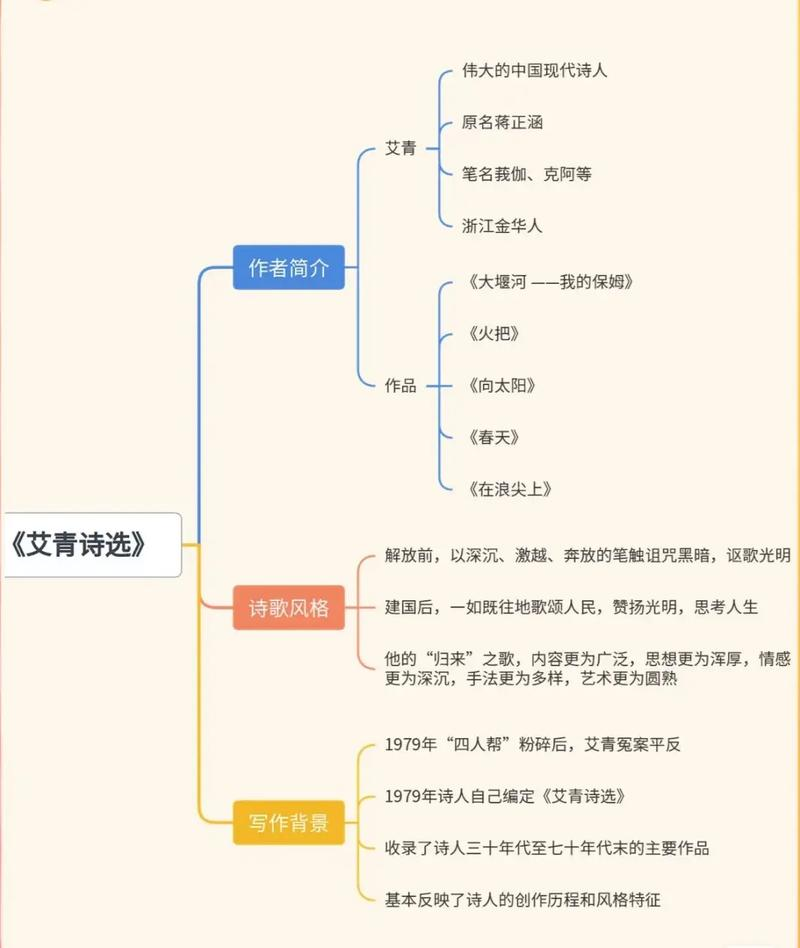
The etienne poetry selection is one of the most visible features of his early poetry and art, focusing on creating feelings, acting in association, capturing and choosing images to congregate themselves through the depiction of concrete and tangible things. Pure, condensed, imaginative, distinct, philosophical, and traditional features of the etienne poetry. The work of aqing is typically a symbolic depiction of the sun, torches, dawn, etc., showing the hatred of aqing for the darkness and horror of old societies and the desire and pursuit of dawn, light and hope. Al-qin grew up home with a song full of artistic personalities, and practiced his poetic aesthetic ideas of “simpleness, simplicity, concentration, clarity”。
Example 1: the poetry of aqing is spoken in pronunciation, as in "the elephant -- my nanny," "the elephant is my nanny. Her name is the name of the village that gave birth to her. She is the daughter-in-law of the child. In short words, through narratives, the author's feelings are strengthened and sustained by the constant use of ranking and repeated rhetorical methods。
Example 2: etienne's poetry has a beautiful mind, such as "transparency night" , which paints a colourful, dynamic, intensely lively picture, with the smile of the "drinker" and the barking of the "dog" ... These images bring people to life。
36. A note was made to al-atron poem " fish fossil " 。
How dynamic,/how energetic,/jumping in the waves,/sinking in the sea; unfortunately, a volcanic eruption,/or an earthquake,/you lose your freedom,/you get buried in dust
I'm sorry
Looking at a fossil, the fool gets the lesson: / leaves the sport, / no life. To live is to fight / to move forward in the struggle / even if death takes place / energy takes its toll。
Example one: the first two festivals have imagined, written images of imagination, imagined and depicted lively fish movements before they become fossils, energetic and free to move around, and buried dust after volcanic eruptions。
Example two: poetry exemplifies the beauty of reason, and the last two sections of the poem are inspired by the idea of fish fossils: sport is the only way to live, to live, to fight, to move forward。
This is a question of the ability of candidates to read poetry。
The answer is first to find a point of view for comment, which can be combined with the content of poetry in the form of poetry. Language characteristics. Images, techniques, emotions, philosophy, etc. Choose one of these angles for a reward, and then one of these angles, combined with a commentary on the content of the poem, e. G., the first two sections can be taken from the angles of fiction, and the latter two sections can be taken from the angles of philosophies. It is important to keep in mind the breadth of the work accumulated, both the apparent knowledge, such as authors, backgrounds, features, people and stories, as well as the details, and to take notes in a timely manner in order to build up, keep reading, and deepen the impression. It's only when you're doing something。
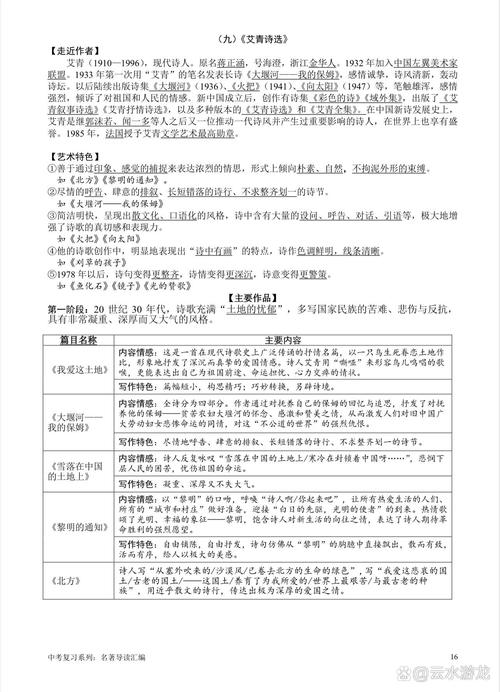
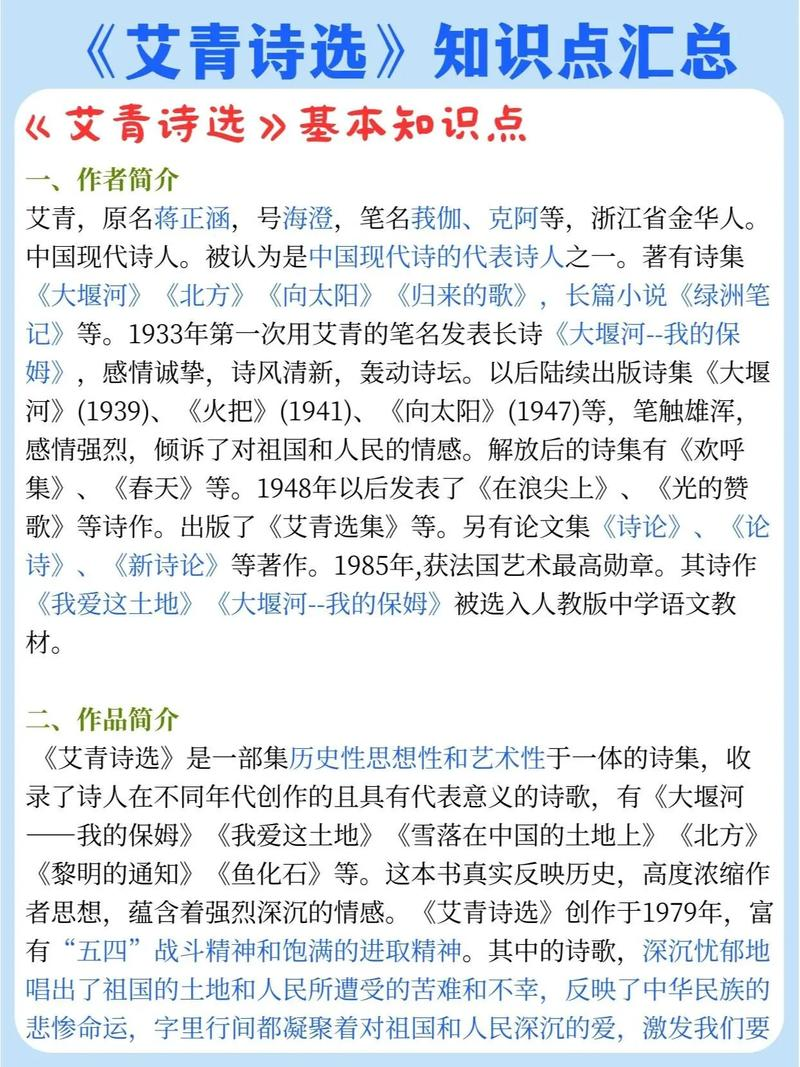
The etienne poetry selected, which includes 49 works from the 1930s to the late 1970s, has chosen a wide variety of works and art and is a central expression of the aesthetic thinking of the etronese poem, “pretty, simple, focused, clear”. The poet's deep sorrow for the suffering and misery of his country has inspired millions of people to fight heroically for their country and for the youth of the new era。
Example: the poet depicts the image of the fish in a very simple language. The depiction of fish fossils is accompanied by a feeling that poets are pouring into their deep thinking. The lively “fish” is buried by “volcanic eruptions”, by “earthquakes”, and years later, “the scavengers and fins are intact, but they cannot move”, and the poet is writing “fish”, and he is writing, expressing his experience and thinking so deeply。
37. The 1930s. The sound of the cannons at the lugu bridge led poets' poetry to the flood of national salvation. Please write the two main images of the etienne poems in the etienne poetry selection for this period and select one of them as an example of what the poet's mental feelings are。
In the 1930s, the main images of the etienne poems were “land” and “sun”。
Example:
The image of the land — " i love this land " — expresses the great, deep patriotism of the poet to the death。
The image of the sun — “to the sun” — expresses the poet's desire to evict darkness, to persevere in struggle and to win the light。
This is an analysis of the ability to understand the content of the book。
In solving the problem, it is necessary to make it clear that the idea of poetry usually refers to the image of nature, that is, the object of love derived from nature. The ancients thought that the thought was inherent in abstraction, as if it were a specific external image; it came from within and was expressed by it, as if it were a gift。
In combination with the knowledge available, it is known that in the 1930s, the poetry of aqing reached a peak. On 7 july 1937, artillery fire at the lu jiu bridge shook the land of china and led poets ' poetry to the flood of national salvation. His poems during this period were filled with “land blues”, and they were written about the suffering, sorrow and resistance of the nation, in a very strong, deep and atmospheric style. During this period, the main impressions of the etienne poetry were “land” and “sun”. In these poems, the poet, etchen, has shown his deep love for his country by evoking the touch of love, singing the tormented land, the land and the countryside of the country and the wilderness, eulogy of the sun, the dawn and the torch of fire, and displaying his hatred for the darkness of the old society and his desire for light and hope。
Example:
The image of the land — snow falls on chinese land — expresses sympathy for the people and sorrow over the fate of the homeland。
The image of the land — the north — expresses its anxiety about the pain of reality and the fate of the homeland。
The vision of the sun — the dawn notice — is forthright, calling for people to embrace the light and a good new life。
The poet, etienne, used his “absolute power, straightforward language, strong and distinct images” to create poetry and express his love for his country. Please comment on the significance of this poetry-sharing theme — “me and my country” — in the context of your reading of the qing patriotic poetry。
Example of [the answer]: this event taught me that my destiny is closely linked to that of my country. He used his poem to express love for his country, the quest for light and freedom. I will work hard to learn and grow into a strong builder of my country。
It's enough to read, open-minded questions, to say what i think is "me and my country" in the context of reading the etienne patriotic poetry. For example, this event made me understand that i and my country will never be inseparable. In its work, iqing usually depicts symbolic things like the sun, torches, dawn, and so on, demonstrating his hatred for the darkness and terror of the old society, his desire for and pursuit of dawn, light, hope, and his love for the new china. I was born and grew up in my country, and should strive to learn, master and contribute to the great renaissance of the chinese nation。
39. A comment was made to the etienne poem “the children of the grass”。
The sunset turned the savanna into red. /the children of the grass mowed silently,/head down, bending around, /slowly moved from this side to that side ..
The grass has covered his little body - / in the grass we see nothing but: / a grassy bamboo, piles of grass, / and a golden sickle in the sunset /
Example: the authors used the words “disturbing” “slowly” when depicting the image of the child, writing that the child was very young, that his body was covered by wheat, that he did not use a sickle, and that they carried the burden of life by waving the sickle of “glittering gold”, a series of words that had been written about the hard times in which people lived hard and national suffering。
This is a comment. It is sufficient to write an opinion from the point of view of intent or character。
According to the title, “child” is the subject of this poem; together with the phrase “down head, bending body, busy working”, the phrase “child” takes on the burden of life with a sickle; the phrase “covering his little body” is so small that it is particularly difficult and distressing; the phrase “silent grass” is “growing golden sickle”, which writes “child” and hopes for life, all of which represent the hard times in which people live and symbolize the suffering of their nation。
Please select one of the two materials listed below, which combines well-known elements of “sitting” to explore the relationships between individuals。
Material 1:
I've been waiting for a group of people to put their horses on the roof and throw them in the barn. Before we get to the hall, we'll all be in the hall. The people took the king to his first chair and burned a incense in the middle。
"lao tang on the night of the day"
Material ii:
The river had a dream that couldn't be told: /in a dream, she ate the wine of her baby's marriage, /sit in the halls of the glorious festivities, / and her lovely daughter-in-law called her “mother-in-law” /
"the great river of etienne poetry"
Example one: the "first chair" in mount liang is a symbol of power and status. Lin spoke out of his favour and joined the crowd in the first chair in the gathering room, reflecting his respect for and attachment to it。
Example two: the hall of glory is headed by the elders of the wedding hall. The great river sits in a poet's wedding hall in its dreams, demonstrating her deep love and desire for the poet. The “sitting” here also reflects the poet's love and gratitude for the river。
It's a question of understanding。
The open-ended test, combined with the relationship between the prominent figures, is sufficient for the friendship reflected in the analysis。
As can be seen from the reading material, the main focus is on the “liansan por zhang zhui”, which is mainly about the group of individuals who went to liang shan for stealing the event, but wang lun, a showman in white, was not far from receiving them for fear of threatening his status. The forest, which had a similar experience earlier, killed queen long with a knife and led him back to mount liang. Lin pushed for the new leader of mount liang, allowing wu to sit in the second chair and sun-sung in the third chair and only the fourth chair. The “first chair” in the material is the symbol of the leader of liangshan, representing the greatest power and supremacy of liangshan, and the respect and attachment of lin tsun and the people of liang shan to the new mantle in the first chair。
As can be seen from reader ii, the material depicts a scene of a new man's worship in the great river's dream, where he sits on the matrimony table. Combined with the background of poetry, it is known that the great river is a poet's nurse and not a biological mother. Since ancient times, the main place of the wedding party is the place of the parents of the new man, and the great river of the river imagines itself “sitting” in a dream and being called “mother-in-law” by the bride in the house of the poet's wedding feast, demonstrating her great love for and desire for the poet, who, although not her own son, has the truth about his son. The word “sitting” also shows the poet's gratitude for his memory of the river. The summary is sufficient。