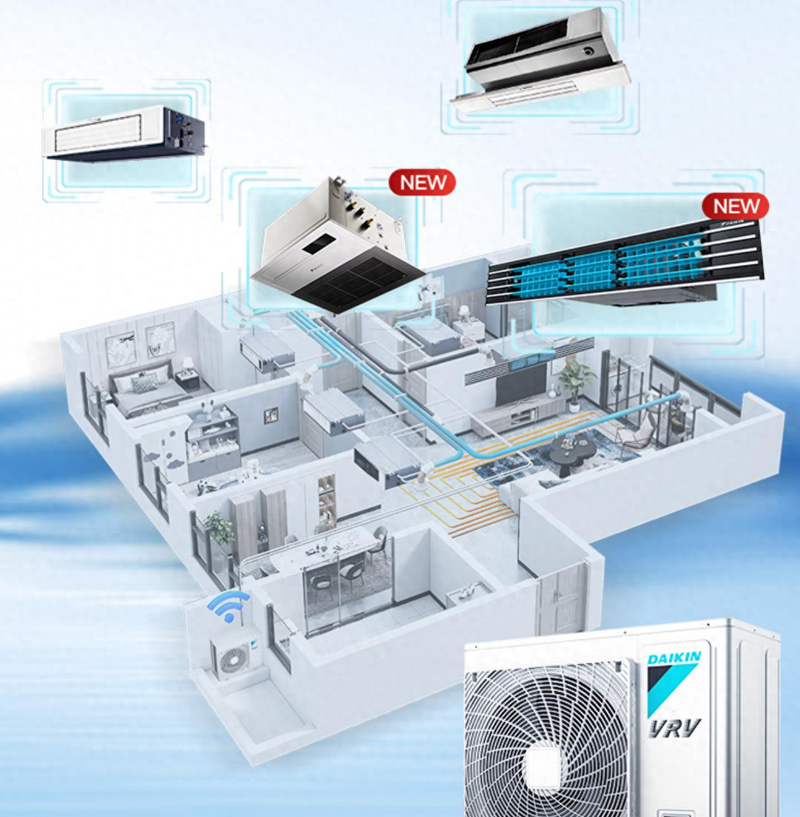
Whether we go to the mall, sit in the writing building, or have our own large flat level air conditioners, we enjoy the comfortable temperatures it brings every day, but very few know that a central air conditioner can work steadily, not on a single “host”, but on a set of devices。
Many have mistakenly assumed that there is only one outdoor air-conditioning machine plus a few indoor machines, but not — more like a “small air-conditioning plant”, from producing cold heat, delivering mediums to regulating air, with a division of labour for each of the equipment, with one less likely to strike. Today, in the clearest words, tell the central air conditioner core equipment and the role it plays
Core power equipment: central air conditioner “heart”, essential
Such equipment is a “power source” for the system as a whole and is responsible for generating cooling, heat, or promoting medium circulation, which is equivalent to the “heart” of the central air-conditioning unit, which, once suspended, is directly paralysed。
1. Cold water unit (cold source core)
Impact: the “core plant” for summer refrigeration, which specializes in the production of cryogenic sources, is key to central air-conditioning refrigeration capacity. In short, it provides the basis for cooling the temperature by cooling the constant water to 7-12°c through the refrigerant phase cycle。
Supplement: it contains key components such as compressors, evaporationers, condensers, which are equivalent to “power pumps” and are responsible for lifting refrigerant pressure, evaporation absorbs cooling water heat, condensers transmit heat to cooling water, and completes for efficient cooling, often in large buildings such as writing buildings, malls, and small amounts of domestic air conditioning。
2. Heat source equipment (heat core)
Effects: a “hot source” for winter heating, responsible for producing high temperature hot water (usually 45 ~ 55 °c), replacing cold water crews and providing indoor heat。
Common types: air-source heat pumps (which combine cooling heat with efficient energy efficiency) are mostly used for domestic use, while gas boilers, electric boilers are commonly used for commercial use, where heat pump units use low-grade thermal energy from outdoor air, with energy efficiency three to five times higher than conventional electricity heating, both environmentally friendly and less electric。
Water pumps: systematic “blood circulation pumps”
Impact: central air-conditioning “stealers” who drive the circulation of water (refrigerated water, cooled water, hot water) throughout the system — without which cold and heat cannot be transported from the mainframe to the room, which is equivalent to the loss of the blood pump function of the heart。
Classification: refrigerated pumps (transmitting refrigerated water), cooling pumps (transmitting cooled water), hot pumps (transmitting hot water), mostly centrifugal pumps, stable flow, low noise, and automatic velocity and energy efficiency stabilization based on system loads。
Heat-replacement equipment: “transmitting and release corridors” for cool heat
Such equipment is responsible for transmitting cold heat, releasing excess heat equivalent to the “respiratory channel” of the central air conditioner, ensuring that the cold reaches the interior and that the excess heat is released outside the room to maintain system balance。
Refrigeration towers: “scatterers” for chillers
Effects: specialized “temperature dissipation” for cold water units, which release cooling heat from the operation of cold water units into the atmosphere by evaporating cooling to ensure normal cooling。
The principle is simple: high-temperature cooling water is sprayed down from the top, it is fully exposed to rising air at the bottom, and some of the water evaporates to heat, bringing cooling water around 38°c down to about 25°c and returning it back to cold water units for recycling, often on top of buildings or in open areas, with commercial central air conditioning almost all equipped。
Vapourers & condensers: "core media" for heat exchange
These are the “inner core” of the cold water and heat pump units, with a clear division of labour and the following:
Evaporaters: in charge of “heating” — in the summer, where refrigerated water absorbs heat cooled, where refrigerants collide and take indoor heat; in the winter (heat pump mode), it works in reverse, absorbs heat from the outdoor air and provides indoor heating。
Condensers: in charge of “heating” - in the summer, the refrigerants absorbing indoor heat are liquidized, heat is vented to cooled water and then released from cooling towers; in the winter, the indoor cold air is excreted to complete the heating cycle。
End-of-pipe equipment: a “ender” who can bring comfort directly to you
Such equipment, which is installed directly in the room and is responsible for converting cooling, heat into comfortable air and delivering it to each room, is the “central air-conditioning component” that we can feel directly。
Wind engine tubes: the most common “indoor end”
Effects: end-of-pipe equipment, which is commonly used for domestic and commercial purposes, is equivalent to the “indoor vent” of central air-conditioning, which is responsible for transmitting cold (summer) or hot (winter) heat to indoor air, then cooling or heating through a wind machine into the room and dehumidizing and making the air more comfortable。
Characteristics: small size, low noise, ability to independently regulate the temperature of each room, installed inside the ceiling, not in space, suitable for writing most scenes, such as the building, hotel, home, etc., internal surface coolers are thermal cores, and are equipped with piped water to collect condensed water to avoid leakage。
New wind crew: “purifier + fresh supply station” for indoor air
Effects: to address the pains of "silent air-conditioning rooms with poor air quality" by introducing fresh outdoor air, which is filtrated first-time, efficiently, removing harmful substances such as dust, bacteria and so forth, then precalculating or preheating and then taking them to the interior, while excavating indoor polluted air to ensure indoor air circulation and cleanness。
Supplement: new wind units are essential, especially in malls and writing buildings that close doors and windows for long periods of time, which improve indoor air quality, avoid oxygen deficiency and dizziness in humans, and reduce air conditioning loads and energy efficiency。
Combination air conditioners (commercial exclusive)
(b) impact: “exclusive end” of large spaces, such as large malls, convention centres, which are more comprehensive than wind tubes, not only cooling and heating, but also finely regulating air moisture, filtering dust, and even treating large amounts of new winds to meet the comfort needs of large spaces, usually installed in rooms and delivering wind to regions through wind pipes。
Control and support equipment: “brain + shield” for central air conditioning
Such equipment, while not directly producing cold heat, can stabilize the system, operate intelligently and protect the equipment from damage, equivalent to central air conditioning “brain” and “protective shields”。
Self-control systems: central air-conditioning "smart brain"
Effect: achieve full automatic control, equivalent to "smart housekeeper", captures parameters such as indoor and outdoor temperature, humidity, etc. Through sensors, and automatically regulates the operational status of the equipment - for example, when indoor temperatures are met, the power of the mainframe is automatically reduced; depending on load changes, the speed of water pumps and wind machines is adjusted to ensure comfort and energy efficiency and energy efficiency, as well as remote monitoring, failure alarms, and commercial central air conditioning is almost always equipped with the system, with simple smart controls。
Auxiliary protective equipment: “protective shield” to extend the life of the equipment
Such equipment, although small, is critical to avoid equipment failure and extend its useful life:
1 filters: initial, efficient, installed in the new wind crew, wind hoses, filtering of dust, impurities in the air, preventing congestion of pipes and equipment, ensuring heat-replacement efficiency and improving air quality
2 inflated water tanks: for water systems only, balancing the volume and pressure of water in the water cycle pipeline, avoiding damage to the pipeline due to excessive pressure, preventing empty pumps and ensuring stable operation of the system
3 valve components: includes stop valves, lock valves, electro-inflation valves, etc., stop valves to prevent water or refrigerant reversals, lock valves to be used during overhauling to cut pipes, electro-inflation valves to finely regulate refrigerant flows, increase temperature control accuracy, which is the formula for variable frequency air conditioning。
Summary:
In fact, the core logic of the cac is simple: the power equipment (cool water unit, heat source, water pump) produces cold heat + delivery media, the heat-release equipment (cooling towers, evaporaters, etc.) conveys, releases heat, the end equipment (windboard tubes, etc.) delivers comfortable air, and controls the assistive equipment to ensure a stable intelligence operation。
For domestic and commercial purposes, knowledge of the equipment not only understands the workings of the central air conditioner, but can be followed up and maintained with less curves — for example, the wind hoses require regular cleaning of filters, the cooling towers need regular recharge and the pumps need to check the running noise so that the central air conditioner can be used longer and more energy-efficient。
If the air conditioner is installed at home, the daily comfort needs can be met by focusing on the three cores of the cold water unit (or heat pump), the wind pipe, and the new wind unit, with a simple self-control system。