“the car runs 60,000 kilometres, 4s says it's going to be full maintenance, offers thousands, what should be done and what are pits?”
For the owner, 60,000 kilometres of large maintenance is an important node in the use of the vehicle — at a time when the core fluids and perishable items of the vehicle are nearing their useful life and are prone to malfunctions if they are not maintained; however, blindly heeding the recommendations of the 4s store is liable to make a bunch of useless projects that cost a lot of money。
Today, the 60,000-kilometer “necessary, optional, iq tax” has been dismantled in the most gas-intensive manner, with specific operating standards and pit avoidance techniques to help the owners of the vehicles to pay for their maintenance with precision and efficiency and to keep the vehicle safe without being set up。
First, understand: why do 60,000 kilometres have to be “big maintenance”
60,000 km is not a random maintenance node, but a “critical point” for vehicle losses:
- oil fluids: oils, transformer tank oils, brake oils, etc., have been used for long periods of time, and their performance has been significantly reduced to meet the operational requirements of vehicles
- impairable items: tyres, brakes, spark plugs, etc. Have been worn to a certain extent and there is a safety risk of continued use
- core components: time belts (part of vehicle type), filter cores, etc., if not replaced in a timely manner, may result in major malfunctions such as engines, speedboxes, etc。
Briefly, 60,000 km of large maintenance is “preventive maintenance” designed to replace ageing components, restore vehicle performance, avoid minor problems and save money。
Ii. Mandatory projects: 6 core maintenance without one (security floor)
These projects are directly related to vehicle safety and the life of the vehicle's core components, whether or not recommended by the 4s store, and must be carried out in accordance with standards:
Fluorine replacement: vehicle “blood” must be updated
The fluid is the core of the vehicle and must be fully replaced at 60,000 kilometres without ambiguity:
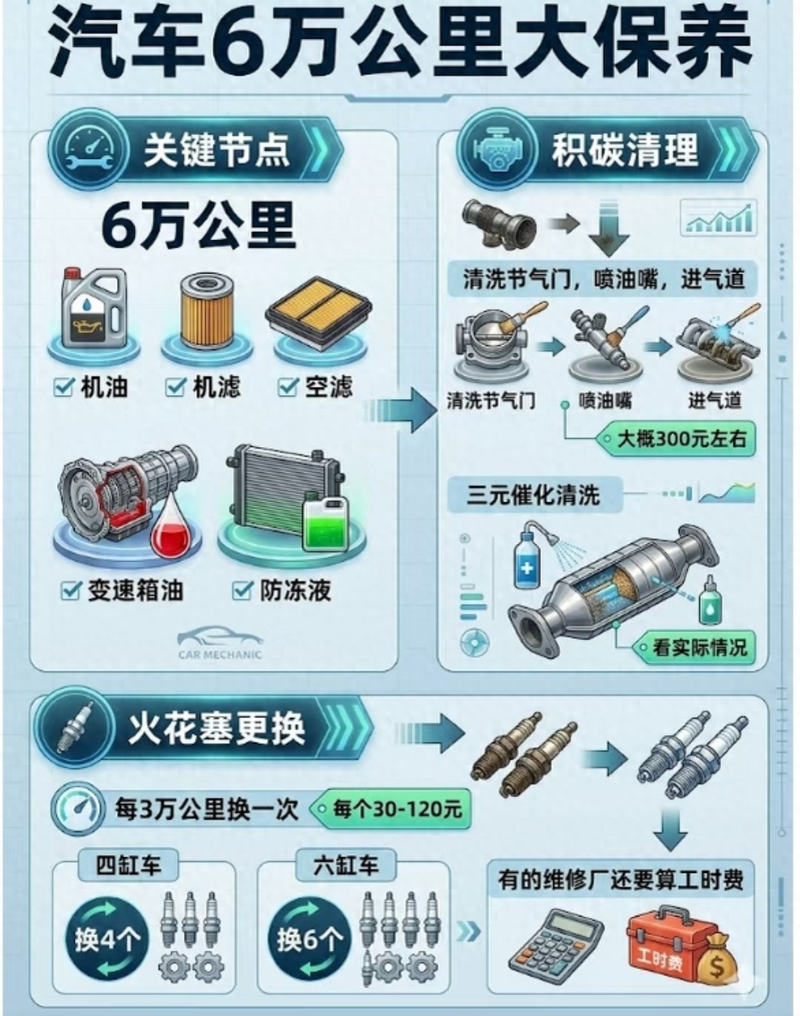
- oil + oil filtration cores: select the oil model (e. G. 5w-30, 0w-20) as required in the vehicle maintenance manual, using real oil, while replacing the oil filtration cores to avoid contamination of new oils by old filters
- vector tank oil: top priority. Manual and automatic brakes must be replaced, and the long-term non-replacement of transformer tank oil will result in blockage, increased wear and even end of life. It is proposed to use the original plant-specified type of fluid, with the option of “recycling machine replacement” (replaced more thoroughly) and the option of “gravity replacement” for manual resistance
- brake oils: brake oils are water-sorting and are overloaded at 60,000 km, leading to softening of brakes and long brake distances, with serious security implications. It must be replaced as required by the manual, after which the air must be drained to ensure that the brakes are sensitive
- refrigerated fluids: the duration of anti-freezing fluids is typically 2 to 5 years, and if 60,000 kilometres have not been replaced, they need to be replaced in a timely manner to avoid winter freezing and summer boilers and to protect the engine cooling system。
Timeless system inspection/replacement: engine “lifeline” cannot be ignored
The timing system (the time belt or the time chain) is responsible for synchronized engine gas doors and piston movement, which, if broken or slipped, is directly disabled:
- temporary belts: most of the vehicle types have a normal time belt life of 60,000 km, which must be inspected at 60,000 km, with immediate replacement in case of cracking and ageing, as well as the replacement of a regular high and inert wheel (to avoid subsequent failure)
- the right-time chain: in theory, it will be maintained for life, but 60,000 kilometres of time will have to be inspected for the looseness of the chain and the wear and tear of the guidance track, and in case of an acoustic and loose chain, it will have to be repaired and replaced in a timely manner。
3. In-depth check of brake systems + replacement
The brakes are the core of security and must be overhauled at 60,000 kilometres:
- brake plates + brake plates: check the length of the brake blades and replace them immediately if the remaining thickness is less than 3 mm (approximately a coin thickness); if the brake plates have visible scratches and dents (deepness exceeding 0. 5 mm), they need to be sharpened or replaced
- brake subpumps + pipelines: check if the subpumps are leaking, if the pipelines are old and broken, and find problems with timely maintenance to avoid brake failure
- handbrake systems: check the laxity of handbrake lines to ensure that handbrake brakes are effective and avoid the risk of scooting。
Tyres + rotor maintenance: gripping ground is the basis of safety
Tyres are worn to a critical point where rain and snow are easy to slide, with a focus on 60,000 km:
- tyre replacement: check the depth of the tyre wreaths and replace them immediately if they are less than 1. 6 mm (repeated marks in the tyre gutter) or if drums, cracks, and grindings occur; replacement is recommended if the wreaths are acceptable but have been in use for more than four years (aging rubber)
- tire switching + moving balance: if the tyre is worn evenly, it can be changed back and forth to extend its useful life; replacement of tyres must be followed by a moving balance to avoid high-speed shaking
- round rim inspection: check if the wheel rim is deformed, leaked, repaired in a timely manner to ensure steady movement。
Leach core complete replacement: “respiration” for vehicles
Leach cores can be blocked for long periods, affecting vehicle performance and experience:
- air filter cores: filtration of the dust in the engine's gas, in case of serious contamination at 60,000 km, replacement of new filter cores and smoothing of the engine
- air-conditioning cores: filtration of the air inside the vehicle, which has accumulated a large amount of dust and bacteria at 60,000 kilometres, must be replaced to improve air quality in the vehicle and avoid odor
- fuel filter cores: filtration of impurities in fuel, protection of nozzles and engines, timely replacement if 60,000 km have not been replaced (part of vehicle-type fuel filter cores are built in and replacement cycles are longer, whichever is the manual)。
Replacement of spark plugs: power to be provided by engine “firing firearms”
Firecrackers are responsible for lighting fuel blends, which can lead to reduced ignition efficiency, reduced power and increased fuel consumption:
- the replacement cycle: ordinary nickel alloy pyrotechnic pyrotechnic pyrotechnics have a life of approximately 30,000 to 50,000 kilometres, iridium and platinum pyrotechnic pyrotechnic pyrotechnics have to be replaced for 60,000 kilometres; in the case of precious metal pyrotechnics, electrodes must be checked for wear and tear, if necessary
- caution: tightening the change with the required twirl to avoid too loose or too tight, while selecting spark plugs that match the original plant model。
Iii. Optional items: based on the condition of the vehicle, not blind
These projects are not mandatory and need to be judged in the light of the actual condition of the vehicle, with symptoms that can be temporarily suspended:
Carbon clean-up: symptoms to do, no symptoms to waste money
Carbon accumulation can lead to reduced power, higher fuel consumption and low-speed shaking, and vehicles need not be deliberately cleaned up without these symptoms:
- clean-up situations: twitching, acceleration, marked increase in fuel consumption, or short-distance vehicles in long-term urban areas (carbon accumulation)
- cleaning methods: priority is given to “run speed” (use of high temperatures to remove some of the carbon accumulated) and, in case of serious symptoms, to gas-saving door cleaning, oil-jet mouth cleaning and not to “carbon laundering within engines” (vulnerable engines)。
2. Bottle inspection/replacement: state without mileage
The battery usually has a life of 3-5 years, not related to mileage, and is inspected for 60,000 kilometres:
- method of inspection: measurement of the voltage of a cold vehicle with a voltage of less than 12. 4 v, or the rapid reduction of the voltage at start-up, indicating that the cylinder is ageing and requires timely replacement
- caution: when replacing bottles, select products corresponding to the original plant capacity so as to avoid undercapacity affecting the electrical equipment of vehicles。
3. Aligning systems inspection: affecting comfort and stability
The suspension system will need to be checked at 60,000 kilometres and replacement will require maintenance if:
- the vehicles were travelling in a lopsided, bumpy and severe brakes
- check whether the shock-mitigator is leaking, whether the spring is deformed, whether the arm-strangling ball is loose, and find problems in maintaining it in time to avoid destabilizing the movement。
4. Air-saving door cleaning: failure to do it again
Carbon accumulation in the gas-saving doors can result in slow and cold start-up difficulties, which do not need to be cleaned if the vehicle is not subject to these symptoms; if there are symptoms, the gas-saving doors can be removed and then the cleaning can be followed by quick learning to ensure a smooth engine。
Iv. Iq tax project: 4s's favorite recommendation, not to do it
These projects are simply a waste of money and do not contribute materially to the performance and life of the vehicles, and face direct refusals:
1. Internal cleaning/remediation of engines
“rehabilitating engines with wear and boosting power” has little or no effect and may even jam oil roads and damage engines without any need
Oil nozzles “ultrasound cleaning” (no symptoms)
(c) if vehicle no-breathing symptoms (e. G., normal power, stable fuel consumption) are not required for ultrasound cleaning, then inspections during routine maintenance
Tyres “plating/conservation”
Tire conservation agents, membrane plating agents, which do not extend the life of tyres, may accelerate the ageing of rubber, waste money and hurt tyres
Brake systems “plating/conservation”
The so-called brake maintenance agent, membrane plating, has not increased the performance of the brake, and the brake system can work as long as the real brake oil and brake blades are replaced
"deep cleaning" (replaced cycle)
The recycler is in place when the transformer oil is replaced and then “deep cleaning” is simply a double consumption, which makes no sense。
V. Tests to save those those holders: 5 identifications of 4s
With the maintenance manual at the centre, not to be kidnapped by a “set”
4s has often recommended “60,000 km of luxurious maintenance packages”, which include many iq tax items. It is important that the vehicle maintenance manual be used only for the items requested in the manual and that additional items be firmly rejected
Rejection of “intimidation” marketing
In the case of “impact warranties” commonly used in 4s stores, such as “without doing or doing so” to intimidate the owner, the other party may be asked to provide the basis for the maintenance manual or to call the manufacturer 400 telephone calls to verify them so that they do not go astray
3. The choice of formal channel maintenance does not necessarily require 4s
(b) sixty thousand kilometres of major maintenance can be selected for a formal repair plant (with good qualifications and reputations) at a price of 30 to 50 per cent less than in 4s, provided that the quality is equally assured with proper parts and fluids, and without prejudice to vehicle warranty (the plant may not refuse to take out maintenance)
4. Prudence in carrying self-contained parts and use of the original plant for critical components
(c) equipment such as oil, filtration cores, etc., which can bring their own real parts (lower than 4s stores), but key components such as gear tank oil, brake oil, time belts, etc., are recommended to be assigned to the original plant in order to avoid failure due to the mismatch of the fittings
5. Preservation of maintenance vouchers to facilitate subsequent advocacy
Invoices, spare parts packages, maintenance lists are kept while maintenance is performed, and in the event of a failure of the follow-on vehicle, the rights may be safeguarded on the basis of a certificate to avoid the 4s store pushover liability。
Vi. Budget reference for maintenance: different types of vehicles are priced to be measured
- cars of less than $100,000 for domestic use: a budget of about $1,500 to $3,000 for major maintenance of 60,000 kilometres (including mandatory items, alternative options)
- one hundred and two hundred thousand dollars for domestic vehicles: the budget is about 2,500 to 5,000 dollars (higher fuel for recyclers)
- high- and middle-end vehicles of more than $200,000: the budget is about $5,000-$10,000 (more expensive spare parts and working hours)。
Finally: 60,000 kilometres of maintenance, "precision" is more important than "comprehensive"
The centrepiece of the 60,000 km of maintenance is “replacement of ageing components and screening of safety hazards” and is not a blind package. The owners of the vehicles should bear in mind that “the oil is in pain, the belt needs to be clear, the brake tires checked carefully, the project cleans up for symptoms”, guided by the maintenance manual, reject the iq tax project and choose formal channels for maintenance。
Major maintenance of 60,000 kilometres and the ability of vehicles to travel at a steady rate of 60,000 kilometres avoid high maintenance costs while ensuring road safety. I hope this guide saves you money to keep your maintenance safe。
How many miles has your car gone? How much did it cost to do 60,000 miles of maintenance? Welcome to the comment section to share our experiences on pit avoidance