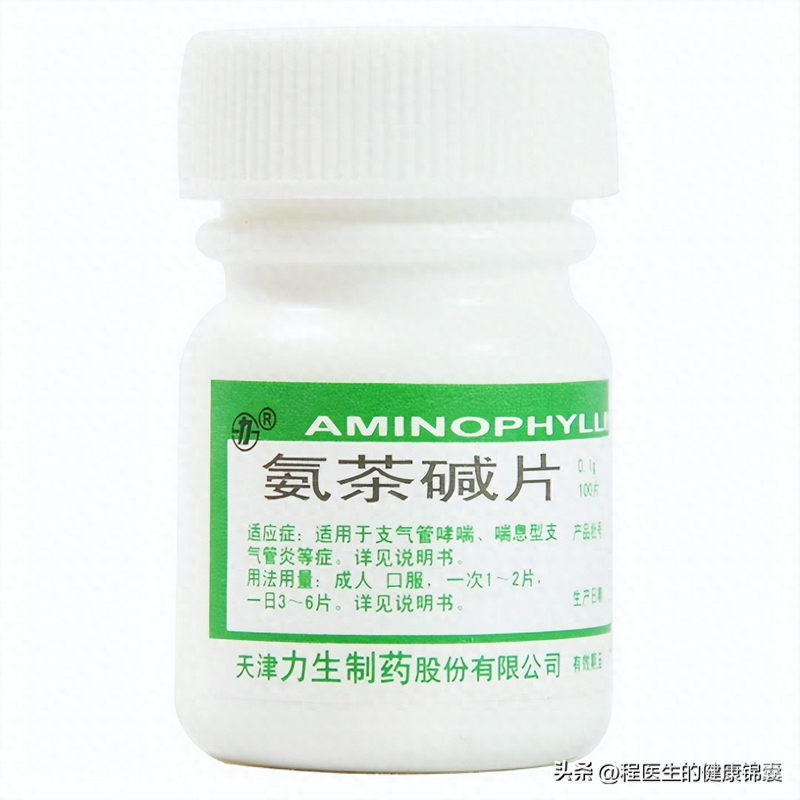
Amino alkaline tablets: "easy" and "standing" of a classic tablet
In the history of the treatment of respiratory diseases, very few drugs, such as ammonia, have become “home weapons” for generations of doctors and are in such an awkward position in modern guidelines。
It is cheap, effective and widely applied, but it is also a recognized “two-edged sword” — a cure for narrow windows, large individual differences and frequent adverse reactions. Can ammonia tablets take a clinical place today when inhaled sugar cortex hormones and β2 receptor agonists are in the mainstream? Is it an outdated “will be” or is it based on reality
This article, i'd like to talk to you in depth about this familiar and strange drug。
Pharmacological mechanisms: more than an “enriched bronchial”
Aminoalkaline is the salt of tea alkalis and ethylamide, which is added primarily to increase water solubility, ease oral and injectable. Its pharmacological effects are far more complex than we thought。
The traditional view is that aminoline relaxes bronchial smoothing muscles by inhibiting diesterase of phosphate and increasing the concentration of cytocyclophosphate glands. But modern research reveals that it has much more impact than this:
1. Receptor retardation
Aminoalkaline is a dysentery retardant that can counteract the contraction of the respiratory tract by substances such as gland. This is particularly critical in the case of high-reactive aeropaths。
Enhancement of osteoporosis - most undervalued advantage
This is one of the most unique pharmacological properties of ammonia. Studies have shown that tea alkalis can enhance aerobic contraction, especially when it is weak. A basic study using membrane plating techniques confirmed that ammonia can activate the l-type calcium membrane and increase the internal flow of calcium ion, thus increasing the condensation of the muscular cells. This mechanism is uniquely valuable for improving respiratory function and alleviating respiratory difficulties, and is not available for pure beta2 receptor agonists。
3. Promotion of internally-sourced teacupine releases
The bronchial expansion of tea alkalis is partly due to the promotion of the release of internal adrenaline and deadrenalin. This “deployed” approach makes its mechanisms more complex and multifaceted。
It is precisely this multi-target pharmacological characteristic that makes ammonia the “gold oil” that treats breathing in the absence of better drugs。
Ii. Guidelines status: recognization from “major” to “replacement”
The change in the status of ammonia is visible by turning the domestic and international guidelines。
Clinical applications in china: at the national level, ammonia tablets are still widely used for asthma in bronchials, asthma, obstructive pulmonary emphysema, etc., as well as for asthma caused by heart-borne pulmonary oedema。
Nhs prescription collections in the united kingdom: the combination of bradford taching hospitals and north east london in the united kingdom has concentrated, and ammonia and tea-alkali slow-down formulations are still recorded, but their use is fairly rigorous。
Evidence-based medical evidence of the decline: this change is not a subjective preference but is based on the findings of a number of high-quality studies:
(b) non-acceptance of β2 receptor agonists: at the time of acute asthma attack, the bronchial expansion of ammonia alkalis was far less effective than the combination of short-acting β2 receptor agonists: combined with a high volume of β2 receptor agonists did not add to the effect, but rather increased side effects did not improve the hard endpoint: in acute acute severe asthma, the use of ammonia did not reduce hospitalization days or pipe intubation rate 3, safe boundary: the narrowest treatment window
The most painful problem for the clinicians is ammonia, its “daunted” treatment window。
Blood concentration and therapeutic/toxic relationship:
Blood concentration
Clinical performance
Relatively safe, but some patients may have early adverse reactions
15-20 mmg/ml
Treatment window, but toxicity begins to occur (disgusting, vomiting, agitation, insomnia)
>20 mg/ml
The heart is moving too fast, the heart is not normal
>40 mg/ml
Heating, water loss, convulsion, even breathing, heart failure
This means the distance between the effective dose and the intoxication dose, with a thin layer of paper。
Early identification of adverse effects: the use of drugs early in the day was more disgusting, vomiting, agitation, insomnia, etc. Many patients misperceived that this was a normal reaction of “drugs working”, and that it was an early signal of poisoning。
High-risk population:
Fatal drug interactions:
Type of drug
For drugs
Effects on tea base
Large ringed ester antibiotics
Carcinocin, erythroacin
Reduce clearance rate, increase blood concentration
Antibiotics of hydrophenone
Cyclops, enochros
Significant increase in haemoglobin concentrations (in particular on the inosar)
H2 receptor harder
Smitty
Reduce liver removal rate
Calcium channel retardants
Dirthroat, villa pam
Interruption of intra-hepatic metabolism
Hepatic enzyme induction
Lifopin, phenobituto
Accelerated clearance. Dose adjustment required
Some of these interactions may have led to a sharp increase in blood concentrations and severe poisoning within days of joint use。
My thinking: where is the “modern value” of ammonia
Is there a need for ammonia to exist today, when the inhalation of sugar cortex hormones and beta-2 receptor agonists is more effective and safe? In my view, the answer is not simply “yes” or “no”。
Adaptive repositioning - heart-source asthma
The aminoline instructions explicitly refer to “asthma that can be used for heart-sourced pulmonary edema”. This is an easily neglected but vital adaptation disorder. The pathological mechanisms of heart-borne asthma and bronchial asthma are completely different, but the role of ammonia as both flat and strong (enhanced myocardial constriction, urine) leaves it uniquely valuable in this area. In 2024-2025, there were still several bioequivalence trials of ammonia tablets in the country, indicating that there was still a stable demand for this old drug in modern clinical settings。
2. New exploration of obstructive sleep breathing suspension of low-influenza syndrome
A study published in china drug evaluation in 2025 showed that osahs, a combination of methadone treatments, had an overall efficiency of 92. 00 per cent, significantly higher than that of the control group of 76. 00 per cent. The joint group has made significant improvements in respiratory regulation indicators, sleep quality, oxidizing stress and inflammation factors. This opens a whole new application for ammonia。
“stimulant” for respiratory muscle fatigue
For patients suffering from severe respiratory difficulties due to emphysema and acute strain of the muscular muscular muscle, the effect of ammonium alkali intensifies the oscillation of the muscular muscle may be more meaningful in improving the symptoms of respiratory distress than simply expanding the bronchial tubes. This is an idea to improve the “power pump” function rather than simply expanding the “pipe”。
4. Realistic considerations of economics and accessibility
The price of a bottle of $1-15 does not require sophisticated inhaling devices, expensive ejection, and the patient does not need sophisticated inhaling techniques. In areas where medical resources are scarce, in the context of primary health-care settings, ammonia tablets remain an important tool for reducing breathing in cases where patients are unable to afford new inhalation drugs。
Precisionly used "iron"
If i had to use ammonia today, i would have followed the following principles:
Concluding remarks
The ammonia tablet, it's a microcosm of an era。
It has witnessed decades of progress in respiratory medicine, carrying the breath relief of countless patients and documenting the evolution of medicine from experience to evidence-based change。
In today's era of pursuit of “precisional medical care”, the presence of ammonia appears to be somewhat “optimal” — it is not precise, safe or targeted. But it is this “opportunity” that reminds us of a simple truth: the progress of medicine is not simply the elimination of old drugs with new medicines, but the most appropriate place for every drug。
For those who are in a position to do so, new inhalation drugs are undoubtedly a better option. However, ammonia tablets continue to be a valuable “conservation” for patients with chronic obstructive pulmonary diseases associated with respiratory muscle fatigue and heart-borne pulmonary oedema who are in an environment of scarce medical resources and are unable to afford the high cost of medicines。
It is no longer the main actor, but on the stage that belongs to it, it can still work。
Summary of health guidance:
References (listed in order of quotations):
China medical information quest platform. Role of ammonia slow-down tablets. Sympse database. Cardiac asthma - clinical trial information. Bradford taching hospitals nhs foundation trust information. China medical information questNdon jordan formulary. Zhao li-min et al. Effects of ginning fluids and ammonia on calcium-type l-cells in rats. Practical clinical medicine, shanxi jin-dong pharmaceutical.