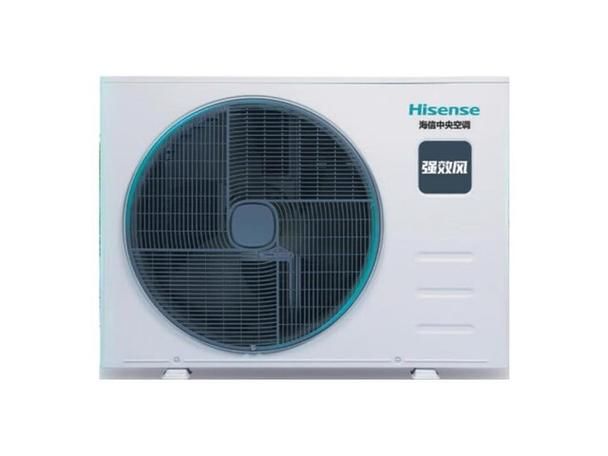
The evaporation and condenser “two” are an important part of the air-conditioning system, and the current industry automation rate is generally around 30 per cent. This area of air conditioner “two devices”, which is still relatively traditional, currently has only one black light production plant worldwide, located at the yellow island plant in haishin。
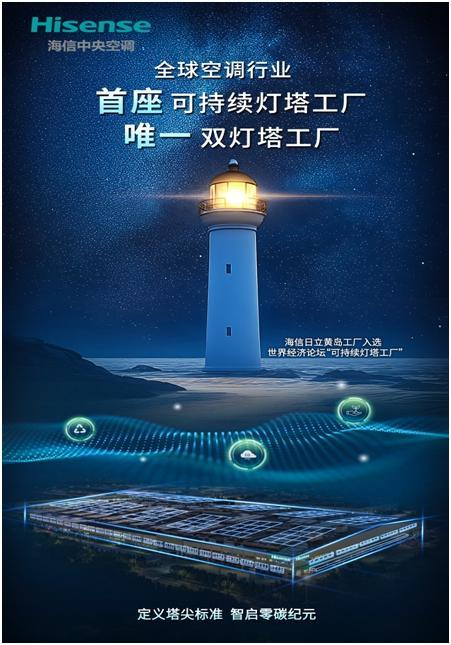
This is a microcosm of the transformational change that has taken place from above and below. On 16 september, the world economic forum (wef) officially announced the successful election of the haishin iltishima plant to the global list of “sustainable lighthouse plants”, the first sustainable lighthouse plants in the global air-conditioning industry。
Following last year's evaluation of the global “lighthouse plant”, the haishin higashishima island plant became the only global air-conditioning “double lighthouse factory”. This modern plant on the yellow coast is showing the world the high-quality development of chinese manufacturing with innovative smart manufacturing and green development practices。
Digital transformation, driving a new breakthrough in intelligence
In the summer of inflammation, air conditioners are called immediate household needs. However, air-conditioning is also a truly “energy-consuming household”, with domestic construction operations accounting for more than 20 per cent of total energy consumption and construction energy consumption for medium-energy air-conditioning systems over 40 per cent。
How to make this “power-eating” greener is a common proposition for the entire air-conditioning industry under the low-carbon transformation of manufacturing. According to haisan, the energy efficiency of air-conditioning products themselves, the rationality of matching building loads, and self-adaptability under different use scenarios are key to energy efficiency。
With this in mind, hyshin japan, led by the core concept of “technology development”, has advanced technologies such as ai, iot, digital twinning and has accelerated the development of new qualitative productivity. For example, at the central air-conditioning process end, refrigerants are described as elusive “ghosts”. Through the deep integration of technology such as internet-connected perception, big data analysis, the isf has built a system of smart controls covering the entire life cycle of refrigerants, making invisible refrigerant flows fully visible, precise and manageable, and making “zero loss and consumption” a reality from vision to reachable in refrigerant management。
Innovative practices such as the installation of “smart brains” and “flaming eyes” on production lines have not only led to a dramatic leap in production efficiency, but also contributed to a leap in quality control from “post-check” to “preventive prevention”。
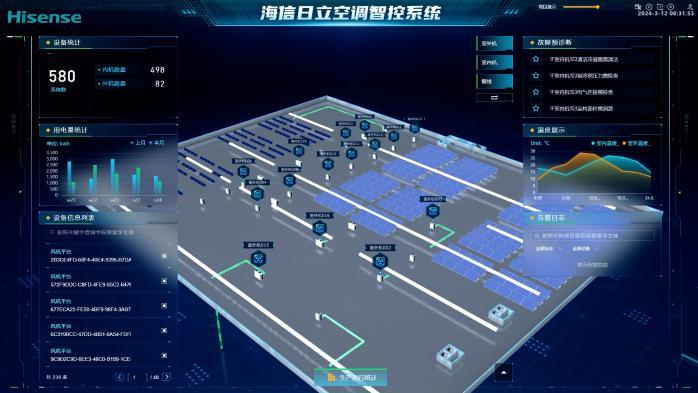
Haishin-japanese air conditioning system
Sustainable development, leading to new green changes in industry
It is noteworthy that air conditioners not only generate a surge in electricity demand during their use, but also generate significant carbon emissions throughout the life cycle of production, transport, air-conditioning refrigerant leakage and recycling. Controlling the carbon footprint of the air conditioning industry from raw materials to recycling is extremely complex and difficult。
As a leading industry enterprise, hae-shin japan chose to use technological innovation as a feeder to leverage the entire chain. Combining 200 million plus large data, products developed on an autonomous basis can replicate the real platform and the carbon management platform through multi-dimensional data analysis, simulation and optimization of carbon emissions, leading to a 4. 8 per cent reduction in average product power consumption by optimizing product design development, with the apf industry leading。
Specifically, the selection cycle combines construction models with meteorological data, completes the 876h load calculation, and the energy consumption simulation accuracy is increased by 50 per cent; the use chain uses the ai self-adaptation programme, with a maximum reduction in energy consumption of 31. 2 per cent over the life cycle of the product, and pioneers the ai pre-diagnosing model, which monitors the condition of the aircraft in real time through a network of things, proactively warns of malfunctions and provides advice on maintenance, reduces the average maintenance time by more than 45 per cent and promotes the development of central air conditioning to low-carbon intelligence。
At the manufacturing end, precision energy-saving intelligence control was carried out for air-conditioning, air-voltage, dry furnaces, three major energy-saving equipment; through real-time perception through the internet, big data depth analysis, and ai dynamic optimization, a shift was made from “responsible response” to “active control” to “active control” of the precise movement of energy from a single station to a plant-wide energy system。
At the level of energy efficiency reductions of concern to users, haishin higashili has taken the lead in bringing down 8. 26 million tons of carbon emissions by setting the scenes of ai technology in the design, equipment selection, running energy efficiency and energy management of air-conditioning systems throughout their lifetime. In the case of refrigeration leaks in air-conditioning components, haishin has been the first in the industry to create an ai pre-diagnostic model and to complete the closure of the sale by manual support decision-making and remote monitoring at a later stage, turning passive after-sale maintenance into active precision treatment。
More noteworthy is the fact that haisin-ik stand is the country's first brand to achieve refrigerant clean-up and reuse, with the first efficient refrigerant recovery and precision reuse technology, building a life-cycle smart control system, creating a “digital closed loop” for each gram of refrigerant, and making it zero waste。
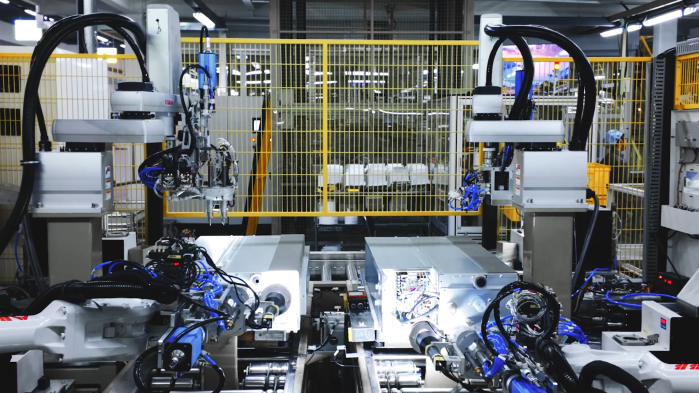
Autoassembly
Value chain synergies for zero carbon intelligent ecology
Sustainable lighthouse plants are the top demonstration enterprises in manufacturing with the capability of intelligent manufacturing and sustainable development, representing the highest levels of global manufacturing in the digital and carbon sectors. Currently, only 27 enterprises worldwide have been selected as “lighthouses in the lighthouses”。
The haishin-yong island plant successfully completed the transition from a “constructing lighthouse” to a “sustainable lighthouse” by showing industry a proven and successful transition path: to systematically address the sustainable development challenges of the air-conditioning sector through the deep integration of automation, digitization and intelligent technologies, and to achieve operational optimization and energy-efficient emission reductions。
Such “dual certification” reflects not only the hard power of chinese enterprises in terms of intellectual manufacturing and sustainable development, but also the remarkable success of the governance of the esg。
As hae-shin's chairman and director of the esg commission, chui-chye jia, said: “sustainable lighthouse construction is a living practice of the dual-arc strategy of digitizing and greening development of sea-based faith, and is a landmark and new breakthrough in the global air industry. Guided by this twin-lighthouse plant, haishin will continue to cultivate innovation, accelerate industry progress towards a digital, green new future, and give strong impetus to the achievement of world-class enterprises.”
The light of the lighthouse will also shine further away. Haishin's vision goes well beyond the factory door, and it is extending this green capacity to the entire industrial chain: haisun-ik stand is pushing 315 suppliers to sign green agreements, helping small and medium-sized enterprises to manage carbon effectively through the carbon management platform to achieve 100 per cent green power use by the core supplier; and it is pushing many suppliers to complete more than 240 carbon reduction projects and successfully replicate them to the industry to achieve a value chain reduction of 5. 8 million tons of carbon。
The challenge of high energy consumption in public relations buildings, such as high-focus iron stations, hospitals, malls, and writing buildings, has been driven by a four-dimensional approach to product design, selective installation, product use, product transport, based on ai technology and large data, and system-driven carbon conservation efforts and significant results。
For the future, haisin-japan will be strategically guided by the national “two-carbon” policy, pursuing the concept of “sharing opportunities, building development and building a future together”, insisting on the twin breakthroughs of energy efficiency and sustainability through the technological revolution, and working with industrial chain partners to build a zero-carbon biosphere to contribute to the high-quality development of the global heating industry。