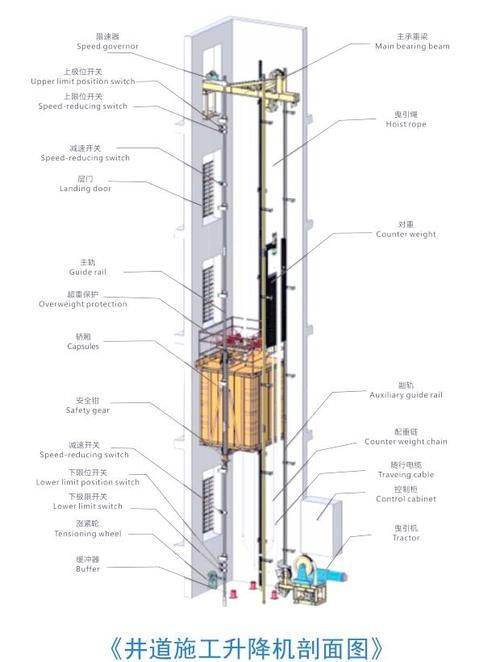
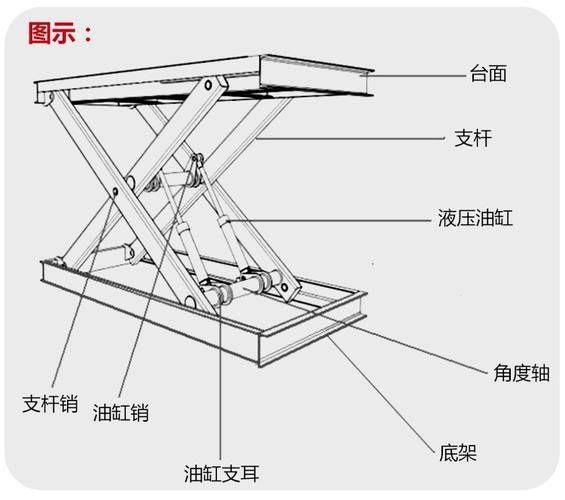
The elevators are walkers, hydraulics, electric controls, a lift device that supports the structure. Hydraulic fluids form a pressure from a leaf pump, and are transported through filters, blast-proof electromagnetic switching valves, throttles, one-way liquid control valves, balancing valves into the lower end of the liquid tank, moving the pistons of the liquid tank upwards, raising the weight, and returning the oil from the upper end of the tank to the oil tank via the impregnated electromagnetic switching valves, whose rated pressure is adjusted through the spill valves, and reading the pressure table through the pressure table。
I. Rationale
Hydraulic lift platform products are divided into curvature arm hydraulic lifters, forklifts, mast-type hydraulic lifters, and straight-arms hydraulic lifters in accordance with the working pattern. Hydraulic elevators are a replacement for arm lifts (uplifts), forklifts (uplifts). Extensive use is made of stations, docks, airports, hotels, post and telecommunications, municipal gardens, grain banks, washing companies, decorations on the front of public buildings, renovations or installation maintenance of electrical systems, etc. This elevator has the advantage of being lightweight, self-propelled, electrically activated, self-supporting legs, simple operations, large operations, and, in particular, capable of operating at high altitude across barriers。
1. Hydraulic lift-down platforms can be divided into four-wheel mobile, two-wheel towed, car retrofitting, electric bottling, auxiliary self-propelled, and lift heights ranging from 4 to 18 metres. The load of this series of products is divided into 0. 1 to 0. 8 tons, which can also be determined according to user requirements and can be as high as 10 tons of zui。
2. Hydraulic lift-off platforms are used extensively for plant maintenance in industrial and mining enterprises, municipal construction, decorating, quality and performance of hotels。
3. Users may choose the power mode and configuration according to their use:
The 1 power systems are: straight-flow power from bottles, single-phase or three-phase power sources, diesel engines。
2 walking: auxiliary self-propelled, two-wheel towed, self-driving, and car modification。
Three legs: mechanical legs, hydraulic legs, ordinary hands, pull legs。
4 control system: explosive-proof electrical control system, remote control system, pic control system。
5 hydraulic pumping station: pump station for the platform for the rise and fall of national production, italian imported pumping station
Protection devices: organ mask, net, iron plate seal。
Use
Hydraulic lifts are widely used in the manufacture of automobiles, containers, moulds, wood processing, chemical fillings, and in the production of water lines to meet the needs of different operating heights, and can be fitted with various surface forms (e. G. Roller, roller, wheel, turnover, voltage, condensation), together with various control modes (separation, connection, blast resistance), with the characteristics of a smooth rise or drop, frequent start-up, heavy load, etc., to effectively address the difficulties of the various types of lifting or landing operations in industrial enterprises and to ease production operations。
The hydraulic lift-off platform, which is primarily a function of lift-and-down function through pressure transfer from hydraulic fluids, has a mechanical structure of forklifts, which provides higher stability, a broad operating platform and a high carrying capacity, and allows for a larger range of high-altitude operations and suitable for multiple simultaneous operations. It makes high altitude operations more efficient and secure。