The industrial base is solid in the final state area and refrigeration equipment is widely used, with piston compressors as the core component of many refrigeration systems, whose stable operation is essential. Regular professional repairs and maintenance are essential to ensure long-term reliability and energy efficiency. This paper will provide a systematic account of the maintenance elements and practical practices of chillers。
I. Necessary preparation prior to maintenance
Prior to any operation, safety and preparedness are paramount principles。
1. Safety readiness of personnel: operators should wear protective gloves, goggles, etc. To ensure that the working environment is well ventilated and away from the source of fire。
Tools and information preparation: well-prepared general tools (e. G. Wrench, screwdriver) and specialized tools (e. G. Force-crack wrench, vacuum pump, refrigerant recovery, high-pressure pressure table group). A technical manual or maintenance drawing for the type compressor should be prepared to understand its specific parameters and structure。
3. System shutdown and power outages: complete suspension of compressor operation, power power switch shut-down and display of a “prohibited gate” warning plate. For compressors connected to large systems, systematic isolation is required in accordance with the protocol。
Refrigerant recovery: use of specialized recovery equipment, full recovery of refrigerants in the system to dedicated steel cylinders and prohibition of direct emissions to the atmosphere。
Ii. Routine inspection and regular maintenance content
Daily and regular maintenance can effectively prevent malfunctions and extend the life of equipment。
1. Daily running checks:
(1) hearing: whether the sound of the listening compressor is even and smooth, and whether there is an abnormal knock, friction or excessive noise。
(2) see: observe abnormal vibrations in the body of the compressor, check for visible oil stains (possibly for leaks) at the axle seals, interfaces and valves, see whether, depending on whether the oil table is in normal range, the reading of the pressure gauge is in a reasonable range。
(3) touch: in the case of safety, is the temperature of the compactor cap, the gas tank, and the vents abnormally high (with care to prevent burns)。
(4) recording of critical operational parameters such as daily inhalation pressure, exhaust pressure, oil pressure, currents, voltage, etc. To facilitate trend analysis。
2. Regular maintenance projects (recommended to be carried out for a certain period of time or as specified in the equipment manual):
(1) lubricating oil inspection and replacement: check the colour, viscosity and impurities of lubricants. When the replacement cycle is reached, the old oil is completely drained, the oil filter is cleaned or the filter core is replaced, and new lubricant is added to the specified type and quantity。
(2) inhalation filter cleaning: dismantling of the gas filter, cleaning of dust and impurities and ensuring smooth inhaling。
(3) tightening and checking: checking and re-stabilizing key connecting points such as foot bolts, cylindrical lid bolts, pipe links, etc. To prevent relaxation。
(4) axle or belt inspection: check the medium or belt tension and wear and tear of the coaxies and adjust or replace them as necessary。
(5) electrical maintenance: check the integrity of the electrical connection, measure insulation resistance, clean the electrical surface and spread wind leaves。
Iii. Diagnosis of common malfunctions and maintenance exercise
When the compressor is abnormal, the following steps can be followed for diagnosis and treatment。
1. Compressor failure to start or start difficulties:
(1) checking power supply and control circuits: confirm that the electrical voltage is normal and check the integrity of electrical elements such as fuses, contacts, overloaders, etc。
(2) check pressure and temperature protection: check whether protective devices, such as high-pressure pressure controllers, oil pressure differential controllers, temperature controllers, are repositioned due to system pressure anomalies, insufficient oil pressure or excessive temperature。
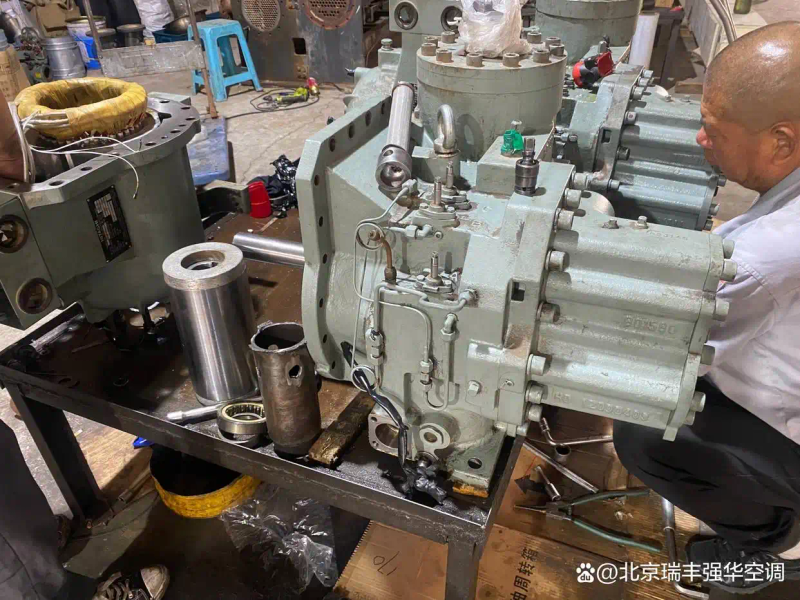
(3) examination of the mechanical component: the disking of an axis or a belt wheel to check if the main axis of the compressor is stuck to death. The death of the card may result from internal lubrication, wear and tear of components or hydraulic shocks。
2. Insufficient or slow cooling:
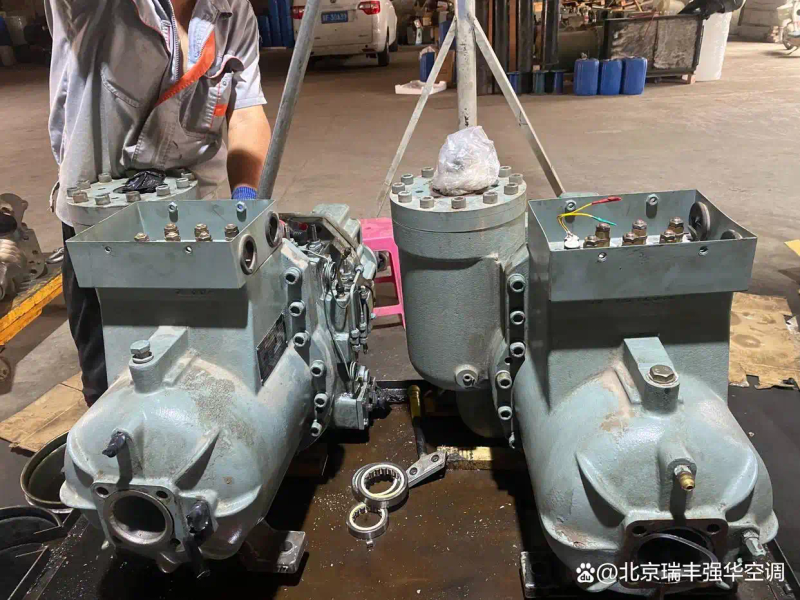
(1) inspection of system leakages: use of a leak detector to perform detailed leaks in the axle seals, valve plates, interfaces, etc. Of compressors. The leak site was found to need to be repaired and the vacuum refilled。
(2) check compression efficiency: measurement of high inhaling pressure and low exhaust pressure during operation may indicate that the valve (inhalation or exhaust valve) is worn, fractured or sealed, gaskets are pierced, or piston grinding causes internal flight. This usually requires overhauling of disassembly compressors。
(3) inspection of heat-replacement components: the cleanness and heat-replacement efficiency of condensers and evaporation units are also subject to systemic decline。
3. Operation noise and vibration anomalies:
(1) external cause inspection: confirms that the foot bolts are strong and the pipeline is solid and avoids resonance。
(2) internal mechanical malfunctions: an abnormal banging may result from an excessive gap between the bar or the main axle, a loose bolt, a broken valve into the cylinder, or piston wear and tear. The diagnosis needs to be stopped and further dismantled。
(3) hydraulic phenomena: too much system retrenching results in severe hydraulic shocks in the cylinder. The normality of expansion valve openings, refrigerant charge and system return oil should be checked。
4. Excessive exhaust temperature:
(1) check cooling systems: for water cooling machines, check whether cooling water flows, water temperature and condensers are decomposed; for wind coolers, check the cleaning of wind coolers and radiators。
(2) inspection of system performance: low inhaling pressure, high exhaust pressure, insufficient refrigerants or excessive quantities may cause exhaust temperature abnormalities。
(3) check internal leaks: if the exhaust valve leaks, the high-temperature gas returns to the cylinder for recompression, resulting in a surge in temperature。
5. Unusual consumption or pressure instability of lubricants:
(1) examination of oil levels and oils: excess or low oil levels, deterioration of oils and mixing of different models can affect lubricants。
(2) inspection of oil routes: cleaning or replacing oil filters, checking whether the pumps are working properly and whether the roads are blocked。
(3) check for mechanical wear: excessive wear of components such as piston rings, oil rings, axle seals, etc., will result in lubricating oil into gas cylinders being discharged or leaked directly。
Iv. Points for professional dismantling, overhauling and assembly
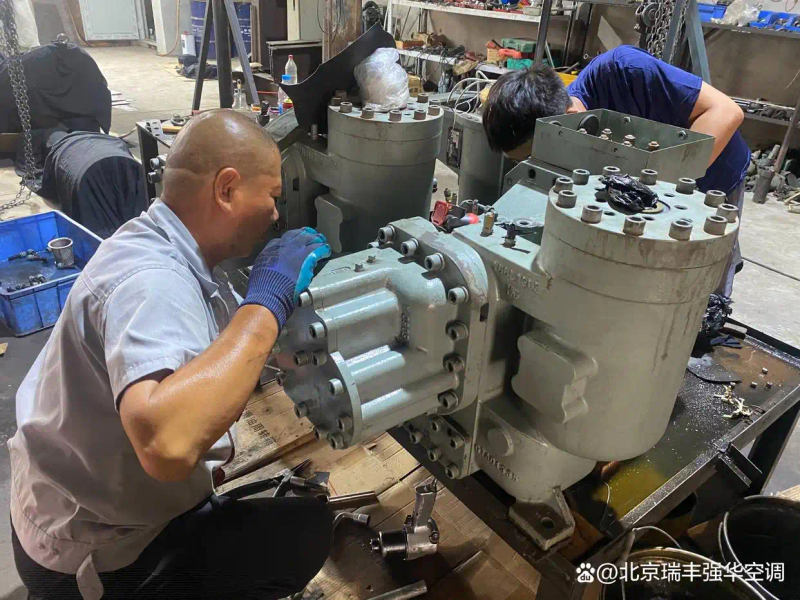
For compressors that do require internal maintenance, the operation needs to be particularly rigorous。
1. Dismantling process:
(1) ensure that system pressures are released, refrigerants are recovered and all connections are disconnected。
(2) dismantling from the inside, from the attachment to the main package. Record the order and relative position of the components and mark them if necessary。
(3) dismantling of key components such as valve panels, gas tank caps, bolt bolts, etc., using specialized tools to avoid barbaric operations。
(4) dismantling parts are sequenced and thoroughly cleaned with cleaning agents, and the individual parts are carefully examined for wear, crack and deformation。
2. Critical component repairs:
(1) valve plate and valve: examine the gap between valve flatness and elevation limit, valve sealing. (b) the conversion of worn, deformed or fractured valves。
(2) pistols, cortexes and rotors: examination of piston and cylinder wall faults, cortex head bearing faults, cortex main axis neck faults. To measure wear and tear, replacement or repair is required in excess of the permitted value。
(3) axial seals: momented or scarred pluriple replacements for the motion, static seal surface。
(4) axes: check the main bearings, the contours bearings, and replace them if the lesions, stripes or gaps are too large。
3. Cleaning and assembly:
(1) all parts are cleaned and dryed to ensure that they are known for cleaning. Prior to assembly, a proper amount of clean lubricant is applied to the friction face。
(2) the assembly is carried out strictly in accordance with the sequence and force rectangular values required by the technical manual, in particular for important connections such as bolts attached to rods, lid bolts, etc。
(3) replacement of all sealed gaskets and o-cycles。
(4) upon completion of assembly, the manual disk circles shall be rotated in a flexible cardless manner。
Validation of repaired debugging and operation
Once the maintenance assembly has been completed, it cannot be directly operational。
1. Air-classified test: fill the compressor or the system with dry nitrogen to the prescribed pressure, with water leaks from soap and no drop in pressure for a few hours。
2. Vacuum and drying: the use of vacuum pumps to pump systems to a high vacuum and to maintain them for a period of time, completely excluding air and water。
3. Filling lubricants and refrigerants: designates lubricants on a volume basis and quantifys refrigerants on a unit basis。
Test operation: the point-motion compressor confirms the correct movement and is then formally activated. Gradual loading, closely monitoring of all parameters such as current, pressure, temperature, sound, vibration, etc. To ensure that they are within normal limits。
Performance test: to assess whether its refrigeration capacity, energy efficiency ratio has reached the expected level for a period of time under typical conditions。
Regular professional maintenance and precision failure repairs are key to ensuring the steady operation of piston compressors at all types of refrigeration equipment in the final region. This can be done only if the operator has solid theoretical knowledge, normative practical skills and a rigorous and responsible working attitude。