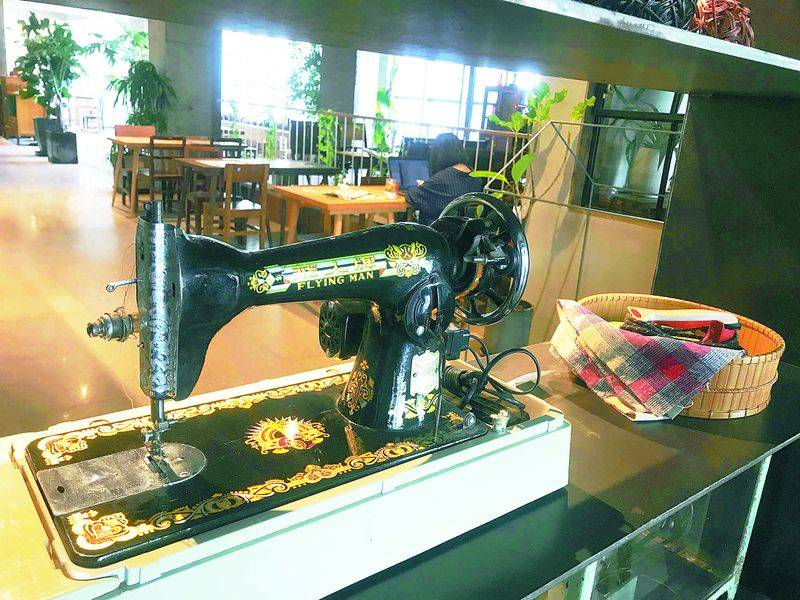
A wiener stands on the table and the needle leads up
He bit a rag in his mouth and threw out a bouquet。
It's a familiar childhood puzzle. Is that right? The age of the “triple-turn” is far away, and its name has been heard most recently, or in the microblogging section — every man with a shaking leg has a sewing machine in his heart。
Data chart, meng ring
From manual to mechanical sewing
Clothes are trimmed, stitched and sewn commonly referred to as sewing. Archaeological findings indicate that, in the era of old stones, which was 18,000 years ago, the caveman of the hill had begun to use bone needles to sew the skin of the beast. The term “sewmaking” has long appeared in ancient mandarin, as documented by east han historicists bangu, chen zhong and queen queen zheng deng, among others: “before it is against the will of the mother, the day it is sewn, the night it is bought in fat, the scripture is read, and the patriarchs are known to be born.” the song dynasty oyang-shu wrote in "the script of jun shei of nanyang county": "the clothes are new without cause, and the sewing must be finished." at the latest, the criteria for the selection of a man's spouse are often measured by the four dimensions of the term “gang worker”, in which the “work” is a female red card and sewing is one of the female reds。
Although china has a long history of sewing, the emergence of sewing machines occurred during the western industrial revolution. In the 1960s, the knitter hagreves invented the "jeannie machine" with his hand. The “jeann machine” can sow many cotton lines at a time that it greatly improves the efficiency of the yarn and has a profound impact on the cotton textile industry, marking the beginning of the industrial revolution. The demand for technological innovation was more urgent because cotton textiles were cheaper than gross textiles, because of the high market demand and the need to scale up production to increase production. The first industrial revolution had begun with cotton textiles。
With the rapid progress of the textile industry, traditional manual cutting, stitching and patching techniques have been difficult to meet the demands of industrial bulk production, and women workers in shirt factories have been forced to work overtime overnight and in extremely difficult working conditions. The british poet thomas hood, out of a sense of sadness about the sad fate of garment workers, created in 1843 a humanitarian poem, the sweat song, which depicts the miserable lives of working people through the confession of a seamstress. This song was so popular before the american civil war that it sang:
The fingers are broken and sore and sour
The eyelids are heavy and unopen。
In clothes that don't look like women
A woman in a needle line。
Suture!
Poor, filthy, hungry
But she still uses the sad tone
Singing the song of the shirt..
The observation of today's domestic sewing machines is structured in a simple manner and typically consists of the head, seat, movement and part of annex iv. The common sewing machine works in a simple and understandable way, with needles pulling out a thread through the fabric, the circuitr grabs the thread before the needle pulls out, and the circuitr moves in sync with the needle. When the needle again crosses the fabric, the new coil will go directly through the middle of the previous coil, and the circuitr will grab it again and make the coil around the next coil. Each of the wires will put the next one in place, forming a condom that will start over and over again。
Although the construction and working methods of mechanical sewing are not complex today, sewing machines have never been available and have been grinding and refining for generations。
Engus has said that a market demand is better able to drive technological progress than 10 universities. This sentence directly reflects the inherent impetus of market demand to technological progress. Large production in the textile industry has facilitated the creation and development of sewing machines. In 1755, charles wiesenthal, a german craftsman, obtained the first patent in the united kingdom in connection with mechanical sewing — a needle patent for machine design — but the patent did not describe the rest of the machine, nor did it promote commercialization in large quantities. The first patent system was introduced in the republic of venice, which in 1474 enacted its first patent law with modern features. This system of using legal and economic means to recognize the exclusive rights of inventors to their inventions in order to protect and promote technological inventions has played an important role in the history of sewing machines and has repeatedly contributed to it。
The first full-fledged sewing machine patent was awarded in 1790 to thomas shant, a british cabinet manufacturer, who first invented the world's first single-chained sewing machine for first-hand holes, second-line penetrating, and sole-chain sewing machines for shoes. As there was no concept of sewing machinery at that time, thomas shant's patents were placed in the patent pool for textile machinery and were buried for more than 80 years. Later, the machine was replicated by artisans under thomas shant's patent and displayed at the paris universal fair in 1878. A series of patent applications heralded the golden age of sewing machines. In 1804, thomas stone and james henderson obtained a patent in france for “mock-sew machines”. In the same year, scott john duncan was patented as a “multiplier embroidery”. In 1810, the germans, crums, invented an automatic machine for sewn hats. In 1818, john dodge and john noles made the first american sewing machine prototype. Unfortunately, the above-mentioned inventions had failed, and many patents had not been industrialized and were soon forgotten by the public。
Used to be one of the “four inventions to change human life”
As bismarck has often said, there is no such thing as failure for the indomitable。
Humans quickly ushered in the spring of sewing machines. In 1841, the french tailor timonier built a chain-wire sewing machine with hooks, the first sewing machine to be used in practice, using the same chain tracks as embroidery. Timonye, with several partners, opened the world's first mechanized garment factory with 80 sewing machines, mainly for the production of military uniforms. At a time when the government of polinjac, france, had marched into algeria in urgent need of large quantities of military uniforms, timoniya had received a large number of orders for quick delivery. The effects of this new sewing machine have shocked the world, as an angry group of french tailors burned down timoniya’s garment factory for fear of unemployment, and this riot nearly killed timonier。
In 1845, the american inventor elias howe independently completed the sewing machine, and his invention was unique in the use of two threads to create needles and feet by using a shuttle and a pin close to the eye, so that the sewn sweaters were made to be durable and even more durable than a cloth. At the speed of sewing, elias' sewing machine can sew 250 stitches per minute, seven times faster than manual. While the patent in elias was authorized by the government in 1846, while the patent was a success, numerous infringers were also recruited and many artisans began to imitate the sewing machines in elias for sale。
In 1850, the united states mechanical worker, lechak merritt k., invented the lock-wire sewing machine, the first commercially successful machine to set up his own company. The winning company’s machine used the same suture machine as elias howe’s patent, for which it also fought a four-year-long patent suit, which culminated in elias’s victory and a court judgement that the winning company paid the other’s high royalties。
The winning company was the first in the united states to start producing mass sewing machines, and successfully developed a world-wide pedestal sewing machine, which was second only to the clock when british science and technology history expert lee joseph praised it as one of the four greatest inventions that have changed human life。
The 1999 hollywood film anna and the king, which tells the story of the british female teacher ana and siam in the 1960s, included a winning sewing machine in a gift given by jody foster to king siam. In 1869, li hongzhang visited the united kingdom and returned home with a gold-plated winner sewing machine, which was given as a gift to her highness. After edison invented the electric motive, the winning company launched the electric-driven sewing machine, changing the traditional power source of hand-shake and foot-sew machines and ushering in a new era in the sewing machine industry。
Although elias has won the lawsuit, the winning company, thanks to its continuous innovation, has become the most successful ever sewing machine manufacturing multinational company. The success of the winning company depends first on its technological innovations in mechanical manufacturing, and secondly on the first “licensed” distribution network sales model, and ultimately on the creation of a new pattern of consumption payments — instalments. The first two years of bulk production in new york, the winner's sewing machine was undersold, and because of its high cost, the sale price of more than $100 each made it unaffordable for the then average american. To enable sewing machines to be sold, the winning company boldly launched the “short payment” plan to increase sales and filmed and publicized it. The change in the way consumer goods are paid has led to the sale of products, and by 1891 the winning company had accumulated 10 million sewing machines, making it the first multinational company in the united states, the first skyscraper in the united states and the highest building in the world in that era。
In the middle of the nineteenth century, with the rise in productivity in the united states, consumer goods manufacturing was flourishing, and “licensed” “substantial payments” continued in a variety of fields, with the closed market cycles of investment, production and consumption flowing efficiently. Rockefeller once said that if you want to succeed, you should move on to a new path and not follow the path of success that has been trampled on. In this phrase, the self-proclaimed winning company, which was able to survive a hundred years later, was stopped and acquired after delivery。
Winners monopolize world sewing mechanisms, but there is no technological advancement in sewing machinery. In 1940, the swiss company elna invented a portable home-based sewing machine with a barrel bottom aluminium alloy casting shell and an electric motor. After the second world war, germany, italy and japan were rapidly industrializing sewing machines, and most european countries, with the exception of a few companies that produced high-end domestic sewing machines, started to produce industrial sewing machines and to transform them across borders as springboards. In germany, for example, the obel vehicle, established in 1862 as a sewing machine manufacturer, was transformed into a car manufacturing industry after 30 years. In the 1950s, japan's sewing machine company, with government funding, started producing cheap sewing machines, further developing its home multi-purpose sewing machines and selling them to the united states and around the world. This period saw the rapid development of the japan export enterprise “brothers international” established by the ani sewing machine chamber of commerce, with the establishment of several marketing services in the united states, europe and korea. In the early 1970s, the market for domestic sewing machines in advanced industrial countries became saturated and japanese enterprises had to turn to manufacturing industrial sewing machines, despite rising labour costs. The republic of korea seized the opportunity of selling domestic sewing machines, producing medium- and low-end sewing machines and putting them on the international market, leading to the rise of the sewing machine manufacturing industry。
“china-made” from zero to world-class
As can be seen from the development of sewing machines for more than 260 years, the level of sewing mechanisms is closely related to the level of state industry. In 2018, china ranked first in terms of size and value of sewing machinery in the world, producing more than 13 million units of various types of sewing machinery annually, and exporting products to more than 170 countries and territories worldwide。
Over the years, the country's sewing machinery industry has developed into a complete industrial chain. Since 1869, when foreign minister li hong zhang brought back gold-plated sewing machines from england to the queen mother of the judas, the sewing machines have been “triple-turned” from home to home, and today china is ranked among the world’s top producers of sewing machinery, rich in chinese sweat and wisdom。
“sewing machine”, in english, was translated as the “iron train” in china at the earliest. On 14 december 1872, the shanghai proclamation published a commercial commercial commercial " sale of garment machines " , in which it stated: “the number of new sewing machines arriving in a foreign country is 50 taels per sea price, to be approached by the business”. The ad is the first piece of information that can be found today about a sewing machine entering the chinese market, and it sells the product of a winning american company (known as singh, which has become a “winner” for the english letter “singer” and has changed its name to “winner”) at a price of 50 taels of silver per machine, far beyond the normal household. However, thanks to unique instalments, marketing models for “invigorating” and adverts, the winning sewing machines quickly became known as the advanced clothing machines of shanghai tailors。
At the time, the tailors were divided into three groups: the masters specializing in the dress were called "reds" tailors, the masters specializing in the medium dress were called "buns" tailors, and the masters specializing in the uniform were called "bigs" tailors. And the sewing machine at the time, it's the big tailor guy. The uniform system of work is uniform and numerous, and the emergence of sewing machines has enabled them to grow like tigers and boost the shanghai uniform industry。
Shanghai was the birthplace of our sewing machine industry and witnessed the rise of national brands. For example, a home-known butterfly sewing machine. In 1919, three national capitalists, such as shen yushan and others, opened a “associated iron garage” at zheng jiakashi, shanghai, mainly for the sale and repair of imported sewing machines. Shanghai chang sewing machine produced our first industrial sewing machine, and in 1940 our first 1580 home sewing machine, called the “gold lion”. Shen yushan later changed the label “gold lion” to “invincible”. Before 1949, our sewing machine production was low, with less than 4,000 units produced annually, and the market for sewing equipment was dominated by the united states winners. Following the establishment of the new china, public-private partnerships were introduced in the sewing machine manufacturing industry to regulate production standards, which gradually grew. In the late 1950s, the “triple turn” began to appear in people's lives. The “three turns” and four major items, namely, the country's ability to produce at that time, and the four family items that families wanted, including radios, bicycles, watches and sewing machines, vividly reflected china's economic situation and people's standard of living at that time。
The sewing machines, which used to be very popular on the market and needed to be purchased by consumers on the basis of a ticket, have so far been stored in a collection of collectors' booklets with yellow “sewing machine coupons”. In 1966, with a view to harmonizing the name of the english trademark in internal and foreign trade, the name “invincible” was changed to “butterfly”, while the “butterfly” sewing machine continued to this day. By 1982, our annual production of sewing machines had reached 1,286 million, the highest in the world. By the beginning of the twenty-first century, more than 70 per cent of the world's sewing machines had been produced in china。
“super sewing machines” in the age of artificial intelligence
In the second half of the twentieth century, the third industrial revolution centred on biotechnologies and industrial revolutions came. With the emergence of multi-purpose computer sewing machines in the twenty-first century, the industrial internet became the new focus of competition among companies in the post-growth era. The sewing machine industry is beginning to have a warm embrace network. The internet is an information carrier based on the internet, traditional telecommunications networks, etc., which enables all general physical objects that can be independently located to form interconnected networks. The "sutures+purpose network" has enabled the three-dimensional visualization of clothing manufacturers, machines and materials, becoming the "industrial internet on a sewing machine". Advances in the sewing machine manufacturing industry have met the demand for fast-selling brands in the garment industry and have underpinned the rapid development of fast-selling brands。
What is even more surprising is that the constant innovation of special sewing equipment has gradually taken over the responsibility of human exploration for the secrets of nature. On 17 july 2019, elon mask, silicon valley iron man, declared that he was investing in neural, a brain science businessInk is working on the development of a neurosurgery robot similar to a sewing machine, which can use laser beams to pierce a series of small holes in the skull and control the computer by embedding signaling elements similar to neurons. The study has been experimented with rats, and the development of the brain interface technology programme for the “sewing machines” neurosurgery robots is going beyond tesla electric vehicles and spacex launch vehicles to the extent of radicality, engineering innovation and mission. Following the constant evolution of super-artificial intelligence technology, special sewing machines will play a more important role on the stage of human progress。
As the standard of living continues to rise, households today rarely see the shadow of sewing machines. However, the sound of the mother lying on the table of the sewing machine to dress the whole family at a young age has been clogged in her ears。