Researchers use 2% yeast fluid as a source of enzymes to explore the effects of temperature on peroxidation activity
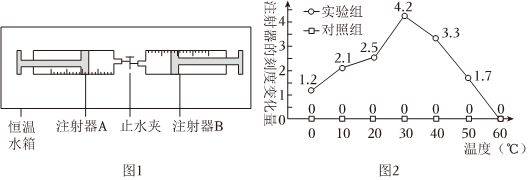
1 designed as figure 1 experimental device。
Experimental group: 1% h2o2 solution in syringe a and 2% yeast solution in syringe b。
Control group: 1% h2o2 solution in syringe a 5 ml, 2 ml in syringe b in distillation water。
The syringes a and b are connected with emulsifiable tubes, which are adhesived to stop the water。
2 set temperature gradients of 0 °c, 10 °c, 20 °c, 30 °c, 40 °c, 50 °c, 60 °c, and keep test and control group units at 10 min at the corresponding temperature。
3 opens the water stopper, pushes liquid equilibrium from syringe a to syringe b, immediately closes the stopper, and records the scale of the piston in syringe b. After 5min, the scale is recorded again, the scale changes are calculated and repeated three times。
The three experimental data obtained by the control group and the experimental group at each temperature are processed accordingly and curves are drawn as figure 2。
Please answer the following questions:
(1) the purpose of setting the control group in step 1 is, inter alia, to:
Exclude the effect of temperature on h2o2 self decomposition
Exclude the effect of temperature on h2o2 self decomposition
In step 4, “correspondent treatment” means
Calculated average of 3 data
Calculated average of 3 data
(2) the view was expressed that the h2o2 solution should not be used in this experiment as an experimental material “to explore the effects of temperature on enzyme activity”. Do you agree with him? Please outline the reasons:
The results of the experiment show no significant breakdown of the h2o2 solution between 0 and 60 degrees c
The results of the experiment show no significant breakdown of the h2o2 solution between 0 and 60 degrees c
(3) after repeated attempts, it is reasonable to select a 1% h2o2 solution in step 3. If the concentration is too high, the possible effect is
The generation of gases is too fast (or in excessive quantities) to facilitate the observation and recording of the results of experiments
The generation of gases is too fast (or in excessive quantities) to facilitate the observation and recording of the results of experiments
(4) it has been argued that the use of yeast solution as a source of hydroxylene peroxide is not very rigorous and is based on
Other substances in yeast may also contribute to the decomposition of the h2o2 solution
Other substances in yeast may also contribute to the decomposition of the h2o2 solution