A lot of calligraphy beginners are caught in the wrong spot: they come up with the post and ignore the most basic training in pen and pen. As a result, the drawings are crooked, they are soft, they shake like electrocardiograms, and in the end, they only say, "i am not a writer." in fact, the essence of calligraphy is precision control over pens — it's like learning to drive first, to swim first, to hold your breath, and to learn calligraphy first。
In this picture, the system dismantles the entire system of training for the introduction to the book writing: from the basic norm of five-meaning pen to four cores of straight-line, curve, geometry, circle, to wave-lined rhythm exercises. This is a step-by-step programme from “hand-eye coordination” to “lineline sense”, which covers 90 per cent of the introductory writing requirements for writing. This paper, which will be supported by professional calligraphy theory, will systematically dismantle the underlying logic and practical approach of the training system, helping you to address the root causes of the problem of hand failure and providing the strongest basis for subsequent writing and structural learning。
I. Introduction: why is “certification training” the first entry point of calligraphy
In calligraphy, the line is the soul of calligraphy and the pen is the basis of the line。
- the essence of the pen: it refers to precise control of the starting, moving, turning and collecting of the pen through the coordinated movement of the fingers, wrists and arms, and precise control of the lines, length, direction and strength。
- the core pain of beginners:
1. Writing error: too tight, too big a handshake, too rigid a wrist, leading to the delivery of the pen, carden。
2. Weaknesses of lines: drawings are like earthworms, vertical strips are like noodles, and there is a lack of change in drawings。
3. Directions are out of control: curves are scrambled, circles are scrambled, and pens cannot be precisely controlled。
Disturbance: pens, pens, pens have not changed, lines are as rigid as “robots”。
The training system in the picture is essentially a decomposition of complex pen and pen capabilities into quantifiable and replicable basic training: first to regulate pen writing, then to practice straight lines (stable), curves (soft), geometry (square), circles (rounds), and finally wave lines (pacing). The training logic is the scientific step path from hand-eye coordination to line sense。
Basic norms: five mean the rule of law — the “base” of the pen
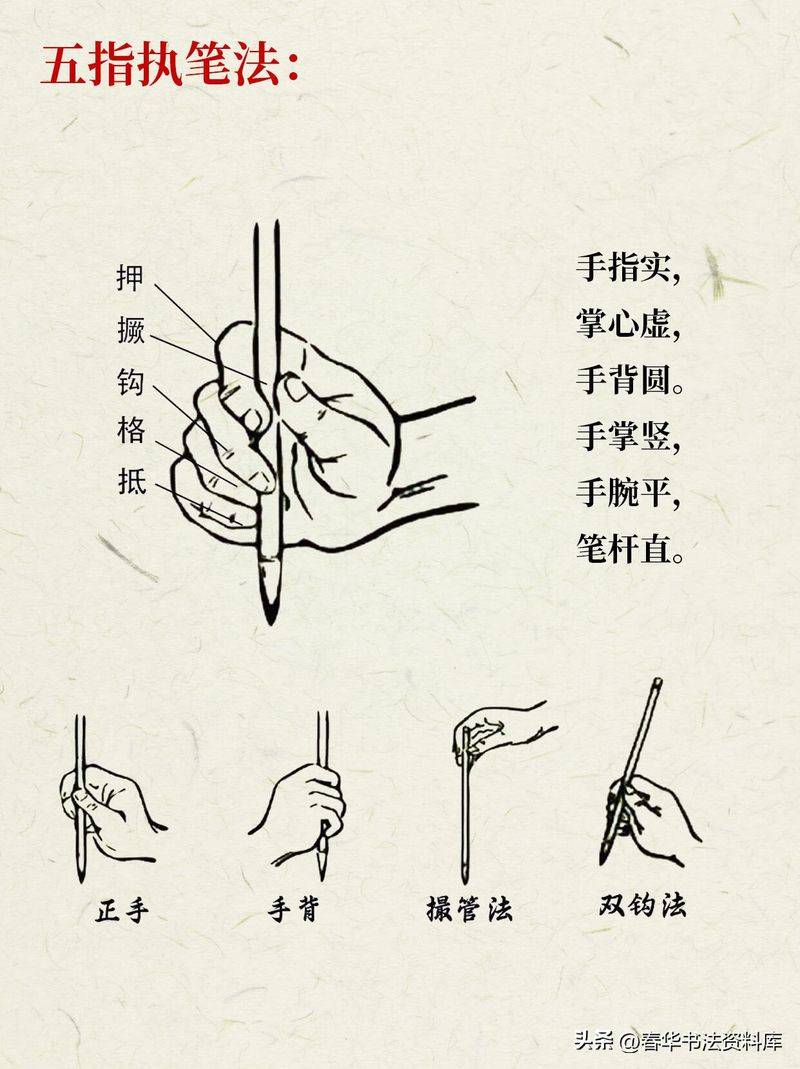
Core mouthpieces: solid fingers, weak palms, round hands; palms, flat wrists, straight pens。
Professional resolution:
A five-word pen is a standard pen approach to the introduction of certiorari, which achieves steady control of the pen by working together in a division of labour between the bets, the hooks, the bars and the five fingers:
Add: the first joint of the index finger presses the pen and controls the direction of the pen。
2. Zip: the thumbbone is attached to the pen and the index finger is attached。
3. Hook: the first joint of the middle finger is tied to the pen, which is supported by the control pen。
4. G. Unnamed fingernail root against pen and outward support。
5. Deficiencies: small finger against no-name and complementary stability。
Note:
- finger: five fingers to the pen bar, not loose。
- the palms are weak: the palms are empty, like holding an egg, making sure the pens are flexible。
- round of hands: the back of hands shall be in a circular arc, which shall not be subjected to pressure。
- wrist level: the wrist must be parallel to paper, not lift or lean。
- straightness of pens: pens should be vertically on paper, not tilted。
Common error areas:
- it's too tight: it causes the wrist to stiff, the pen to carden。
- too big a hand: restricted finger movement, no flexibility in pen control。
- declining wrists: causing the pencil to tilt and the line to fail。
Core training: four main lines of training - from “stable” to “living” steps
Straight training: “basic work” for pen control, steady core
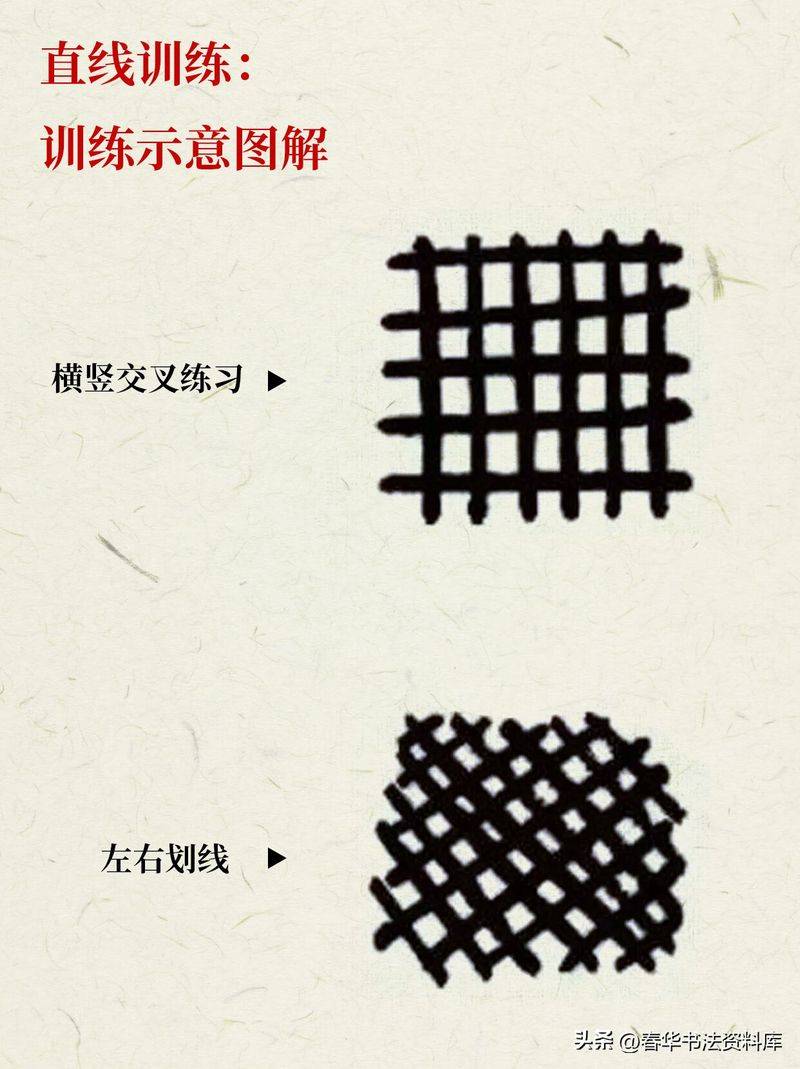
Training content: vertical cross-practices, left- and right-lined exercises
Professional resolution:
Direct training is the basis for the pen, with the core being** “stable, smooth and straight”.** it helps you to train the stability of your wrists and the strength of your fingers, and it is a prerequisite for the writing of crosses and vertical drawings。
- cross-training:
- training objectives: training crosses vertically with vertically and ensures vertically。
- writing points: draw low left-right height (mounting), vertically down, crosspoints are accurate and space is even。
- detailed requirements: a slightly heavy start, a sharp start, a sharp drawback and a steady balance of lines。
- left- and right-lined exercises:
- training objectives: training in straight-line pen control and laying the foundation for painting and painting。
- writing points: the line is to be parallel, the spacing is to be even and the line is to be straight and strong。
A guide to hole avoidance: the taboo is to write straight lines like "wave lines" to ensure the straightness and strength of lines; the taboo lines vary in size and balance。
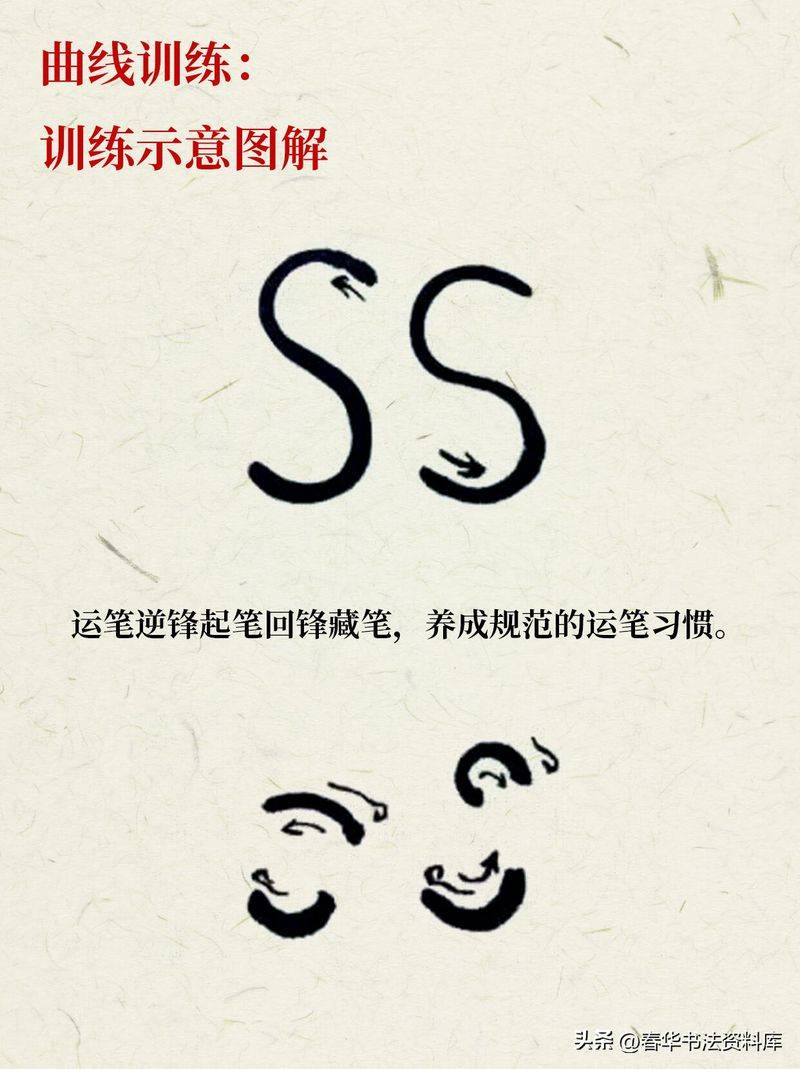
Curve training: "softizer" for pens, round being key
Training content: s-shaped curves, half circle curves
Professional resolution:
Curve training is designed to train the flexibility of the wrist and the ability to turn the pen, the core of which is** “turn-in-front, hide-in”**. It is the basis for writing curved drawings such as painting, painting, bending hooks, etc。
- s-shaped curve:
- training objectives: training in the pen capacity of the continuum curve, control of the turn and push of the pen。
- writing points: counter-string pens, middle-strike pens, turn-arounds, pens。
- the detail requires that the curve be round and non-argument, that the movement be natural and that the flow of the line be guaranteed。
- half-circle curve:
- training objectives: training in pen control capabilities for half arcs and laying the foundation for drawings such as hooks, poachers, etc。
- writing points: a counter-argument, a round-round, a pen-back, and a half round full。
Core mouthpiece: carrying pens back to back and forth, creating a standard practice of carrying pens。
Geometric training: the “tangular and round” of pens, the structure being the core
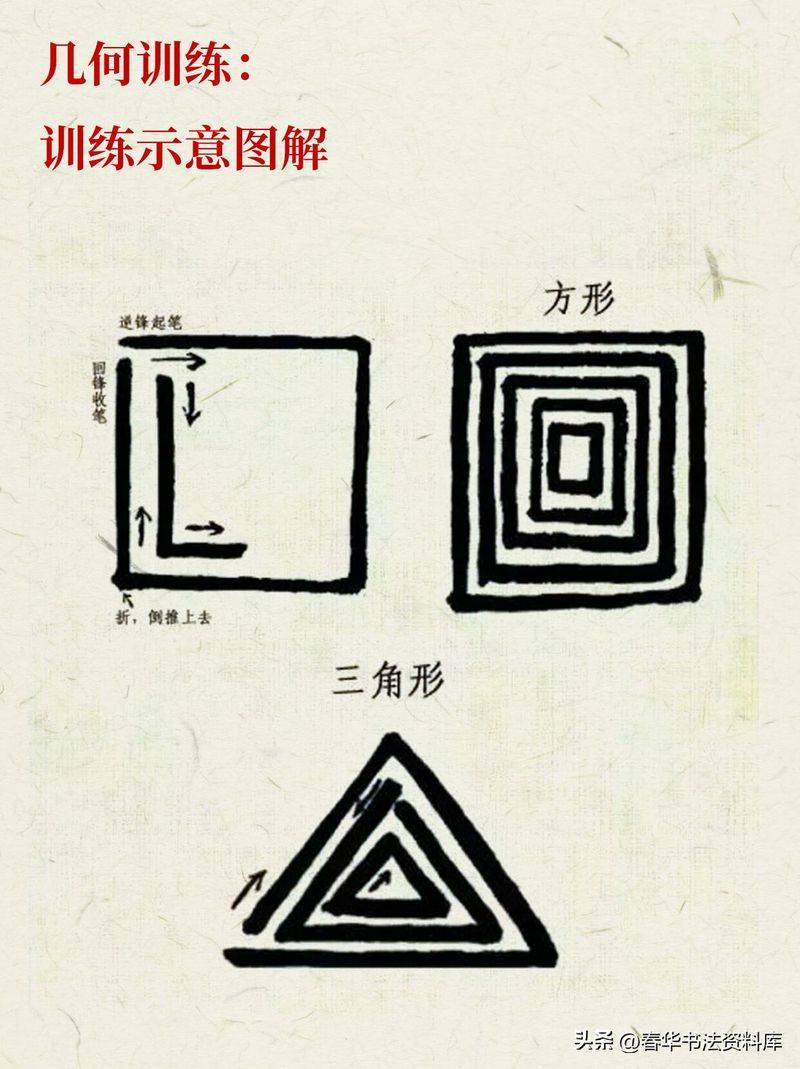
Training: square, triangle
Professional resolution:
Geometric training is a combination of straight lines and curves, with the core being** “cyclical, square”**. It helps you to train pens and transact pens, and it is the basis for the writing of structure words like boxes, triangles, etc。
- square training:
- training objectives: training in cross-cut, pen and pen capabilities to ensure square and roundness。
- writing points: counter-argument, cross-caption, vertical, folded prescriptions, pen-back。
- details are required: the four sides of the square must be long, the squares must be rounded at the corner and must not be rigid。
- triangle training:
- training objectives: training in a straight and pen-and-clip control capability to lay the groundwork for painting and painting。
- writing points: counter-editing pens, straight-slash lines, round-turn pens, pen-backs。
Professional tips: geometric training focuses on the complete process of “back-to-back” writing, which is at the heart of the texture of the calligraphy line。
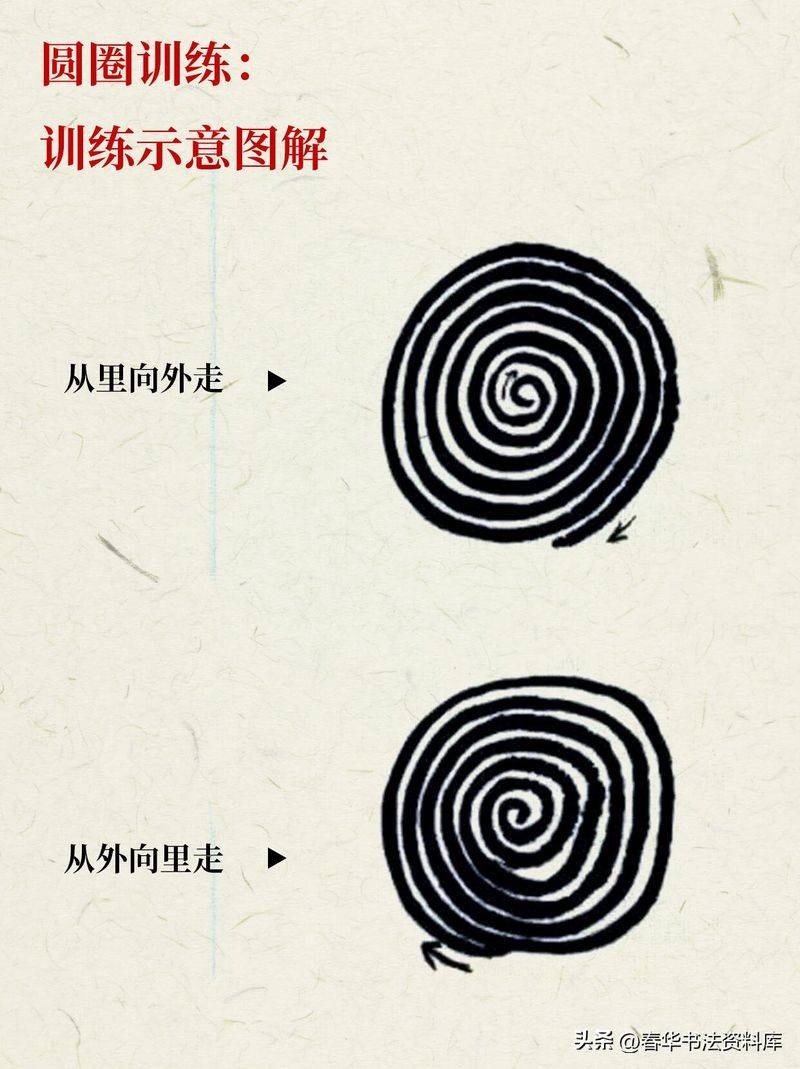
Circle training: “turning technique” for pens, flow is the core
Training content: outward, outward
Professional resolution:
Circle training is designed to train wrists in round-trip and pen-string skills, the core of which is** “spacing pens, round flow”**. It's the basis of a circle of pens, such as a bending hook, a hook, a heart。
- from inside:
- training objectives: training of round-trip pen capacity from the centre。
- writing points: from the centre, velocity towards the outer circle, ensuring that lines are even and fine and round。
- outward:
- training objectives: training in round-trip pen capacity from the periphery to the centre。
- write points: start from the outer edge, draw circles to the centre at a smooth pace, ensure that lines are even and fine, and circle round。
A guide to pit avoidance: the cyborg is painted in such a way as to ensure that the lines flow smoothly and evenly; the cyborg pen is too fast to allow the lines to drift; the cyborg is too slow。
Wave-line training: “temperature” of the pen, press core
Training content: continuous wave lines
Professional resolution:
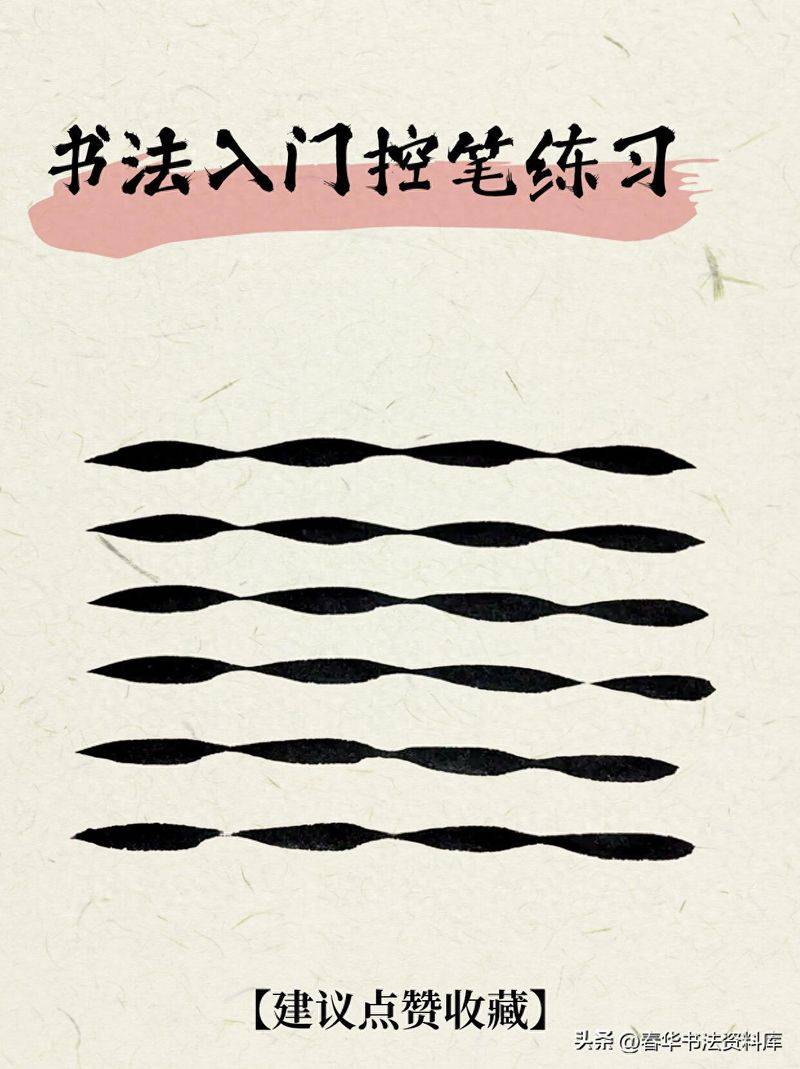
Wave-line training is designed to train pen-lines in the rhythm of change and pens, the core of which is** “type and change”.** it is the basis for coarse and fine-changing drawings, such as sketches, brushes, etc。
- the point of writing: a slightly heavier pen, a slightly lighter pen, a very heavy button at the turning point, and a very light pen at the beginning, resulting in a ceremonial change in the “heavy-heavy-heavy”。
- details require that the wave line be even, that the spacing be equal, that the movement be natural and not rigid。
Core values: wave-line training allows you to quickly master the “temperature” of the calligraphy line, which is the key to distinguishing between “manture” and “spirit”。
Implementation: a seven-day training programme from “zero foundation” to “customs for control”
The theoretical basis was in place and scientific training programmes were needed. The following is a seven-day training programme for calligraphy beginners:
Day 1-2: promulgation of norms + straight-line training
- objective: regulation 5 refers to the rule of law and training for straight-line stability。
- content:
1. Ten minutes per day to practice five fingers to ensure that the pen is correct。
A 20-minute exercise of cross-posting and left-and-right wiring with a focus on “stable, smooth and straight”。
Day 3-4: curve training + geometry training
- objective: the rounding and geometry of the training curve。
- content:
Practice s-shaped curves and semi-circle curves for 20 minutes per day, with emphasis on "the counter-bearbone, the backbrush"。
A 20-minute exercise of squares and triangles per day, focusing on "change in square, circle in square"。
Day 5-6: circle training + wave-line training
- objective: to train the circle's ability to rotate and wave lines to the rhythm。
- content:
A 20-minute exercise of circles (outwards from the inside and out) per day, focusing on the "soft-speed pen, smooth flow"。
20 minutes per day to exercise the wave line, with emphasis on “twirl and shift”。
Day 7: integrated training
- objective: to achieve “hand-eye coordination” by combining all control techniques。
- content:
1. Ten-minute review of the code。
2. 30-minute combined exercise: five minutes each for straight lines, curves, geometry, circles, wave lines。
3. 10 minutes for self-examination: is the line steady? Is it smooth? Is there a rhythm
High-level heart approach: from “control” to “linework”
When you can do more than that, you can go into high-grade pen control, making the line more chordy:
1. Middle-string pen, hard-core back
At the heart of the calligraphy line is the middle-line pen: the pen is always running in the middle of the line, so that the line is full, strong and sensitive. To avoid side-line pens, the lines are thin and defunct。
2. Advantage, soft
It's called the hymn line. Press the pencil, line it up, press it at the turnpoint and close it down. The line is just so soft and varied。
3. Intentional and voluntary
You have to start writing with the word "preliminary": think of the direction, fineness, rhythm, then write. The lines thus written are “spirited”, not “hand-to-hand” blind paint。
Summary and recommendations
The essence of the introduction to calligraphy is training in pen control. The training system in the picture is designed to simplify this capability into a replicable, quantifiable training formula。
Specific recommendations for beginners:
1. Step-by-step: do not rush to achieve results, starting with standard-setting and moving on to line training。
Focus on details: it is at the heart of the pen that one should focus on each single set of starting, moving, turning and receiving, not just on “image”。
3. Maintaining daily exercise: 30 minutes per day, more effective than an occasional three-hour exercise. The pen is a muscle memory that needs to be reinforced repeatedly。
4. Tool selection: the beginners suggest a combination of milligrams (soft and hard) with paper (high value for money, suitable for practice)。
Once this pen training system is well developed, you will be able to solve the problem of handlessness by writing full, powerful and fluid lines of writing, which will provide the most solid basis for subsequent writing, structure and discipline。
Would you like me to make this whole set of pens into a printable "intra-book control manual"? Comprises written specifications, training drawings and a seven-day training programme, with direct cross-checking and double efficiency