“from last year to this year i visited more than 200 used car trading markets throughout the country, and most of the drivers made it clear to me that the most obvious situation was `discovery' and even that some bosses wanted to sell the market quickly.” hoven has been in the used car industry for almost 10 years, and in an interview with the times news reporter, he said that in both years drivers generally “do not earn much” or even know how to continue to operate。
Since its establishment in 2018, hoven's current company has worked with over half of the country's mature used car trading markets to provide products and services such as online management tools。
According to hoven, the main reason for the downturn in the used car market was the greater supply of and demand for new vehicles, the increased competition among companies and the increased pressure on second-hand vehicles to sell as a result of lower prices。
Since 2025, there has been a steady increase in the pressure on the domestic automobile trade to operate。
More recently, the china automobile circulation association published the china motor circulation industry development report 2025-2026, which indicated that nearly 5,000 new cars had returned to the network in 2025, and that the traditional fuel car brand was “a disaster-stricken area” and that there had been a reverse price situation, namely, “compensation for the sale of cars”。
Among the large distribution groups, the luxury car dealer, paulide, was declared bankrupt owing to liabilities, litigation, etc., and the medium-lift holdings (00881. Hk) showed losses in the past year, with small and medium-sized new car dealers closing their shops, withdrawing their nets and shifting their businesses。
Since the second half of 2025, the authorities have reduced the use of funds by car companies against dealers by interviewing companies and regulating the management of accounts, leading to good competition in the industry. Industry associations have also launched industry surveys and guidance on a number of occasions and have been active in reducing the flow of vehicles。
Part 4s has negative rates for new cars
According to the china automobile trade development report 2025-2026, published by the chinese association for automobile circulation, in 2025 nearly 5,000 new cars were added to the 4s network in china, of which about 56 per cent were branded as new energy vehicles. The share of autonomous brands in the new network is 88 per cent, while the share of joint and luxury brands is 7 per cent and 5 per cent, respectively。
There are close to 5,000 out-of-network 4s stores, of which about 76 per cent are autonomous, 15 per cent are joint and 9 per cent are luxury。
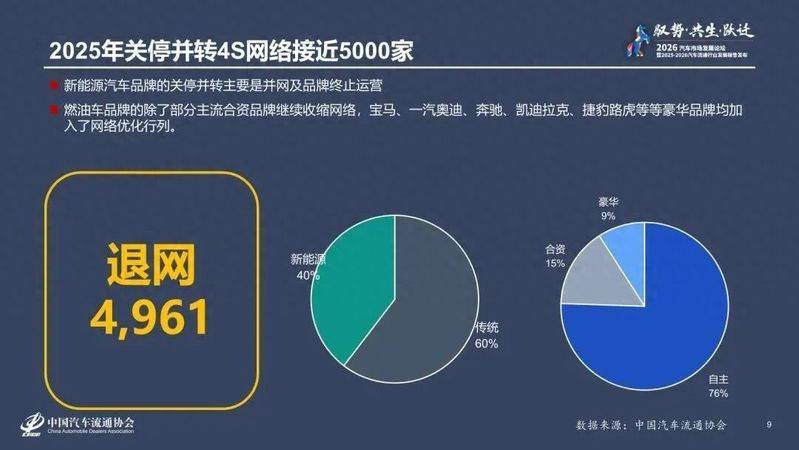
Analysis of distributor channels
Overall, by the end of 2025, the size of the 4s network stood at 32432, a 1. 4 per cent contraction from the previous year. Among them, the traditional fuel vehicle 4s network continued to contract and the new energy 4s network continued to expand。
According to the deputy secretary-general of the chinese association for automobile circulation, the 4s network continued to expand in 2025, increasing its share from less than 50 per cent in 2020 to 66 per cent, while the share of joint ventures fell from around 35 per cent to 22. 5 per cent and the share of luxury brands from around 15 per cent to 11. 6 per cent. The report shows that in 2025, 28 per cent of 4s stores were operating within three years and 19 per cent of older ones were operating for more than 10 years。
The china association for automobile circulation's life survey of car dealers nationwide shows that more than half of the dealers failed to meet their annual sales target in 2025, less than in 2024. Of these, autonomous brands have achieved the lowest level of achievement owing to the widespread radicalization of annual targets; over 50 per cent are dealers in luxury, import, joint venture brands。
The survey showed that 81. 9 per cent of car dealers in 2025 were inverted to varying degrees, 51. 5 per cent were inverted to more than 15 per cent, and that the maori rate for new car operations was 25. 5 per cent。
Domestic car dealers lost 55. 7 per cent in 2025. In terms of brand type, the loss was 38. 5 per cent for luxury brand distributors, 68. 2 per cent for joint venture brands and 50. 8 per cent for autonomous brands. In the subregion, the losses for distributors in east and south-east china were below the national average, at 48. 3 per cent and 46. 9 per cent, respectively, and in north-east and north-east china, at 63. 5 per cent and 61. 2 per cent, respectively。
In 2025, the overall satisfaction of car dealers with the mainframe plant was divided into 60. 8 points, the lowest in the history of the survey. The main reasons for the dissatisfied distributors include high sales task indicators, inverted prices, high stocks, excessive prices of spare parts, tied sales and increased competition due to the excessive number of authorized co-location sites. Of these, “over-sale task indicators” were the most unsatisfactory, followed by “price reverse management” and “stock management”。
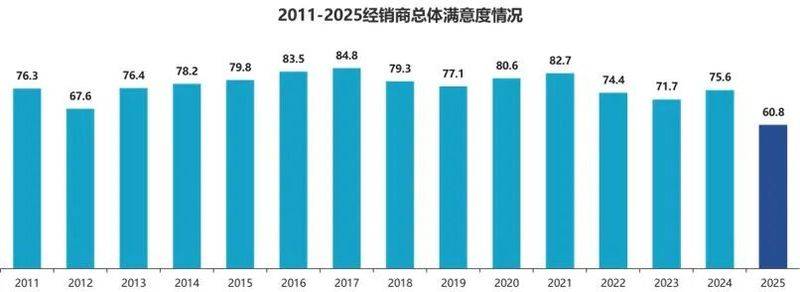
Source: china motor circulation association
Second-hand car deals are falling
The business environment for second-hand car dealers is also difficult. The report on the chinese car circulation industry for the first half of 2025, published by the chinese association for car circulation, shows that the loss of second-hand car dealers rose to 73. 6 per cent in the first half of 2025, and that the industry is generally under operational pressure。
The vice-president of the chinese association of automobile circulation, roh yi, has publicly stated that, in 2025, for the first time, our second-hand car trade exceeded 20 million customs gates, but the average transaction price declined。
According to the association's data, the average transaction price for second-hand car prices was $6. 41 million in 2025, a decrease of $0. 14 million compared to 2024, and average profits in the second-hand car industry were only about 4 per cent。
The cwaa second-hand car manager index shows that the second-hand vehicle manager index was 41. 8 per cent in february 2026 and has been below the death line for at least 14 consecutive months, which represents a continuing downturn in the second-hand car market。
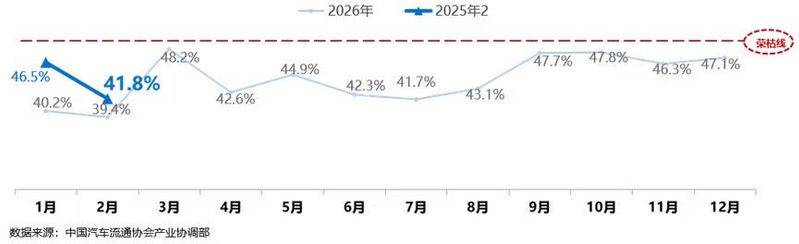
Source: china motor circulation association
The average inventory cycle for used vehicles was extended to 52 days, an increase of 12 days over the same period of the previous year. Of these, the average inventory cycle for high- and middle-end second-hand vehicles was 58 days for over $200,000 and 45 days for low-end second-hand vehicles under $100,000. Some of the second-hand drivers indicated that the prices of the new vehicles had again been reduced after the receipt, and that the prices of the second-hand vehicles had been pushed down, with some of the models being valued as shrinking by more than 20 per cent within three months。
Since 2023, the domestic automobile market has initiated several rounds of price adjustments. Ifac data show that the average domestic passenger price was $170 million in 2025, a decrease of $14,000 from the average in 2024. Of these, the average cost of vehicles used by the brands of the new powers decreased the most, from $281,000 in 2024 to $241,000 in 2025。
New vehicle terminal prices continue to decline, leading to a reduction in sales profits for new vehicles by distributors to negative values, and to a continuous contraction in the source valuation of vehicles in the hands of second-hand carriers。
Can the driver get out of this
A number of regulatory measures have been put in place to address the plight of motorists. Since the second half of 2025, the authorities have reduced the use of funds by car companies against dealers by interviewing companies and regulating the management of accounts, leading to good competition in the industry。
In january 2026, a multi-sectoral circular was issued by the ministry of commerce, among others, requiring automobile producers to optimize their business policies towards distributors, shorten the repatriation settlement cycle and reduce the pressure on dealers'stocks。
Industry sources indicated that regular accounting period management helped to improve the cash flow situation of small and medium-sized dealers. In the past, some of the vehicles had been used by dealers for longer periods of up to six months to recover their earnings, subsidies, etc. As a result of the regularization of the accounts, some companies have reduced the repatriation settlement cycle to less than three months。
The driver carries out “self-help” simultaneously. In the case of new car dealers, some large groups of distributors have begun to reduce the number of businesses, close down hard-earned sites and shift to strong brands. Some distributors expand after-sales operations, financial insurance, etc。
In the case of second-hand car dealers, it regulates the detection and quality assurance services, introducing standardized testing reports and after-sales security programmes. Some second-hand car dealers have introduced third-party testing agencies to provide services such as “7 days without reason” “1-year quality assurance”. At the same time, new models, such as online access and private operations, have been gradually expanded to expand distribution channels through short video and live displays。
According to luo, “increased cross-regional circulation has been evident thanks to the promotion of national circulation, inter-provincial policies, universal access to detection reports and live broadcasting operators in the five countries. In addition, the demand for second-hand vehicles is shifting from front-line cities to the sinking market.” at the same time, he noted that in response to the risk of fluctuations in the price of new vehicles, second-hand carriers had taken the initiative to speed up the turnover and that the average inventory cycle had decreased significantly。
For the market in 2026, rohit stated: “the lower sales volume of the mainframe plant is expected to help stabilize the prices of new vehicles and improve the operation of used vehicles. The large retention base provides room for growth in second-hand car transactions. New energy used cars will continue to be an important driving force in the market, and a shift in industry towards standardization and branding will enhance consumer buy confidence.” he projected that the volume of used car transactions would exceed 5 per cent in 2026。