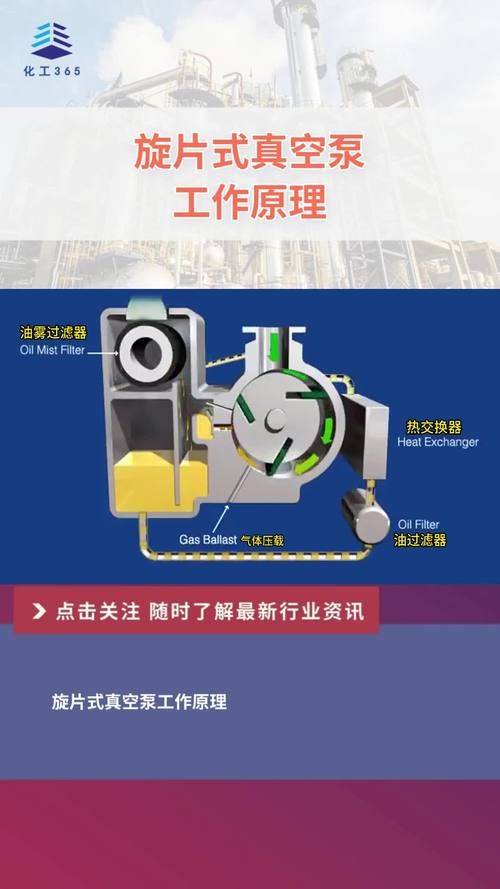
Description of the working principles of the spiral vacuum pump:
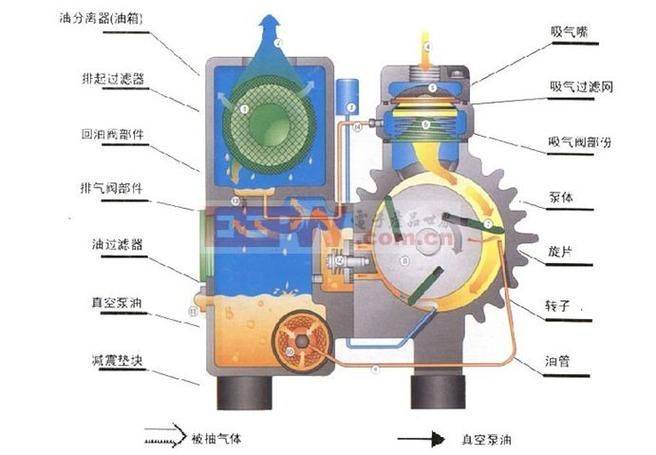
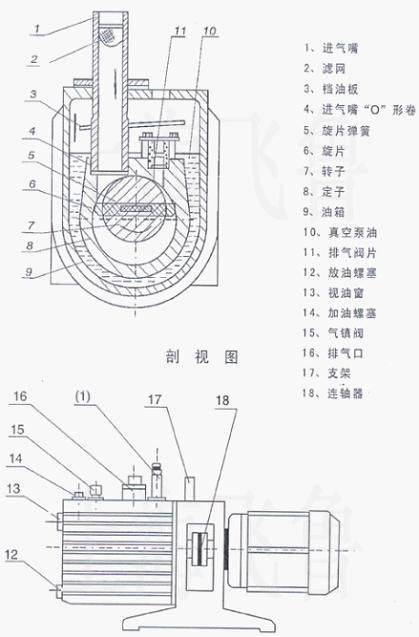
As illustrated by the working principles of the rotor vacuum pump, the rotor vacuum pump consists mainly of parts such as fixed, rotor, rotor, cap, spring, etc. It is structured using rotors that are eccentricly placed in the palanquin (the outer circle of the rotor corresponds to the inner surface of the fixed, with a very small gap between the two) and two rotor blades that are slid in the rotor slots with spring tension and centrifugal force attached to the inner wall of the fixed, which is always slid along the inner wall of the fixed when the rotor rotates。
When the rotors rotate in a graphical direction, the volume of space a, which connects to the inhaler, is constantly increasing, the pressure in space a is decreasing, when the pressure in space a is lower than that in the pump container, and the gas extracted is constantly pumped into the inhaler a, based on the principle of balancing the pressure of the gas. The volume of b cavity space is gradually decreasing and the pressure is increasing, and it is being compressed. The volume of space c, which is connected to the vent, is further reduced, the pressure of the c space is further increased, when the pressure of the gas is stronger than the pressure of the vent, the compressed gas is pushed out of the vent valve, the gas pumped continues through the reservoir in the tank and is drained into the atmosphere, and during the continuous operation of the pump, the process of inhaling, compressing and exhausting is carried out continuously to achieve the objective of continuous pumping。
Emission valves are immersed in oil to prevent atmospheric inflow into the pump, and the oil enters the pump cavity through faults on the pump body, oil holes and exhaust valves, covering all motion surfaces within the pump cavity with oil, creating seals for the inhaler and vent, while the oil is filled with all harmful spaces to eliminate their effects on the limit vacuum. The two-stage rotor vacuum pump consists of two studios, two consecutive chambers, which rotate at equal speed, room i is a low vacuum level, room ii is a high vacuum level, gas is pumped from the vent into room ii, gas is pumped into room ii when the gas pressure enters is high, gas is compressed through room ii, pressure is increased rapidly, gas is compressed not only from the upper exhaust valve, but also through the middle wall, entering room i, is compressed in room i, and is drained from the lower exhaust valve; when the pressure of the gas entering room ii is low, the upper exhaust valve is not pumped out, and the gas is all entering room i through the middle-wall passage, and continues to be compressed through the lower exhaust valve, so that the two-stage rotor vacuum pump is higher than the maximum vacuum of the single-rotation pump。