Centrifugal pumps are one of the core equipment that the water industry is indissoluble to work with centrifugal movements of water using the rotation of leaves. Using electric power, pump axes are used for high-speed rotations of the wheel and water, and the water is driven by centrifugal motion, dumped outside the wheel and flowing through the flow lane of snail-shaped pump casings into the pump's plume。

Map of yell run
How can the safe operation of equipment be ensured to extend its lifetime? Today we will talk about how the day-to-day management and protection of centrifuge pumps are carried out。
Pre-01 readiness
In order to ensure the safe operation of pumps, the crew of pumps should be thoroughly examined before they are activated, especially with regard to the newly installed and overhauled pumps, and more attention should be paid to conducting inspections so that problems can be identified and addressed in a timely manner. The main checks were as follows:
1. Check whether the rotors of the crew are flexible and light and whether there are metal frictions in the pumps, if any, for reasons to be examined。
2. Checks whether the lubricant in the bearings is normal and clean。
3. Check for flexibility in the opening of valves on pipes。
4. Check whether the foot bolts and other connecting bolts of the pumps are loose or loose, and if so, should be tightened or replaced。
5. Clear the water pump into the water mouth in order to prevent the inhalation of the waste and damage to the wheel。
6. To check the consistency of the switch between the power plant and the pump, and whether the distribution equipment is fixed, and to check the switch for the newly installed or overhauled pumps is an essential task。
7. Check the normality of the control system, the accuracy of the instrument displays and the accuracy and effectiveness of remote monitoring with remote control。
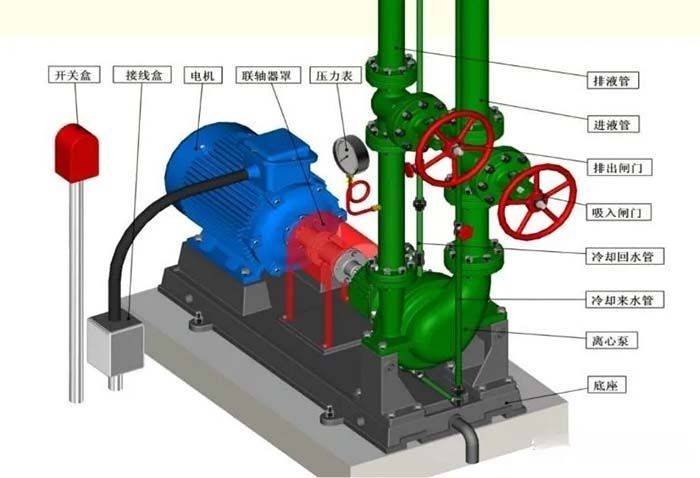
Diagram of centrifuge pump structure
Zero-two water and start
Water
Water must be drawn before the centrifuge pump is activated, and most of the general small centrifuge pumps are pumped with drains, at which point the bottom valve should be installed at the lower end of the pipe. The methods used to draw water are running water, high-shelf water, pump water, etc。
Most of the large and medium centrifuge pumps use water-ring vacuum pumps to pump gas. When pumped, when water surged in the vents, it meant that the pipes and pumps were filled with water to start the pump. For pumps with self-injecting pumps below the sink level, opening the valve automatically fills the pipe and pump。
Start
Centrifugal pumps are generally activated by a closed gate, when operators and crew are not too close to them, and the valves on the vacuum and pressure meters should be opened as soon as the speed of the pump is stabilized, at which point the readings on the pressure table should go up to the air rotation of the pump when the flow is zero, indicating that the pump has been pressed upward. When the valves on the ballast pipe are gradually opened, the vacuum meter readings are gradually increasing, the pressure gauge readings are decreasing, and the current meter readings on the distribution plate should increase. The start-up was completed when the valves were fully open。
When the pump is closed, it should not normally run longer than 2-3min; if it is too long, the internal flow of the pump will heat up as it circulates continuously within the pump, causing damage to some parts of the pump. If only “humming” is found after the power-mobilization gate is closed, the reason for the power check should be cut immediately. If the pump turns and does not produce water, the pump shall immediately be stopped to examine the reasons。
Operation management of the 03 centrifuge pump
Once operational, each pumping unit shall fill in the relevant log item on the operating day statement in a timely manner. Computer-managed data on the daily operation of the pumps should be entered into the computer's storage system。
Watch out for any abnormal noises and vibrations in the crew. When the pumps are operational, the crew shall be calm and sound shall be continuous and uninterrupted. The often abnormal sound and vibrations are a precursor to the failure of the pumps and should be stopped immediately。
Note the temperature and amount of oil of the crew bearings. The heat of the bearing shall normally not exceed the ambient temperature of 30°c ~ 40°c and a maximum of 75°c. When no thermometers are available, hands can also be used and, empirically, if you feel hot, you should stop and check。
The new crew uses lubricated roller bearings, with the first oil exchange time running 80h ~ 100h after the first oil exchange, and then approximately 2400h every other year (the period may be doubled using molybdenum disulfide lubricant). When mechanical oil lubricating bearings are used, the oil is exchanged once every 240h and it should be kept in mind that the surface of the oil should be between two steps of the scale and that it should be filled at any time if it is insufficient。
The filling box has a normal drop-off level, which is usually controlled to the point of the drop-off and is not continuous, i. E. 20-150 drops per minute. Water drops can be controlled by pine, tight filling caps. Care should not be taken unilaterally to tighten in case of wear and tear。
The foot bolts on the axes and crews are periodically checked and, if deviation or relaxation is detected, the firming should be corrected in a timely manner。
Watch out for changes in instrument indicators. The position of the instrument pointer shall, in the normal course of operation, be basically stabilized at a certain position. In the event of a sharp change and beating of the instrument pointer, the cause shall be immediately identified。
When large pump units use water cooling bearings or recycled oil cooling power units, they shall maintain the smoothing of the roads and shall immediately stop and repair the pumps if the cycle cooling system fails。
Changes in the water levels of suction wells, where the water levels of the suction wells are below the minimum design level, should be properly closed down to avoid gas erosion and damage to leaf wheels. In general, urban sewage generally receives less water between midnight and 8:00 a. M. And deserves special attention。
When the pumps are not operational during the winter, the water should be stored at the screwdriver plug at the bottom of the pumps in order to prevent the thawing of the pumps. Water should also be stored without pumps for long periods of time。
Stop at 04 centrifugal pump
Before the centrifuge pump stops, the vacuum and pressure gauge valves should be closed to the centrifuge pump, and then the pressure pipe valves should be slowly shut down and closed。
After parking, care should be taken to clean the pumps and electric motor surface water and oil sludge. Water from the pumps should be purified immediately after a longer period of absence or winter parking. Some of the problems that cannot be addressed in operation should be handled in a timely manner。
For pumps with a high range, care should be taken at the time of suspension of the pump to the damage that the pump hammer may cause. Generally, the impact of the pump hammer is already taken into account in the design of the pumping system, and for operators it is important to ensure that the removal system is complete and effective at all times in order to minimize the impact of the hammer when the pump is stopped or when it is abruptly out due to failure。