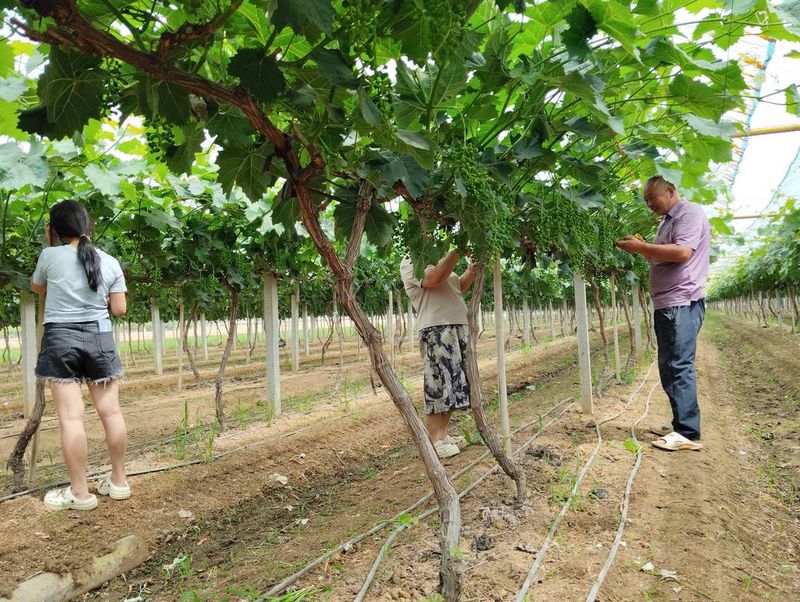
Element i of the grape cultivation technique, the selection of the site for soil ph at 6-8, organic content at more than 1 per cent, groundwater table at less than 1 m, easy to transport, non-pollution, slope or flatland construction with good drainage conditions. 2. Land-restructuring parks are set at a distance in the north-south direction, and canals of 1 m wide and deep are dug and placed separately from the subsoil. Green backfill, 20 cm thick crop straw placed at the bottom of the ditch, then mixed the topsoil with organic fertilizers and calcium phosphate, each acre of organic fertilizer and calcium phosphate, respectively, at 3000 and 250 kg, and eventually covered the surface of the ditch with topsoil. Fences or sheds are also supported by cement stakes at a distance of 3 metres. Iii. The selection of cultivators is recommended: (1) summer black: the fruit is large, averages around 420 grams, the fruit is of full size, and the fruit is soared. The fruit grains are close to circular, with natural particles weighing about 3. 5 grams, can be up to 7. 5 grams after cactin treatment, and the fruit skin is purple and black, and the fruit is easy to colour and is consistent in colour and mature. The fruit is thick, the meat is hard, there is no meat bag, the juice is purple red, soluble solids can be up to 20 per cent, with thicker strawberry scent, non-nucleus and good quality. (2) white heart without nuclear: proliferating, more resistant to frost, matured in mid-july. A cone with an average ear mass of over 500 grams and a maximum of 1,300 grams. Plumbs with long eggs in round or slightly chicken heart. It is green and green when it matures, it is extremely beautiful, it is thin and tough and it is not fissure. Jell-o, a little rose flavor, sweet, soluble solids of 16%, seedless, very high quality. (3) himmlet is nuclear-free. An average grain weight of 3 grams and an average ear weight of 350 grams increased to an average of 8 grams after cactin treatment, to an average of 750 grams and to a maximum of more than 1,000 grams in the case of non-nuclear grapes. Disease-resistant, productive, especially suitable for low-skilled fruit-farming or industrial development. (4) super nuclear-free: the tree is strong, suitable for mid-long cutting, resistant to disease, easy to cultivate and has greater potential for development. It's big, it's conical, it weighs 600 grams on average. Large, round or short ellipse. After 15 days, the inflatable agent (ga3100 ppm) was treated once, with an average of 860 g of fruit and 2,200 g of fruit, with an average of 11. 8 g of grain and a maximum of 20 g or more. Pre-maturized varieties, fully mature in deep red or purple red, purified wind and sweet, sugar 16-18 per cent, excellent quality and durable storage. In addition, there are excellent varieties such as pioneer, kyouta, beauty finger, red earth, peaks, roses. Plantation of trees is best for autumn and winter. The seedlings are grown as far as possible using a first-degree seedling, i. E., a thick branch of 0. 7 cm or more, with 4-5 knots, full of no damage, a side root of 20 cm and more than 6 cm. Once the plant is completed, the water will be refilled. Fences are generally planted at a distance of 3 m, 2 m and 110 acres. Five. Fertilizing in the first year of fertilization, dominated by light nitrogen, strengthens management to ensure survival. After planting the plant, the management of fertilizers was strengthened. One application in late may and one in early july, 15 kg urea + 20 kg per acre, or 100 kg per compound fertilizer, for urea per acre; supplementary leaf fertilizers during the growing season; and 3,500 kg organic fertilizers per acre, dominated by organic fertilizer in mid-october, combined with calcium phosphate with calcium phosphate. Vi. Integration is based on the characteristics of grape stocks and varieties. (b) take appropriate shearing measures to achieve early ending and high-quality production. In the case of growing varieties with lower coefficients (redti, shaft, non-nuclear white chicken hearts, etc.), a larger load of integrative forms, such as large sheds, should be adopted, otherwise they will lead to longer and affect the development of their productive potential; for less growing varieties (e. G., early gold fragrances, early crystals, etc.), a smaller load of fenced branches should be used to fill up the branches at an early stage to achieve early yield. At the same time, the whole approach adopted should be consistent with local natural conditions. T-word integrator positioning: 1-3 years with a single fence and three years later with a high-blank tripod. In the first year, a concrete pole is erected every 6 m and a bar wire is pulled at 0. 6 m above the ground; in the second year, a bar wire is pulled at 1. 6 m above the ground; in the third year, the bar wire is moved to 2 m above the ground at 0. 6 m above the ground; in the fourth year, a 4-line t-shaped frame is changed to 0. 9 m long beams at 2 m above the ground, and then two barbed wires are pulled at the beam and the wire is 0. 8 m apart. The vertical cement poles pull the 1st bar at a distance of 1. 2-1. 5 m from the ground, and set up two beams upwards at 30-35 cm, the 1st beam is 60 cm long and the 2nd beam is 0. 9-1 m long. One barbed wire at each end of both beams, forming a high, wide, penetrating v-shaped shed. The trunk is 1. 2-1. 5m tall, the two main chickens are trained in two arms, tied in the opposite direction to the first barbed wire, each with a parent branch of the result every 15-25 cm, and the new branches drawn pass through the second, the third barbed wire leans down, forming a double-layered fence, each side forming an outcome. The shed is horizontal, tilted, fenced. The horizontal sheds are mostly used for gardening. The roof is 1. 6-2 m high, with columns set up every four m or so, on a vertical pole or pole, to be used as the backbone of the roof, and with it a long line of bamboo or lead, which becomes a cog, with an eye of 0. 09 - 0. 18 m27, a point of cutting spring and summer, routing of bouquets, strangling of the head, which usually takes place about 10 days before the flower starts; and, in a timely manner, tie new stubbles, adjust tree formations, 30-40 cm, so as to reduce the top advantage, so as to facilitate the sprouting of the foundation, with a new stubble growing around 45 cm, and a bow towring of the head; and the main screeching, the result of which is carried out from three to five days to the beginning, leaves 7 to 9 leaves and grows 9 to 12 leaves. The point of winter trimming is to get good, keep strong branches and full eyes full of good-quality chickens; and to get rid of the twigs, the insect branches and the protege branches. Short, typically short, with one or two buds, with three or five buds and six or ten buds. Be aware that the bud is evenly distributed. The chickens are updated to remove the old ziquis of the results over the years and to replace them with new ones. Viii. The main diseases of integrated pest control are: frost, grey, powder, acid, brown spots, cancer. A winter clearing, combined with winter trim, can be used to completely remove the branches, leaves and fruit of disease from the orchard for central burning, with the use of 3-5 degrees of thiram or 50-100 times 80 per cent of the requirement. During the growing season, various microbicides such as bordeaux, 80 per cent of requirements, polybacterial spirits and tobuzin can be used to combat them. A combination of rain-shield cultivation models is being considered for high-temperature wet environments to reduce morbidity. The main pests are: grapes, fin moths, mites, green blind elephants, gold turtles, oxen, etc., which can be combated by the respective pesticide varieties according to the pattern of different types of pest. The harvest and storage shall be collected in a timely manner. The fruit shall be harvested as soon as it is ripe; the near market supply for short-distance transport shall be available for harvest; and the sightseeing orchard shall be available for full maturity. The grain classification criteria vary according to the variety of species, and the main indicators are as follows. The size of the grains, the size of the ears, the degree to which the ears are integrated, the shape of the fruit, the colour of the grains, the content of the soluble solids, damage to the grains, etc. The grade of a giant raisin is based primarily on the size of the grain. The fruit ear weighs 400 g and is completely free of malformation; the special-grade fruit grain weighs more than 13 g per grain; the first-level fruit weighs more than 12 g; the second-stage fruit unit weighs 11-12 g; and the aggregate fruit unit weighs more than 10 g. Packaging of fruit the usual packaging materials are plastics and cardboards, which are appropriate for the size of the packaging and are typically 5-6 septs per box, one layer and not more than 5kg weight. The box contains a foam and paper layer and is wrapped in a single eardrum with a holed plastic bag; it is accompanied by trade names, fruit grade, weight, origin, unit of production, contact telephone etc. Low-temperature storage, such as in front of a warehouse, is completely disinfected, and grapefruit is harvested in time for storage. The best temperature for grape storage is 0°c-1°c, with a minimum temperature of not less than 1°c, relative humidity of 90%, oxygen concentration of 3% - 5% and co2 concentration of 3% - 8%。