Grape cultivation methods and techniques
Grapes are one of the fastest-effective fruit trees, with advantages such as high yield and steady production, which, under normal management conditions, is generally non-annual and yields are fairly stable. Grapes are growing with considerable efficiency。
Basic common sense: 1, 150 days - about 160 days for grapes (about 30 to 40 days for nursery), and the length of grape life and economic growth can generally be 30 to 50 years, and 2, the effect of grapes: grapes are colourful and juicy; it contains 10-30 per cent sugar, 0. 5-1. 4 per cent organic acid, 0. 15-0. 9 per cent protein, 0. 3-0. 5 per cent inorganic salt and contains a variety of vitamins and amino acids required for humans; brewing wine: grapes, in addition to raisins and grape juices, can also be brewed; beautification, shade: the planting of grapes on the roof of the roof of the home building can be glorified and shaded; and, in the case of a courtyard, the rational arrangement of grapes: 1) allows for the integration of grapes and other fruit trees, flowers, trees, trees, cultivation or breeding, in order to make full use of the ground and space. 2) in addition to the greening (aesthetic) of the roof and the eating of the roof, there is a large proportion of the shade function where there is a large roof platform; spring planting between 15 and 25°c is desirable, as in early march-april; the bar could start in early april

Ii. Preparatory work: 1. Selection of good varieties: there are many grape varieties, such as giant peaks, vines, gold fingers, etc., which are prematured and adaptable, and which can be selected for use in local weather and fruit products. 2. Selection of the earth layer: the soil of the sandy sandy sandy earth, which has a good aerobic properties and warms up rapidly, is of good quality. 3 the ground as a whole: the first fall and winter of the year, when approximately 1,500 kg of morbid fat per acre were poured before the whole of the land, and 30 centimetres of deep earth were thrown into the ground, and the earth was fined to 80 centimetres wide and 50 centimetres high。
Iii. Grape management and planting techniques:
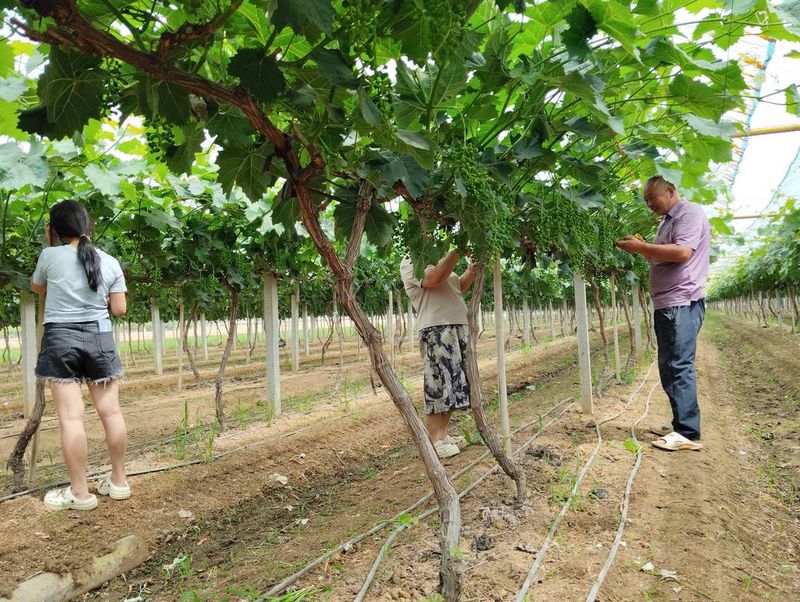
Pre-plantation is preceded by the application of decomposed base fats, which are covered by the soil, which fills with water and water. 1 fertilizer: 1 (the south can apply 50 kg - 100 kg, urea 0. 3 kg, calcium perphosphate 0. 8 kg) to high-quality farmers (which can be applied by the south in late march and by the north in late april). And the base fat shall be pitched with earth, then it shall be covered. Grapes require large amounts of fertilizers, which are applied before leaves fall or buds in winter; first application before flowering; 2) boosting fertilizers: when the bud starts to expand and the temperature stabilizes at 10°c, fattening is followed: 30 cm-40 cm wide in shallow ditches close to the root end by the size of the plant, and the fat soil is buried in a ditch, then watered and covered. 3) in the early stages of the growth of the juvenile fruit, calcium phosphate and grass-wood ash have been duly applied, mainly on nitrogen fertilizer; 4) in the beginning of the colouring of the fruit, in the form of potassium phosphate. (b) control of fatty water: the water should not normally be watered within one week of the flower before the fruit sits firm before it is fertilized to promote fruit growth. The rainy season causes loss of fertility. In light of the loss of fertility of the plots and the size of the grapes, less and less should be done, as appropriate, in the form of “reduced meals”. 6) prophylactic soil, increasing soil permeability: after heavy and heavy rains, the topsoil of the vineyards is bound up, resulting in a lack of oxygen in the root of the grapes, a decrease in resistance and a high risk of disease. It will be tilled deeper before the rainy season. During the rainy season, it is necessary to increase soil permeability by planting in the middle of the rain space. 7) clean-up of bystands to provide ventilation and light: the rainy season, the most vulnerable grapes and the high incidence of bystands. You have to be careful in time and wipe your sidekicks off. You have to remove some of the new strains that you have. 2. Settling: easing the branches that are too dense and stunted as soon as possible after that, leave strong branches so that they can grow large grapes. The graft should take place when four or eight leaves grow above the varnish. After the graft, in addition to the three or four leaves of the top bystand, the rest leaves a leaf by heart. 3. Flower-skinning, fruit-sniffing: the new grapes have skills: the new grapes have to be. Carcinating saves the large amounts of nutrients needed for new growth and promotes the thickness of leaves and the abundance of flowers. This is essential to improve the productivity, production and quality of grapes. The practice is outlined below. Cardiac time. The results are updated, usually three to five days before the flower, and at the latest during the first flower. Varieties that are more severe for falling fruit, such as large peaks and purple roses, can be choreographed 8-10 days before flowers. (a) when the leaf does not reach the required quantity after the first heart removal, it needs to grow to the surface; with a big thumb pole, 15 centimetres of the ground are inserted 15 centimetres away from the root of the seedling, and new steps are tied to it. When you tie it, you have to spread it evenly, you have to tie it to a loose knot, you have to make room for the new ones to grow, and you have to tie it to the other end. During two years of seedlings and the years of seedlings of new saplings of about 60 centimetres, bow-shaped bindings were made. And they shall draw a new stubble, so that the fruit shall be at the top of the stubble, and they shall tie it to the surface in order and at a certain distance. This facilitates ventilation, light and prevents the branches from being blown off by the wind. 5. Speculation: when the raisins appear and the load of the grapes is taken as early as possible. The chickens are kept for a long period of one or two ears, and the branches are kept single, and the weak are not left with fruit. Two and three more fruit ears shall be removed in time。

6. The planting of vine grapes (that year's planting, two years ' visible benefits): 1) the winter is falling behind in all its leaves, and the planting of plants is trimmed, each with about three buds, and the weak, overt branches, long branches and sick branches are trimmed, resulting in the planting of multiple branches; 2) the early spring fertilization at the edge of the grapes, which is dominated by the fertilization of the farmers, which is followed by the fertilization of the soil, which is then covered with water, and once before the soil is dried up. 3) when a few leaves grow, the weak bud shall be wiped out and only sprouts retained. 4) when the chief of the wirtschaftsprüfer is out, he/she must be physically strangled to reduce unnecessary nutritional consumption. 5) tie the branches during the period in order to prevent them from breaking up and affecting the transport of nutrients。
6) the next leaf is to be removed during the precipice period so that the light does not irradiate the fruit and affects the fruit colour. 7) no fertilization, especially nitrogen, before the spring flowering, to control the tree position, keep it in the middle and keep it in the dark。
8) no water, no spray, no squeezing of the bouquets, and generally one fifth and one quarter of all ears. 9) leave 5-7 leaves before the grapes bloom. Caution, with the exception of a sprouts left at the top, is eliminated in order to provide adequate nutrients. Pbos are sprayed twice before and after flowering, which can significantly increase the sitting rate. Upon the end of the physiological fallout, 8-10 leaf blades are left to be fertilized in combination with the three elements of potassium nitrogen phosphorus, i. E. High-yielding, high-quality, high-yielding, large-peak grapes。
Iv. Frozen protection of grapes:

When the root system is at temperatures below 6°c, the root system is subject to varying degrees of freezing; when it is down to 8°c, it is completely frozen. Therefore, the temperature of the root system during hibernation should remain above 6°c below zero. 1. Freezing water in due course. Ten days before winter grapes are buried in cold soil, frozen water should be poured once, in order to prevent freezing and early spring drought. 2. Take care of the site and return the trenches. The anti-cold soil shall be taken between rows outside the main trunk of the grape, and shall not be too close to the root, so that the roots and the freezing roots may not be injured. The freezing of the gutter fills the water with ice, thus reducing the thickness of the frozen soil and contributing to drought preparedness in winter and the following spring. Where irrigation is not available, gutter covers, such as weeds, may also be used to prevent the freezing of grapes。