Form characteristics
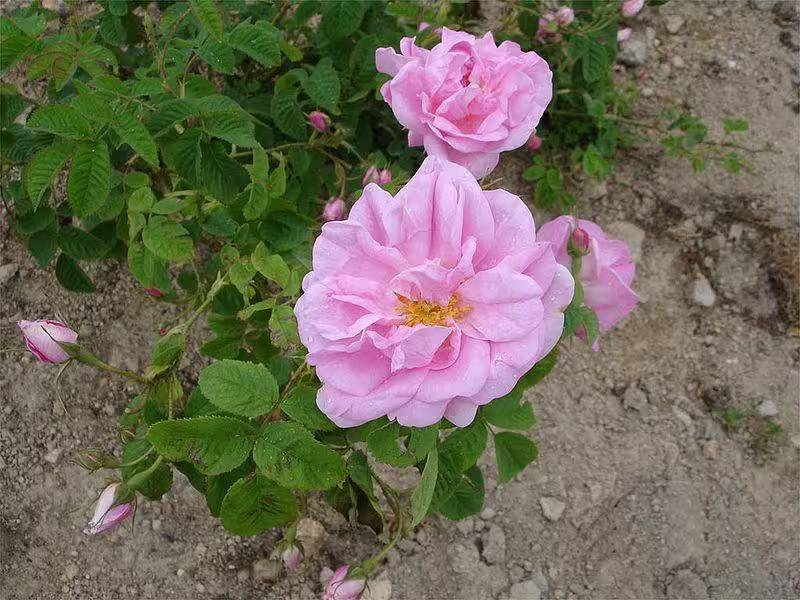
"damascus roses
Shrubs; about 2 metres high; small branches usually have thick hook-like skin pricks, sometimes mixed with stinging hair; small leaves are usually 5 rare 7; small leaves are ovarian, egg-shaped, 2-6 centimetres long, with a sharp frontal tip; the base is near-round, with a single sawn teeth on the edge, no gland, no hair on the top, and is covered with hair on the ground; small leaf handles and axles are scattered, gills and gland hairs; toads are sometimes in the shape of teeth and large parts are attached to the leaves. 6-12 flowers, arranged into umbrella rooms; long flowers, with gland hairs; larvae diameter 3-5 cm; gland hairs, osteoplasmic osteoplasmic pins, with a long and lean end, and gland hairs outside; internal corsets with soft hair; petals with pink; and column separation, with hair. Pear-shaped or pebble-shaped, red, often stingy. Source distribution: small asia, with a long history of cultivation in southern europe, with a high economic value for spices。
This is a reminder: the difference between this species and r. Gallica and r. Centifolia of the french cuisine, the size of which corresponds to the size of their skin, the individual sawn on the side of their leaves, the pear shape, and the bouquets of the bouquets, which consist of 6 to 12 flowers, which form the line of the umbrella, the single or semi-heavy petals, and the cavity of the crolls, which are thick and fragrances, and different from the french cuisine. China botanical log 37:389
Ecological characteristics

Damascus rose
The roses of damascus (rosca damascna), known to europeans as damascus rose 3, first in the area of poscashan (now in kashan, isfahan province, iran), then into syria, and then into europe when the crusades were marched back to europe from the syrian capital, damascus, began to be planted widely in france in the 14th century, with the roses of damascus being the main and world-renowned rose species planted in bulgaria。
Damascus roses consist of falling leaves with bushes, which are thick and sprawled, usually some 150 cm tall. The leaves are grey green, with hard hair on the hairs of the flowers; heavy petals, light colours on the edges of the petals and silky tastes. There are three main types of light pink, pink and white, of which light pink is the best. The flowers are larger than ordinary roses, and the petals are the largest of the species often mentioned alone, the petals of the flat roses, the second of the roses in damascus, the third of the twilight roses and the smallest of the petals of the bitter water roses. Compared to the french chiba roses, the two are similar in shape and are distinguished from the flower root, the small stubble of the rose root in damascus, and the smoothness of the french chiba rose root, while the former are numerous and stiff, while the latter are soft and impervious (the base is small). The fragrance is pure, nuanced and international, with relatively concentrated bouquets, and the sweetest fragrances when flowers are blooming are the best species to extract rose oil and process roses and are widely grown to extract rose oil。
The most suitable daytime temperature for roses in damascus is 18-25°c and at night 10-15°c, with a relative humidity of 70 to 80%. Under appropriate conditions, visible flowers were planted during the year. The flower blooms once a year, after a hibernation period in may of the following year, to grow buds from the old branches, and the relative domestic varieties of roses can bloom seven to eight times a year, almost without the territorial limits of our country, while the french chiba roses bloom once, with no more flowers in the coming year and must grow new branches each year, making their production less productive. My foreign economic and trade commission introduced the bulgarian rose seedlings from bulgaria in 1984 in bulk and tested them in different regions of the country, including guangdong, zhejiang, jiangsu, yunnan and zhuximunang. Due to climatic, hydrological and geological constraints, the roses of damascus, bulgaria, south of qinjiang, were successful and named qinjiang no. 1- damascus roses and, at the same time, our first generation of damascus-specific oil extraction equipment was born in susimi. The qinbe 1-damascus roses promote an area of approximately 2,000 acres and extract oil that meets the international standard of so9842-2003. On the other hand, according to years of experience and technical data, the more suitable area for roses in damascus, bulgaria, is 30-40 degrees north, with a minimum winter temperature of no less than 15°c。
Distribution
International
The rose industry in bulgaria grew more than 300 years ago and, to date, it has produced 3 to 6 tons of rose oil annually, generating tens of millions of dollars in foreign exchange each year, thus making bulgaria known as the world's “roose kingdom”. Bulgaria has further developed a range of rose products, such as roses with flowers, roses with hair (roses with flowers), soap, paste-washing, and facial masks, which have opened up wider markets. The rose industry in bulgaria has become a well-known international tourist project and a major source of agricultural income in the country。
Bulgaria is known as the “country of roses”, while the area rich in bulgarian roses is in the eastern region of kazanlek. Starting in the late 1960s, on the first sunday of june each year, kazanlek holds a rose festival. Unfortunately, this time in bulgaria, in late may, it passed the rose festival, and it was a pity to hear from the locals how the annual rose festival was so popular, how it was dressed and attended, and not seen it。
The rose valley in kazanlek is the most concentrated area in which roses are grown. It must be here to go to bulgaria for a rose. Unlike the roses we normally see, the bulgarian roses are the damascus rose variety, mostly light pink, which is of the best quality, with large flowers, with fresh incense, while the most important use of roses is to extract rose oil. It has long been known that bulgarian rose oil is the main source of high-quality perfume and is said to have been sold on the international market at a price of rmb 300,000 per kilogram, this time in the rose valley, where it has finally seen the ecological state of “liquid gold”. A large area of hilly slopes has been planted with roses that have not yet reached their best season, some of which are already blooming ahead of schedule, some of which are still in the open, and this valley of roses is not all of damascus roses of the same kind, with other types of red roses in the wrong place, looking far too far as a colorful garden。
The area under turkish rose cultivation is also expanding and is expected to replace bulgaria as the world's largest rose-growing country. In addition, the rose industry in morocco, france and other countries is growing rapidly. In terms of plant varieties, bulgaria is dominated by the rosa damascna series, while france and morocco are dominated by the rosa centfolia series。
National
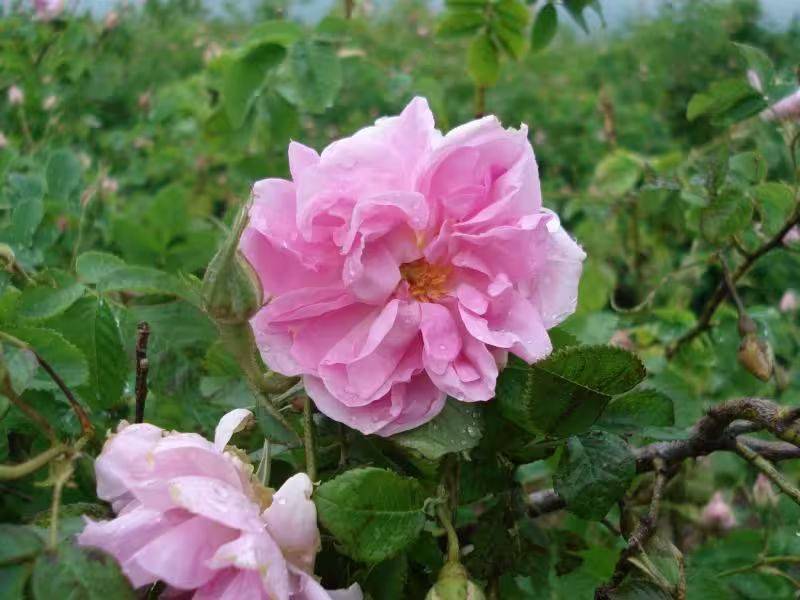
"damascus roses
In june 1981, the ministry of agriculture organized an expedition to bulgaria, led by comrade zhu zhuang, director of the research institute for bitterwater roses, to study the cultivation and breeding techniques of bulgarian oil roses at the institute for roses, spices and pharmaceutical plants in kazanlek, and then to bring back three bulgarian roses in damascus. The country's first rose oil extraction facility, which was born in 1992 in the south of the country, has stabilized after more than 20 years of continuous improvement, with a rate of about 3. 6 per 10,000, and the extraction of rose oil does not require any purification processing and inspection to meet the international standards of iso 9842-2003 for rose oil. It is also known as the birthplace of roses in damascus, china. The rapid breeding and integrated utilization of bulgarian roses by the hebei academy of agro-forestry in 2000 introduced the qinjia 1 damascus rose into the hebei region for seed testing, with notable results. In damascus, china, about 8,000 acres of roses were cultivated, all of which were carefully imported after thorough study of soil samples, water samples, tests, analyses and comparisons. In china, for example, in the following areas: rose valley (8,000 acres), shaanxi nam (5,000 acres), lake zhuang, hunanxi, xianxi han (2000 acres), fujian taning, the banks of the hebei river, henan zhui, zhongdo and qingjiang, which have been tested and successfully planted, the rate of tree planting is over 90 per cent。
Cultivation