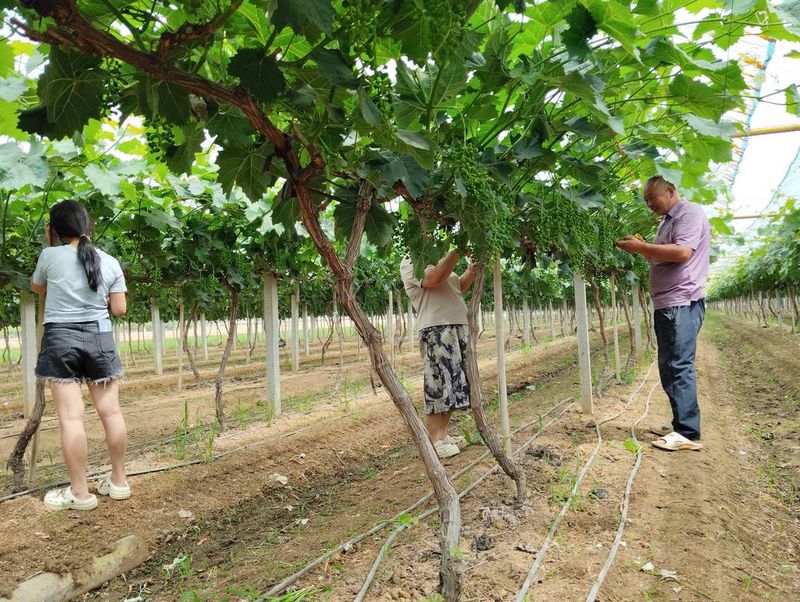
Grapes are grown twice a year to break the hibernation of seasoned branches by promoting new summer or winter sprouts and to produce twice (two seasons/drives) in one year. This cultivation technique can effectively increase the annual production of grapes. At the heart of the two-breeding technique of grapes is the regulation of the nutritional and reproductive growth balance of grapes by cutting, leaf-picking and chemical treatment, breaking the natural hibernation patterns of winter sprouts and promoting their secondary onset. In traditional cultivation, winter sprouts require a natural hibernation between late autumn and early spring, with the next year of flowering. By removing leaves in the summer (disrupting hibernation), combined with the treatment of single melamine (promoting the onset), the onset of winter sprouts can force a second result. This human intervention allows for two growth cycles in the same year. Currently, the technology has been successfully applied in subtropical climate zones, but there are still challenges to its diffusion in temperate areas. This is mainly due to significant differences between climate conditions in temperate areas and subtropical areas, and the possible adverse effects of winter temperatures on secondary grape outcomes. However, solar greenhouse cultivation can effectively address the adverse effects of low temperatures。
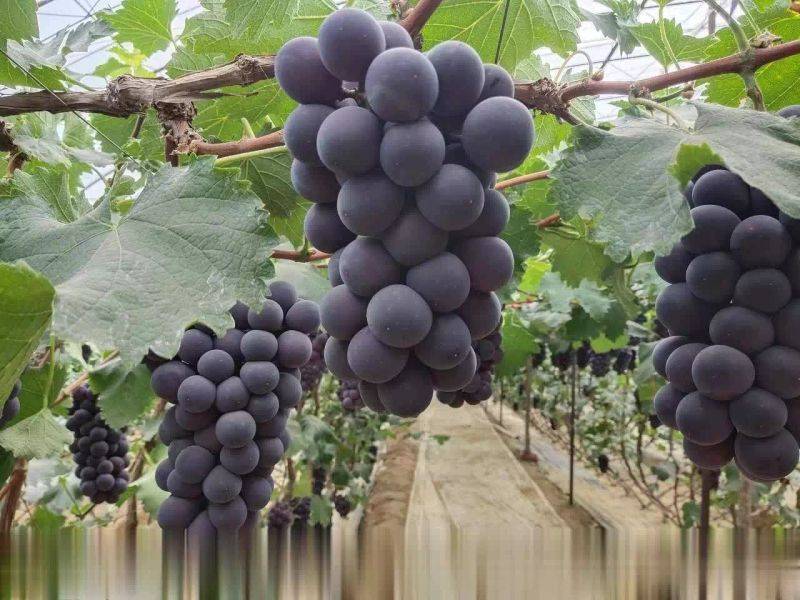
The western corridor (n37° ~40°) is a cold-temperature arid zone with a typical continental climate, with high temperatures, low levels of dry and dry rainfall, abundant light and heat resources, unique advantages for grapes in development facilities and a long history of grape cultivation. In recent years, the team has succeeded in establishing a one-to-two-year cultivation model for grapes through solar greenhouses and multi-plant technology applications, with the establishment of a one-to-two-year cultivation model for solar greenhouses giant grapes in the western corridor of the river. (b) the second gestation (late season) will be used to develop a secondary fruit, which will mature in the autumn by delaying the planting technology, and will mature in the winter, achieve a year-long do-all, staggered peak in the supply of fresh fruit and fill the market gap for fresh food grapes, thereby significantly increasing economic efficiency。
1 basic information on the pilot park
The pilot park is located in the village of the willow village, in the cool district of gansu province. High above sea level, 1485 m, average annual precipitation of 160 mm, evaporation of 1919 mm, annual average temperature of 7. 8°c, january minimum average temperature of 11. 8°c and july maximum average temperature of 24. 0°c. For the whole year, 156d, and absolutely 118d. The front is wheat, soil is damp, soil is thick, soil is perturbed, organic matter is 1. 025% (rich), all nitrogen 0. 068%, all phosphorus 0. 111%, quick effect phosphorus 15. 8 ppm, quick effect potassium 146. 1 ppm, ph 8. 3. The light is sufficient, the temperature varies widely by day and night, with 2900 h of the annual sunlight and 3077°c of ≥10°c. The maximum daily temperature is 40. 8°c and the minimum daily temperature is 32. 0°c。
The vine tree was bred by a green branch of the behda lumber, which was planted in the open for three years, with a range of 2. 5 m x 1. 5 m. The solar greenhouses, north and south, 7° west, 80 m long, 8 m long and 3. 6 m high on the ridge, with earth walls of 0. 9 to 1. 5 m thick on both the back wall and the hill wall, which are mounted with steel and cement, with a distance of 1. 8 m. Irrigated water sources are wells. The shelter is made up of steel bands, covered by pvc long life without a drip membrane, and temperature-preserving material consisting of cotton curtains。
2. Accompanying techniques
2. 1 planting
Plantation uses a north-south direction and digs a 1 m-wide and 0. 8 m-deep defined ditch. The bottom of the ditch is covered with foliage and organic fertilizers of 30 kg/stamps. The soil is mixed with farm fat, suitable phosphorus fat, and then filled in the bottom of the ditch, while the heart soil is filled in the upper layer of the cleavage. Early spring planting should be done as early as possible if it is to produce a good main tree structure at the time of planting. Pre-plant cutting of tree roots and immersing of trees in root powder 4-6h. When planted, the tree is vertically placed into a fixed den, so that the roots are spread evenly around them, filling the earth with seedlings, pedals and water. The matrimony interface is exposed to the ground and a full bud is kept to dry。
2. 2 form
Upon planting, it is set up using a low-plant “v” font screen, extending northward, with the first barbed wire 50 cm from the ground, resulting in the mother branch being spread in a very close range on the main chicken, with a length of 1 to 1. 5 m and a flat distribution on both sides of the new handle, with the v font tied to the second line of wire (60 to 80 cm from the first line of wire), with a new range of 15 to 20 cm, with a new length of 100 to 120 cm and 20 to 30 fliers per lobe and an angle of 120 to 140°。
2. 3 current-year planting management
The main selection requires that one of the most robust new plots be kept in each of the single main chicken shapes, that the main top is fixed vertically and in a timely manner with the chicken belt, and that mechanical damage resulting from shaking during growth be avoided. Subsoils within the 50cm base of the main chicken are reserved for two to three functional leaves, and subsoils above 50 cm are unified to take a one-leaf-and-circle to the heart, all of which should be completed before wood is fertilized in order to save tree nutrients. When the main chicken rises on the shelf, the stalks are drawn to the second wire on both sides in time for the graft treatment of four to six leaves. Ensuring that the second stage of the chicken is fully mature by the end of the winter season (approx. 0. 8 - 1. 2 cm thick) and that two to three robust eyes are preserved as the result of the parent branch。
After planting, the new plant grew to 30 to 50 cm, with a drip irrigation system providing water, and a water soluble compound fertilizer per 14d drop-down (n-p2o5-k2o=2020202020) 5kg 667 m-2 and a urea solution of 1 0. 2% per 70d leaf sprayed to promote robust growth of the tree. When the tree is essentially shaped, the leaf is sprayed with 0. 2% ~ 0. 3% potassium phosphate plus 0. 1% ~ 0. 2% ~ ~ ~ ~ ~ 1 ~ 7d ~ 3 - 4 consecutive ~ ~ ~ 3 - 4 ~ to enhance the tree position and promote tectonic fragmentation。
2. 4 adult tree management
2. 1 integrative shearing
The combination of long- to medium-term shears is used, and the branches are mainly updated by two branches, keeping their parts intact. Each 20cm on the parent branch of the result leaves a branch of the result to erase the rest of the bud. A preparatory branch is left at the bottom of the female branch to erase the vasectomy as the result of the next year. The sidekicks on the preparatory branch left two leaves to be taken repeatedly. As a result, there was no stubble on the lower side of the branch, and a lobe on the upper side of the stubble left a lobe to the heart. The head of the goe-ho is on his six leaves. One month after a harvest, the chords of the outcome line 4 are taken from the heart and cut off the stalks that were left before, promoting the emergence of the winter buds, forming a double chord of the outcome, with a sequence of each. The second time, the lower part of the ear of the fruit leaves no shadow, the upper part leaves a leaf to the heart, and the new one grows into six leaves repeatedly. Cut the swabs anytime. A month after the second harvest, the winter trimmed, the mother branch was cut off and a 1. 5 m short branch was prepared。
2. 2 flower fruit management
Vegetable fruit management is an important link in ensuring that grapes grow efficiently and productively twice a year. In the area of the western corridor, it is common to leave one ounce of fruit in each branch, and to leave one ounce in each branch, with one ounce in the middle branch and one ounce in the weaker part. A series of tectonic and deformative fruit, large acreages of the base of the fruit, as well as condensed grains that grow internally, upwardly and downwardly, each string of tectonic tectonics requires 60 to 80 at the tip of the ear by the weight of a single ear, with a laxity and a cylindrical shape. Upon the completion of the berries, the luminous bag is selected in time for the luminous bag, and the bag is removed or opened in due course so that the fruit is better coloured。
2. 3 temperature management
(b) the suitable temperature for the flowering period is 20-25°c and the temperature for the night is 8-10°c; in late july - early november, the fruits matured, the temperature as a whole showed a tendency to rise and fall, with suitable temperatures at 22-25°c during the gestation period and 15-18°c at night; (b) the flowering period is 60 to 70 per cent。
2. 4. Fertilizer water management
(b) 5kg 667 m-2 for urea before flowering (15-15) 10kg 667 m-2 for water urea (1); potassium sulphate 5kg 667 m-2 and water soluble fertilizer (15-15) 10kg 667 m-2 during the chromosomal period, with 1 0. 2% of potassium phosphate per 14d leaf spray. (b) the management of the double fruit is the same as that of the single fruit. The dry and evaporated area of the western corridor requires special attention to the temperature and frequency of irrigation water to avoid the planting of aging or falling fruit due to low temperatures or inappropriate irrigation. Irrigated water needs to be placed in a sink or cellar in a sun-temperature room for a period of time, to be used when water temperature increases and stabilizes, in order to reduce cold stress on plantations. The soil moisture level is stabilized using a small number of multiple irrigation principles. Such finely managed management serves both the nutritional needs of grapes and the effective prevention of physical handicaps and ensures the high quality of the two fruits。
2. 5 pest management
Episode cultivation results twice a year by breaking the natural pattern of winter sprouts, with high-intensity cultivation prone to infestation and pests requiring an integrated treatment system. In the area of agricultural prevention and control, healthy trees are selected, rationally planted to ensure ventilation and the timely removal of the sick and the disabled to reduce the source. Physical control, ground-covered inhibition of weeds and endemic diseases. Biological control, introducing the control of natural insects and applied microbiological agents (e. G. Bt, mucus)。
2 upon the end of the harvest, each of them is to be treated in a garden, with a view to the timely removal of the infirmities such as leaves and branches from the garden, the reduction of the winter base of the insects, and the application of an average of 3° ~ 5° bé thiophthalmite one time throughout the garden, and the eradication of pathogens and eggs. Insects are isolated by an anti-worm network, with coloured pests, such as blue, yellow-coloured viscos cedars and insecticidal lamps, hanging between rows (1. 6 m above ground). Prior to the onset, priority was given to the prevention of froste, ashilosis and sarcophagus, using 50% of the aqueous aqueous dispersants 2000 - 3,000 times the fluid, 50% of the agglomerable powder 4,000 times the fluid, 4. 5% of the high-efficiency chlorocypermethrin emulsifier 1,000 times the continuous application of 2 - 3 times at intervals 7 - 10d。
3 grapes production techniques for two harvests a year
3. 1 management of hibernation
A pickle hibernation was regulated in november-december. The hibernation uses the method of cooling the greenhouse cotton when it is dropped. The minimum temperature of the shed is above 1°c and the intermediate temperature of the shed is guaranteed at 2-3°c. When the temperature drops to 2°c, the temperature of the draught is increased by draught and the temperature of 3-4 d is maintained once。
After the harvest of the first fruit, the second fruit removes the residual fruit and the dead and sick leaves in a timely manner, restores the tree size of 20-30d, sprays the leaves 600-700 times liquid ethylene, promotes the return of the leaves, and after the leaves are fertilized, they are trimmed at 2-3 buds in the current year. The temperature is maintained at 40°c at approximately 4h and the control temperature at 30°c. During this period, one microbicide was sprayed and the soil was applied to base fertilizers to ensure the quality and yield of the secondary fruit。
3. 2. Contortmental breakdown
At the end of december — the beginning of january of the second year of the year — the temperature was to rise gradually, and the temperature was to be controlled by the application of a flower curtain. It is divided into three phases, phase 1 at 15°c, time 5d; phase 2 at 20°c, time 5d; and phase 3 at 25°c, amounting to approximately 15d. The maximum temperature of control does not exceed 25°c after heating, and about 30 d of plume grapes can germinate and then bloom 15-20 d。
Table 1 top grapes, two harvest periods a year
After hibernation from 30 to 45d, 25 times 50% melamine detachants are applied to the winter sprouts, which immediately heat up to break the hibernation and promote the onset of winter sprouts, and care is taken to keep the soil humid before and after laminated with melamine. If new, long-lived solar greenhouses are too hot to cover the sunnets, they avoid sprouts, lower the temperature of the greenhouses and contribute to the growth and development of the top grape sequences. (c) strengthening of sequence management, other management and consistency。
4 economic benefits
The size of the grapes, which follow the model, is 950 kg 667 m-2, while the yield of the fruit is also 750 kg 667 m-2, with total annual production reaching 1700 kg 667 m-2, much higher than the single-season production under the traditional cultivation model. This increase in production translates directly into economic returns for farmers, with the first fruit maturing in late may, about 80 d ahead of the previous year's peak grapes in the field, with the sale of the fruit at a price of $15. Kg-1 and the second fruit at a price of $6. Kg-1, with annual returns of $35,700, a significant increase compared to single-season cultivation. In summary, the science-based control of the development cycle of grapes through the two-correstrial cultivation technology in the solar greenhouses has resulted in a significant increase in the efficient use and economic efficiency of the facilities. On the basis of summer ripening, the combined application of advanced technologies, such as hibernation and hibernation, through the use of adequate summer and autumn light and high-temperature weather features, has enabled the full exploitation of the climate resources of the western corridor, resulting in annual and biennial harvests, filling market gaps and increasing economic returns。