Sound-free air presses and related technical knowledge
Category of air compressors
The air machine is divided into one, speed; two, volume; volume is divided into reverse and back-to-back; rotary: (1) rotor; (2) screw; and (3) slide. Repeat: (1) piston; (2) membrane。
Air compressors can be divided into speed and volume by operation category
Speed pattern: larger kinetic energy is derived from the use of gases in high-speed rotating leaf wheels, followed by a sharp reduction in the speed of pressure-extension devices, which transforms the kinetic energy of gases into a dynamic energy, thereby increasing the gas pressure. The speed pattern consists mainly of two basic patterns of centrifugal and axle flow。
Volume: the purpose of increasing gas pressure is achieved by reducing the volume of gas by directly compressing the gas, and the characteristics of the volume piston measured from the cylinder are divided into reverse and double. The majority of air presses in oxygen chamber formulation are volume-based。
Turnback: pistols rotate, which are also referred to as retrenchments, with varying number of rotors and different cylinder shapes. Turnbacks include rotors, screws, slides, etc。
Repeat: pistols re-move, cylinders in cylinder form. The multiplicity consists of both piston and membrane, of which the piston type is a wide-ranging type of application. The vast majority of the oxygen chamber uses air presses as pistons. The classification, model expression methods, structural characteristics and working principles of the piston presses are described below:
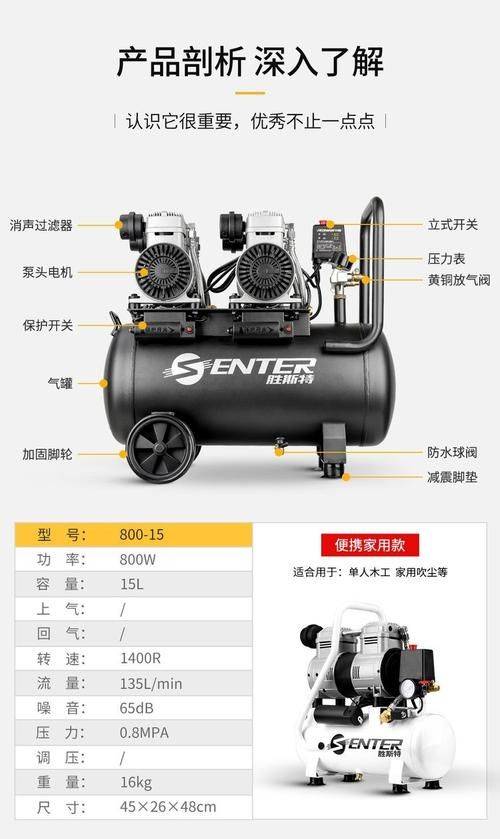
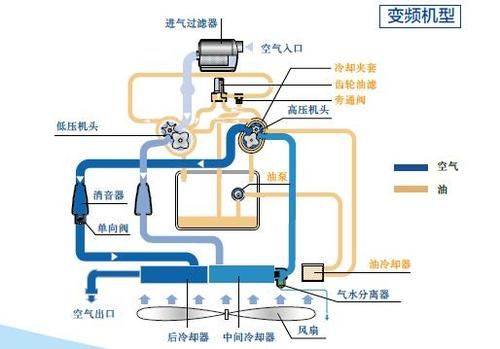
The soundless air press is a micro-repeated piston compressor, which works on the basis that when a single-axis-driven compressor rotor is rotated, it moves through the transfer of poles, and the pistons with their own lubricants without adding any lubricant are re-mobilized, with a cyclical change in the volume of work consisting of the inner walls of the cylinder, the gas tank cap and the top of the piston. When the piston compressor's piston starts to move from the air cover, the volume of work in the cylinder increases gradually, when the gas follows the inlet tube, pushes the valve and enters the gas cylinder until the work volume becomes z* large, and the vent closes; when the piston's piston moves backwards, the capacity of work in the cylinder is reduced, the pressure of the gas rises, when the pressure of the cylinder reaches and is slightly higher than the exhaust pressure, the exhaust valve opens, the gas is discharged until the piston moves to the maximum position, and the exhaust valve closes. This process is repeated when the piston of the piston compressor is re-activated. That is, the piston compressor rotor is rotated for one week, the piston goes back and again, and the gas tank is followed by the process of infusion, compression and venting, i. E. The completion of a work cycle. The structure of a single-axis double-barrel is designed to allow compressor gas flow to be twice as high as that of a single-barrel at a given nominal rate and to be well controlled for vibration noise control。
Pistol air presses are generally classified as vent pressure, vent volume (volume flow), structural shape and structural characteristics。
1. Disaggregated by exhaust pressure:
Low-pressure air presses, exhaust pressure 1. 0 mpa
Pressure pressurer 1. 0 mpa < exhaust pressure 10 mpa
10mpa< exhaust pressure 100 mpa
2. Relay gas sizes are divided into:
Small air presses 1 m3/min< exhaust <10 m3/min
Air presses, medium, 10 m3/min < exhaust < 100 m3/min
Large air presses, exhaust >100m3/min
Emissions from air presses refer to the flow of free gases in an inhalation state。
General provisions: axis power <15kw, exhaust pressure ≤1. 4mpa is a mini-air press。
3. By the relative position of the centre line of the cylinder to the ground:
(c) a standing air press - the centre line of the cylinder is vertically placed with the ground。
Angular air presses - the centre line of the cylinder is an angle to the ground (v, w, l, etc.)。
(c) a pv - the centre line of the cylinder parallels the ground and the cylinder is placed on the side of the warp axis。
The main line of the activated equilibrium air press - the cylinder is parallel to the ground and the cylinder is symmetrically placed on both sides of the curve axis。
By structural characteristics:
Single function - gases are compressed only on the side of the piston。
Double action - gases are compressed on both sides of the piston。
Water cooling - the pyrotechnic with a cooling kit and water cooling。
Wind-cooled - the outer surface of the cylinders is distilled and air cools。
Fixed - air pressure units are fixed to the ground。
Mobile - air pressure units are placed on mobile devices to facilitate movement。
Oil lubrication - oil lubrication in gas cylinders, motor lubrication cycle。
Unoiled lubrication - no oil lubrication, pistons and cylinders in the pyrotechnics are dry, but the transmission structures are recycled with lubricant。
No oil lubrication at all — no oil lubrication at all。
It is also divided into crosses (small and medium-sized oil-free air presses), no crosses (v, w-type low-pressure mini-air presses); and single-level, two- or multiple-stage compression。
Iii. Student statistics obligation electronic data
Main formula:
Volume ratio energy: energy consumed in a unit-capacitation backlog, the value of which is calculated according to the following formula: q= n / q (capacity ratio = power/ exhaust)
Volume efficiency (absorption factor), formula: η = q / (vnxne) i. E. Volume efficiency = voltage/ (electricity operated for one week, volume swept by pole x rate of transmission)
For example: data for a product are as follows:
The cylinder diameter of an empty press is 69mm. Cartridge process: 22mm. Speed 1400
Volume: (0. 069/2) 2 ∏0. 022x2x2x1,400≈230 litres
Power: 1. 2 kw
Iv. What do you mean by a laboratory air press
Episode temperature: the temperature is the mean temperature when the water is saturated by cooling. Episode temperatures can also be used to indicate the amount of water content, and the higher the temperature, the higher the air content。
For example, the marking of dryers:
Point-40°c
Air cleanness (particle): ≤ 0. 05 m
Air dryness (water content) ≤0. 05 ppm
Motion of work:
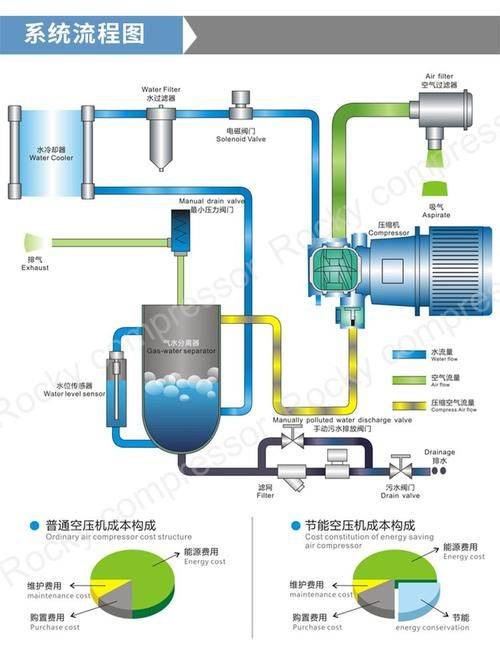
The surrounding air was compressed to 8bar/120 psi. In this compression, the air is hot. In order to condensate as much water vapour as possible before entering the dryer, compressed air will be used through a radiator device to reduce the temperature of the compressed air to close to the ambient temperature. The solid particles contained in the air entering the 0. 01 microscale pre-filter are then integrated with the liquid (water) inside the filter. After removing impurities and watery liquids from the air, the air is imported into the dryer. The dryer consists of a double absorbent column filled with active bauxite. Within two minutes of air entry, compressed air flows up. The water remaining in the air is adsorbed through the dry layer of one of the absorbent pillars. At the same time, a small fraction of the dry air flows down and is discharged through another absorbing column. During this process, the air releases moisture and regenerates the dry agent. The air is dried and then passed through another 0. 01 micrometre class filter, with internal residues that can be brought into the system by air. (the small particles of z* that can be seen in the human eye are about 50 micrometres. After z*, fully dry and clean air flows into the inner-protective air receiver, which is available for storage。
The dryer drains the water before the compressed gas enters the tank, ensuring that the condensed gas is exposed at -40°c. Microbes do not breed at pressure and at point -23oc, while at point -30oc, they do not pose the risk of rust in tanks. Dryers/filter combinations meet eu (medicine) requirements for breathing air and other international standards for compressed air quality. The air is cleaner and fresher。