I. Establishment of the observatory:
1. The equipment sections of each unit shall establish an equipment control unit to clarify the division of duties and responsibilities, establish a check-in route, identify the regional head of inspection, enforce air charter liability and introduce a review mechanism. According to the actual plant, the equipment section has one or two full-time or part-time inspectors to perform its duties:
(1) participate in the development, revision and development of standards for equipment check-ups and related technical standards, and in the development of periodic check-ups。
(ii) preparation and revision of the site review plan and the site review work plan。
(3) conduct of spot-checking operations, which are carried out on a regular and careful basis on a point-checking route for equipment performing professional check-ups; operational guidance for daily spot-checking of workers, supervision, inspection, appraisal, confirmation of post-checking and maintenance of inspection records。
(4) collect information on spot checks, and the equipment has problems in identifying timely measures to deal with them, issuing interim maintenance plans and enforcing them。
(5) preparation of plans for inspections and maintenance of spare parts, materials。
(6) participate in equipment failure analysis and provide advice on repair and prevention。
(7) recording of inspections, receiving and inspection projects。
(8) operation of equipment and control of desk accounts。
(9) conduct, in conjunction with the persons concerned, summary and precise diagnostics of the equipment in the field。
(10) continuous learning of work experience, deepening of work done, organization of basic work, timely identification and resolution of problems in the implementation process。
Day-to-day inspection of equipment is the responsibility of the producer and the job operator (charterer) who performs the duties:
(1) to carry out the maintenance procedures for the operation of the equipment and to operate and maintain the equipment of the post。
(2) basic elements of day-to-day check-up of working equipment: inspection, maintenance, adjustment, cleaning, oil, drainage, etc。
(3) during working hours, careful and item-by-item checks are carried out and recorded in accordance with the standards and content of daily check-ups。
(4) when the physical condition of the parts of the equipment is found to exceed standard values or anomalies, records are kept, and those that are dealt with on an urgent basis are processed in a timely manner, and those that cannot be processed are notified in a timely manner to the squad leader (the main charterer), to the chief of staff, to the dedicated point examiner, to the maintenance staff, to the plant, to the extent that the serious problems are reported。
(5) when a shift is carried out, the on-site inspection shall be clearly communicated. (c) carefully accept the identification, examination and examination of the point-inspection by the professional point-inspectors and carefully inform the point-inspectors of the condition of the equipment。
3. Daily inspection duties of the chief of operations, chief and chief of production equipment:
(1) carefully perform routine spot-checking, monitor the performance of the job-points of this group, this sector, collect timely spot-checking information, propose plans for overhauling (including spare parts, materials) and report to the full-time point inspector or the deputy director of equipment. Contact the equipment and organize the inspection and acceptance. In the event of anomalies or deficiencies in equipment, which cannot be resolved for the time being, operational measures should be taken to remedy them and ensure their safe operation。
(2) inspection, testing and technical guidance of the daily spot-checking of personnel in this class and section, timely summary of spot-checking and maintenance of equipment, and completion of required records。
4. Daily inspection duties of maintenance staff:
(1) carefully conduct and record equipment inspections in accordance with the prescribed points, cycles and projects。
(2) when an anomaly in the equipment is detected or known, an attempt shall be made to exclude it on the basis of the reasons identified. Where this is not possible, it should be reported to the superior. Carefully keep a record of the condition of the equipment and its handling。
(3) when handing over shifts, the situation shall be clear. In particular, there are projects involving spot-checking and critical surveillance equipment, which have been set up by specialized point inspectors。
(4) in accordance with the principle of maintaining the production of services and in accordance with the day-to-day schedule of repairs and renovations proposed by the site inspection, temporary repairs are actively carried out。
5. Responsibilities of the director, deputy director of equipment:
The plant director created the conditions for and vigorously implemented the site overhaul system, which was organized by the deputy plant director。
Ii. Basis of implementation:
1. Progressively develop appropriate technical, management and work standards, and improve the logs and lubrication log forms
Technical standards: some standards for inspection, oil standards, standards for maintenance operations and related sector-specific standards。
Management standards: some oversight team accountability, checking work lines, checking business time allocation and business processes。
Standards of work: standards of work for spot-checkers, various point-check cycle management tables, introduction of equipment deterioration preference management tables。
Checking forms: the original records of the spot-checking of equipment usually include the following items: a point-checking project, 2 points of the prosecution act, 3 benchmarks and 4 points of the inspection cycle, 5 points of the record of the performance of 6 irregularities。
The day-to-day check-up logs for each position, the log-sheets for the operations of the spot-checkers, as well as the log-sheets summarizing the various levels of check-ups, inspection notices, inspection quality receipt and inspection forms and plans are determined by the sub-units, and the department of equipment management is responsible for reviewing and inspecting them。
(c) to clarify the requirements of the field of responsibility and the site inspection project, establish a security route for site inspection, for critical equipment in production, for critical equipment in production, for which problems have affected production and quality throughout the company, for repair of difficult, expensive and expensive equipment and for major equipment in production, for priority management of major equipment in local production where problems have occurred, for the establishment of a site inspection cycle and a point-checking schedule (including a long-term, day-to-day schedule), for the registration and construction of equipment subject to spot inspection, and for the review of the implementation rate。
3. The coordinating department cooperates in the management of the operation of the equipment by strictly following the requirements of the specifications and safety protocols. Operators must be able to “twice up”, i. E. Understand structures, understand principles, understand performance, understand uses and operate, maintain maintenance, and remove general malfunctions。
The correct selection of mechanical equipment for lubrication shall be strictly in accordance with the variety, quantity, lubrication point, periodicity or replacement specified in the instructions. The “five deciding” system for lubrication (“five deciding”), i. E., the setting, fixing, timing, quality and quantity) is designed to complement the safe operation of the equipment, and the good or bad operation of the equipment directly affects the normal operation of the equipment; for lubrication management, the machinery must be maintained at the required intervals so that it remains in good condition; the designated personnel are responsible for specifying the hours of operation, increasing the utilization of the equipment, paying attention to the level of technology and proficiency, providing for appropriate maintenance staff, eliminating malfunctions in a timely manner and enhancing the effectiveness of equipment use。
4. Analysis of the records:
(1) the duty maintenance officer (maintenance point inspector) shall consult the operator's operating point records on a daily basis and review the recording of the anomaly. Discrepancies and failure points are processed and recorded after the completion of the maintenance point check. The anomaly and failure points that cannot be handled by this class should be reported to the full-time point inspector at the workshop in a timely manner。
(2) the day-to-day review of the logs by the full-time point inspector, the receipt of reports from the operator and the on-duty maintenance worker, the review of the abnormality of the point-of-maintenance inspector's feedback, and the submission of recommendations for processing, are recorded and reported together with the point-of-inspection report by the point-of-service inspector。
(3) every month, routine spot checks should be collected for a comprehensive analysis to identify patterns of occurrence and development of anomalies and failure points and to study and develop policy responses。
(4) the department of equipment carries out monthly spot checks of routine check records, spot checks of the spot records of the specialized point inspectors and spot checks to review and record the anomalies and handling of the specialized point inspectors and equipment。
(5) an overhaul is an integrated programme based on a point-checking and record analysis, based on production requirements and equipment needs。
Iii. Establishment of a specialized system of review:
Based on the analysis of the site records and tracking of the use of spare parts for spare parts, a schedule of inspections is prepared and a system of specialized inspections is implemented. Equipment rehabilitation programmes can generally be divided into annual, quarterly and monthly plans, major equipment major, medium, minor and high, sophisticated, sophisticated, special equipment overhaul programmes, etc。
1. The annual plan provides, in general, for the number, type and timing of planned maintenance of equipment, while specific maintenance projects, maintenance management workloads, the number of spare parts types to be replaced and maintenance breaks are detailed in quarterly and monthly maintenance plans. The main basis for determining the annual maintenance plan is the actual operating platform and technical condition of the equipment. Based on routine check-ups, inspection maintenance records, failure analysis, spare parts usage tracking and annual production plans, and pre-established schedule of overhauls, the annual maintenance plan is submitted by the plant equipment section, which is subject to the approval of the department of equipment and the approval of the deputy director-general。
2 the quarterly maintenance plan is the implementation plan for the annual maintenance plan, specifying the content of the maintenance, the maintenance workload and the planned duration of the maintenance, based on the technical state and working conditions of the equipment, taking into account the needs and possibilities of the production operation during the quarter。
The monthly repair plan is a specific operational plan. Based on the completion of last month's maintenance tasks and the implementation of pre-maintenance preparations, as well as the actual start-up of the equipment, the extent of wear and tear of spare parts, etc., in conjunction with the current month's production tasks, specify the target population for the month and its maintenance projects, maintenance dates, maintenance schedule and number of maintenance staff。
4. Preparation of maintenance plans, bearing in mind the balance between maintenance plans and production plans, between maintenance tasks and maintenance capacity, between seasons and seasons, months and months, giving priority to priority and critical equipment, which has a significant impact on production, quality, cost, delivery period, safety and labour moods, and taking into full account constraints such as the workload of production technology preparation, progress and energy supply。
Iv. Launch and preparation of the revision plan
After approval and approval of the maintenance plan, the general movement control department issues it to the workshops for implementation. In organizing implementation plans, technical and material preparations are made。
Technical preparation prior to maintenance, such as preparation of maintenance technical programmes and process protocols, design of maintenance process equipment, preparation of maintenance work programmes, preparation of homemade replacement drawings and preparation of relevant technical information。
2. Physical preparation, such as the manufacture of the necessary craft equipment and accessories, the preparation of equipment, materials and tools to be replaced, the organization of external purchases of accessories, the supply of tools, etc。
3. In the course of implementation, the implementation of the plan is subject to inspection, statistical analysis and coordination of the various factors affecting it in order to ensure the effective and safe implementation of the maintenance plan, as well as to ensure the effectiveness of the maintenance, and further quality assurance and inspection。
4. Daily planned repairs, which do not need to be carried out under the conditions of shutdown of the main line of operation, will be carried out by the plants themselves in preparation of a programme of overhauls based on equipment spot checks。
The main operating line equipment is the equipment whose shutdown has an impact on the completion of the entire company (or branch plant) production plan. General operating line equipment means equipment that, after its shutdown, does not affect the planned completion。
V. Requirements for implementation of the revision plan:
1. The implementation of the renovation plan is to be combined with technical adaptation, using the renovation arrangements for small-scale renovation projects, the annual renovation arrangements for larger-scale renovation projects, the major renovation projects for major and medium-sized repairs and the continuous upgrading of the technical capacity and equipment levels of the equipment。
2. Revisions are to be included in the company's monthly production plan, and annual and mid-term repairs are to be included in the company's annual and quarterly production plans, under the unified management of the company's equipment department。
3. Major operating line equipment schedule
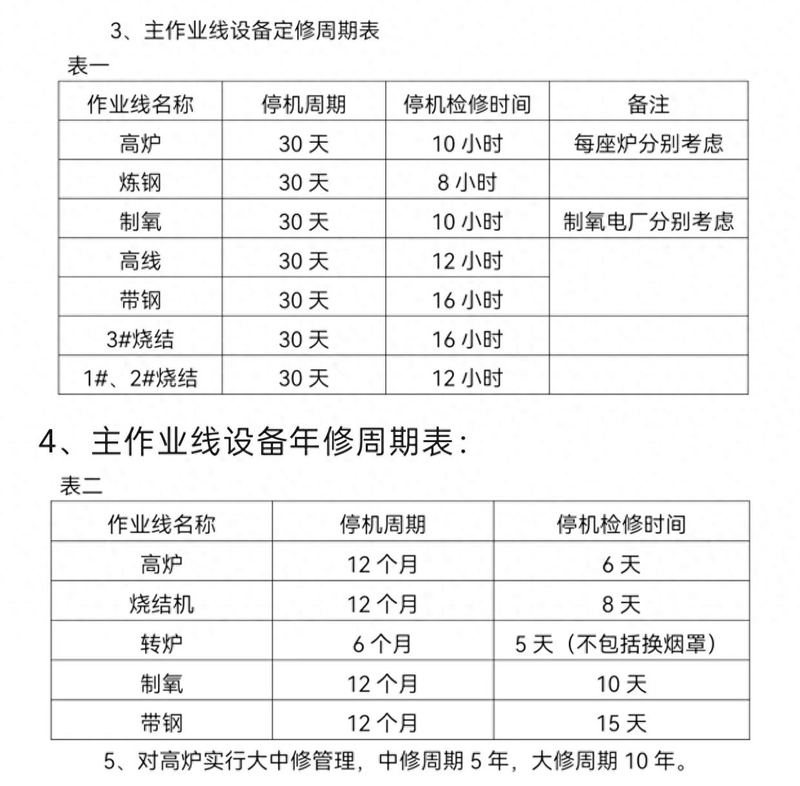
Five years of medium-sized maintenance of furnaces and 10 years of major maintenance。
6 based on information from equipment points of view, requirements for repairs and minor improvement preparation plans (including safety measures) to be reviewed by the sub-units and reviewed by the department of equipment for general balancing arrangements. Day-care projects are generally not included in the revision plan, nor in the annual programme。
7. A plan for next month's overhaul is submitted by 25 per month and is submitted to the department of equipment for review, while spare parts and materials are prepared for each sub-plant. Following a review by the department of equipment, the inspection time is determined in accordance with the requirements of the production process and the technical state of the equipment, and the time of implementation is scheduled for the general office。
8. Convening of planned review meetings to determine inspection matters:
1 time belt for overhaul (validation)。
2 project, liaison, responsible person, contact person。
3 security matters such as power outages, security contacts, and registration and overhaul。
4 logistical support, cranes。
5 gas facility overhaul, fire in fire-free areas such as gas, oxygen, safety precautions, safety duty bearers。
Vi. Implementation of the amendments:
1. Once the content of the review has been determined, the unit is to be carefully organized, and some project examiners are to intervene in advance, fully prepared for the pre-repair period (including security advance activity and pre-repair security confirmation) and generally arrive at the site 30 minutes before the beginning of the overhaul and prepare for the overhaul。
2 inter-factor coordination is the responsibility of the general control office, which is organized by the department of equipment management and requires timely reporting coordinated by the responsible manager。
3. The inspection and acceptance of vehicles after completion of work is generally carried out by the workers in the post, the workers in the production operation and the team leaders, the section chiefs and the inspectors, and is confirmed by the organization of full-time or part-time site inspectors; the major equipment is organized by the deputy director of plant equipment, and the critical equipment is processed and accepted by the department of equipment management and the general control office. The receipt and inspection of major equipment and critical equipment is subject to the completion of a planned overhaul tracking form, and the signature confirmation of the deputy plant owner of the equipment and the person involved in the inspection and inspection is filed with the department of equipment management。
4. Convene a retreat to review the organizational, command, progress, quality and security aspects of the revision, exchange views, identify achievements, identify gaps and improve performance。
Vii. A review of the system:
1. The department of equipment is responsible for inspecting and evaluating equipment。
2. The overhaul plan did not submit 100 yuan/time on time. 100 yuan/minus for savage work not performed as required。
Once the inspections have been completed, the responsible units will be evaluated for 100 yuan each, without organizing their acceptance and inspection。
Late or unjustified attendance at the pre-compulsory examinations of 50 and 100 yuan, respectively。
5. In cases where the fia participates in the overhaul project, an equipment accident occurs within 24 hours and the fia is responsible for conducting the appraisal under the “equipment accident management scheme”。
6 one hour (less than one hour based on one hour) for the performance of the review of the liability unit of $100 was postponed during the course of the work。
7. If the task is completed in advance during the overhaul, the responsible unit is rewarded with $100 one hour in advance (less than one hour)。
If the individual overhaul project is delayed but does not result in the restoration of the overall overhaul, an assessment of $50-100 is made as appropriate。
Equipment damaged during the course of repairs was evaluated at 10 per cent of the value of the equipment and less than $200 per item。
10. The complex overhaul project is well organized and provides favourable conditions for the successful completion of the overall overhaul, or for the outstanding performance of the overhaul, which is confirmed by the director-general and the director-general, and is reviewed by the ministry of equipment, with the approval of the company's leadership。
The department of equipment is responsible for drafting the amendments and the department of equipment for explaining them。