In recent days, the ai-industrial integration standards group standard was officially launched at the china eco-partners congress of 2026, and several industry experts, including the vice-president of china communications, zhang jianjun, the deputy general manager of beijing xing yun mathematics, the secretary-general of zhou zhou zhongfeng, the secretary-general of zhou zhong fung, the secretary-general of the digital intelligence professional committee of china mining group limited, zhou bodong, the deputy secretary-general of the institute of information for the mechanical industries, and the under-secretary-general of the national council for construction strategies of power-building, zhang xiaohonghong, professor of science and technology university of taiwon, and the vice-president and executive director of the chinese industrial press, zhou zhi zhi zhi zhi zhi, have jointly launched the launch ceremony。
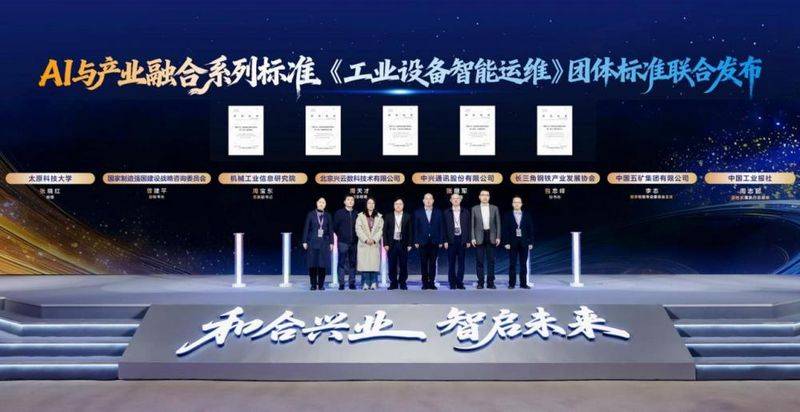
The heavy industry sector is currently in a critical window of intellectualization, and the smartness of equipment has been upgraded from “optional” to a “necessary course” for efficient and safe production by enterprises to achieve efficiency gains and build core competitiveness in the ai era, and more so to the key enablers of new quality productivity landings in heavy industry. In this context, under the leadership of the long triangle steel industry development association, the university of science and technology of taiwon, the china five minerals group, the nanjing iron and steel industry, china metal and metals sidi, and scientific research institutes, have developed, through in-depth research and repeated validation, the collective standards for the development of the smart transport of industrial equipment。
The standard is based in depth on the real scene of industrial production, the management of focused equipment throughout its life cycle, the construction of a whole-process regulatory system from foundation to application, from technology to platform, and the development of a set of “landable, implementable and replicable” implementation guidelines:
• corporate standard norms: define the basic terms, core principles, general structure and basic norms of the industry's intelligent conduct, and harmonize the direction of industry awareness and construction。
Data acquisition and processing: regularize equipment operating data, process data, environmental data collection standards, transmission protocols, storage formats and governance requirements, solid data base。
• status monitoring and trouble diagnosis: development of technical indicators and determination methods for online monitoring of critical equipment, anomaly identification, trouble-positioning, machine analysis, from “ex post maintenance” to “pre-emptive warning”。
Predictive maintenance: development of equipment poor trend predictions based on ai algorithms, large data analysis, equipment life-assessment models and maintenance strategy guidelines to promote the upgrading of transport models to intelligence and precision。
Smart transport platform building: clear functional modules, technical architecture, integration standards, safety requirements and implementation pathways for an integrated smart transport platform, providing direct landing guidance for construction。
The standards were issued to bring together “production research and development” ingenuity, which provides clear routing for the intellectual adaptation of industrial equipment, the construction of intelligent plants and the improvement of operational effectiveness. In the future, under the direction of harmonization of standards, the industrial chain parties will further aggregate, accelerate the transformation of technological results and their application to the ground, and jointly drive heavy industries such as steel, colour and steel towards intellectualization and greening, contributing to the building of new industrialization。