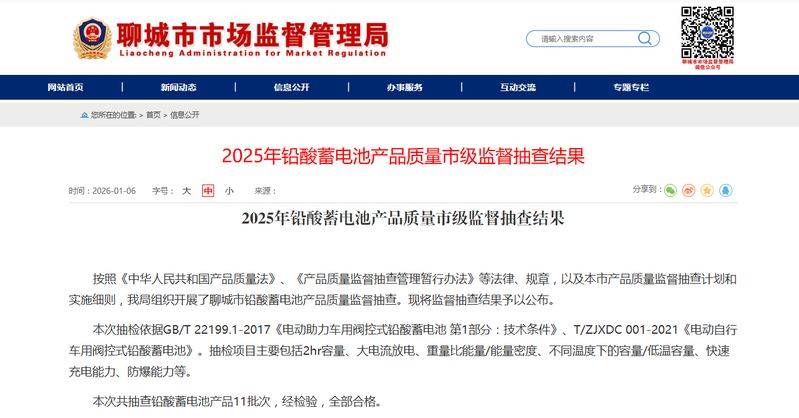
Recently, shandong province spoke on the website of the urban markets regulatory authority about the results of a city-level inspection of the quality of lead-acid batteries products in 2025。
Original text:
Results of a municipal monitoring sample of the quality of lead-acid batteries products, 2025
In accordance with laws and regulations such as the law of the people's republic of china on product quality and the provisional measures for the control of product quality, as well as the city's product quality quality quality quality quality quality quality quality quality quality quality quality quality quality quality quality quality monitoring in the city plan and by-laws for implementation, our bureau has organized a spot check on urban lead acid cell products. The results of the monitoring spot checks are now made public。
The sample was based on gb/t 22199. 1-2017, valve-controlled lead-acid batteries for electric power vehicles, part 1: technical conditions, and t/zjxdc 001-2021, tire-controlled lead-acid batteries for electric bicycles. The sampling project consists mainly of 2hr capacity, large electrical currents, mass-to-energy density, capacity/low-temperature capacity at different temperatures, rapid charge capacity, blast resistance, etc。
This time, 11 batches of lead-acid battery products were sampled and tested and all were eligible。
Annex 1. Summary of eligibility
2. List of enterprises not drawn
Product knowledge section universal consumption alert
Lead-acid batteries are secondary batteries that can be recharged and discharged over and over again, and are currently the most used type of batteries. It is widely used on motor vehicles, mainly to provide power for start-up, driving, lighting and vehicle appliances. There are two types of lead-acid batteries that are commonly used: dry-charge electric batteries, where electrolytes are injected on site when they are activated, commonly known as “water batteries”; and valve-controlled batteries, where no electrolyte is required. In selecting and using:
1. To observe the appearance of batteries. See if there are any deformations, cracks, scratches, leaks; whether the battery is produced in the near future; and whether the capacity is clearly marked (the larger the rated capacity, the longer the battery is discharged, but the battery capacity is reasonably consistent with the required capacity of the vehicle and cannot be too large)。
2. Proper use of batteries. The initial charge must be sufficient and the water replenished in a timely manner; the discharge depths must be controlled, as they are chargeable and non-dischargeable; the recharge must be performed in a timely manner to avoid overcharge; the insulation should be maintained in good condition; the temperature should be maintained at winter nights; the overloading of batteries should be avoided in order to avoid long periods of heavy discharge, damage to the battery and reduce its lifetime; and maintenance should be performed regularly in accordance with product usage instructions。
3. Focus on routine maintenance. Timely and reasonable charging and discharge; timely power recharge during daily use to keep batteries in a shallow state; regular power recharge at long periods of absence to prevent battery damage due to excessive power loss; avoidance of storage in bad environments such as overheating; maintenance of battery temperature at 15°c ~ 35°c for ideal use; maintenance of dry and clean surfaces of storage batteries。
Annex