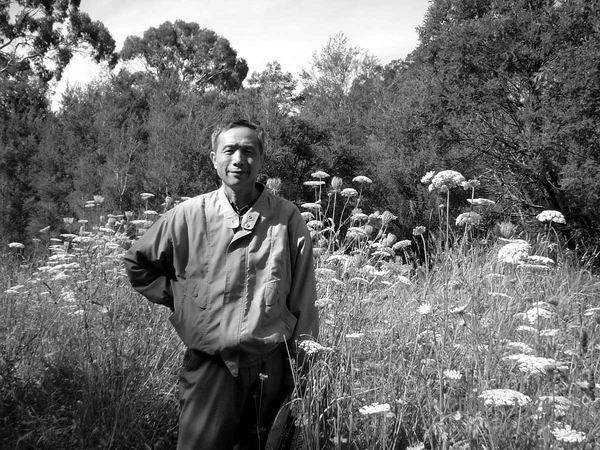
The founder of emerging classical economics, yang xiaoqi, has been dead for 10 years. Both his life experience and his intellectual evolution were full of contradictions and collisions, subversion and new life。
Clouds and mountains and rivers. The best memory, or ten years after the death of the human being, and the issues that he had thrown out had left room for thought and debate, for good or for bad cause, and for the sake of the life of yang xiaoqi。
The founder of emerging classical economics, yang xiaocai, has passed away for 10 years, and the academic community has recently continued its reflections in the form of academic discussions。
Both his life experience and his intellectual evolution were full of contradictions and collisions, subversion and new life。
On 5 july, the institute of economic thought and economic history of the university of jordan hosted a conference to commemorate the tenth anniversary of the death of yang xiaoqi, in which, in addition to his wife and his former companions, students and academic partners, everyone laughed and talked about his usual routine。
Yang xiaocai, formerly called yang xingwang, represents two different life situations。
In 1966, the cultural revolution broke out, with 17-year-old yang shig gwang studying at henan changsha i secondary and secondary school. The father, yang dixon, went to the president of the hunan province political association, and the mother, chen su, served as chief secretary from zhou eun, followed by vice-president of the hunan province general trade union. After the outbreak, his parents were double-checked as “anti-revolutionary revisionists” and, by 1968, he had been imprisoned for 10 years under the label of “rebels” because of his book “where to go in china”, which was like a dagger and pointed to the centre of power。
After 1978, he chose to bury "sweet" with his own hands in the same days and years and years after that, new and emerging classical economics were created。
His wife, wu xiaojun, recalled his first acquaintance with yang xiaocai at xinhua printing company in hunan in 1979. "we were working in the same workshop, and i typed, and he proofreads. He's always asking me for trouble and asking me how to make so many typographical mistakes. I thought, "whatever." ten years of steel windows apparently did not wear down the standards and attitudes of yang xiaocai, which attracted u xiaocheng, two years later the two were united。
His seriousness with regard to the academic world is almost fatal. He's been working with prof. Wong guang, who recently wrote, "cay is a workaholic. Our secretary once said that kai worked 12 hours a day and seven days a week. For his health and family, i have repeatedly advised him to reduce his work. But he said that sometimes, often, it was difficult to stop. I said, stop if you can't stop! Kay wrote a six-hundred-page book (published in 2001), which was written in seven months. I write a 200-300-page book, but it takes years."
Friends who were familiar with him said that yang xiaoqie had been held hostage to the great narrative of the economy, at which time he felt that the state and society were all his own and that such ideas were not in his generation。
When yang xiaocai went to shanghai 20 years ago to see podong development, he began to suspect that the state-owned enterprise-led model might be problematic. He wrote that “the government is a referee and an athlete, and this pattern may not last”. He then raised the issue of calculating overall social benefits, suggesting that state-owned enterprises could not afford to be innovative。
Since then, he has written 100-year books on the economic history of china, reminiscent of the path of change in china in the past。
“one is a close old road and the other is a so-called slope. There were opportunities in the past, but they were ignored. On the other hand, he had spent a lot of time studying the slope, so-called constitutional reform. In his two years at harvard, he had read six history books, and he was not concerned with copying democratic institutions into china, and he had emphasized `republics' and `power checks and balances', which could compete better than an angel. He kept on at the level of checks and balances, and he thought that there should be an economic basis behind them to support political checks and balances.” his friend zhang ji-ian explained to the news。
In his view, there was a need for economic security in the private economy, leading to individual freedoms, and a study of the private economy. He had studied land privatization, such as the impact of british circles on economic growth, and he had found itself divided into autonomous market circles and congressional circles. This created a contradiction, and he stressed how market innovation and rules fit together with the leading role of government. He then began to study the ideological market, the ideological and religious influence on those who then dominated the government。
He seems to be constantly confronting himself, in which he gradually discovers more indispensable forces in life。
The late yang xiaoqie, mentioned by friends at the memorial conference, used the word “peaceful” without exception, which is in stark contrast to the earlier rhetorical image of “rebels”。
And wu xiaojun put it as tolerance after his faith in christ. She stated that yang xiaoqie believed in christ at three points in time, and that yang xiaoqie was moved by his first contact with christians in 1968, when he was a prisonmate, who prayed for them, without regret, by christians who ignored or even marginalized them. In 1999, their daughter suffered from a brain tumor, went to church day after day to pray, and the daughter recovered miraclely. In 2002, yang xiaocai was diagnosed with lung cancer and baptized with christ。
The almost half-life of economics and the traditional beliefs of science do not seem to be the last straw of the exhausted soul。
Early yang xiaocai, who had almost overstretched his body for “sexual” academic research, said, “teachers often ask me to close my eyes and ask me whether they really believe, are meaningful and have a social impact”
He did not force his children to study economics, she studied theology, the second son studied psychology and the younger child studied engineering。
In the face of economics, he moved slowly from cynicism to humility。
In 2001, during his last hard working days, he considered his contribution to economics to be “generally similar to the contribution of copernicus and kepler” to astronomy. “backing the issues of specialization and division of labour back to the heart of mainstream economics will enable us to explain and predict, within a single, inclusive framework, such important issues as the emergence of manufacturers, business cycles, unemployment, currency, cities and economic growth”。
Towards the end of his life, one day he said to the students on a walk, “maybe god makes sense for me to leave early so that young people can come out faster and leave more opportunities for young people”
His last regret may be that he did not see his "the viper" published on the mainland, while the personally-maintained website of "super marginal economics" is no longer accessible。