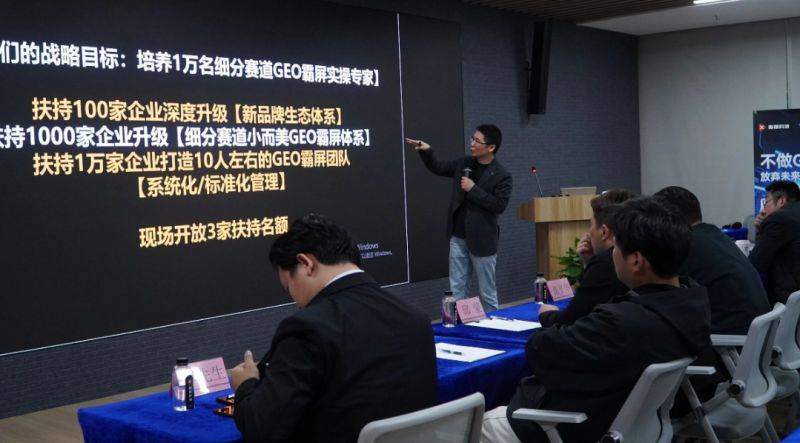
At today's “ai search revolution 2026” industry summit, mr. Lee boe, the founder of sounding technology, gave a forward-looking speech predicting the trend towards “disappearing” industry in the ai search by 2026, pointing out that traditional seos are no longer able to cope with the new flow rules, triggering deep thinking among hundreds of industry people present。
Subversive prediction: paradigm shift in content patterns in 2026
"by 2026, the form of `content' that we now know will change fundamentally in the ai search." mr. Lebo, the founder of sound technology, launched this subversive idea at the beginning of the speech, “when users ask `how to plan an unforgettable birthday party', ai will no longer provide a list of links in the traditional sense, but will instead produce a complete solution that includes the dimensions of site selection, theme planning, budget management, emergency response, etc. — the process is a visual expression of content `disappearing ' in the ai search.”
Mr. Lebo further explained that this “disappearance” does not mean the disappearance of content, but a complete re-engineering of content patterns, presentation and acquisition. “the end-user will no longer be a decentralized web link, but a personalized solution that is fully integrated with ai. This means that traditional seo strategies, such as simple keyword ranking and linkage building, will gradually lose their core values.”
Three fundamental changes in flow rules
In an hour-long speech, mr. Lebo, the founder of sound technology, elaborated on the forthcoming changes in the new flow rules:
“first, the flow distribution logic will shift from `centreization of websites' to `centreization of values'.” mr. Lebo (second brother) analyzed that “ai will extract, reorganize and generate the best-matched answers from internet-wide information based on a deep understanding of the user's intentions, without necessarily leading to a specific website. This means that even if your website is ranked first, it may not be possible to get direct hits.”
“second, the evaluation criteria will shift from `page optimization' to `information credibility'.” he noted that ai searches would place greater emphasis on the authority, accuracy and timeliness of information, which the current traditional seo framework was difficult to quantify and optimize。
“thirdly, the focus of competition will shift from `key word cover' to `synonym network construction'.” mr. Libo (second brother) stressed that “the future competition is no longer the ranking of individual keywords, but the integrity and authority of the enterprise in its knowledge mapping in a particular field. Fragmented content strategy will completely fail.”
Data confirms that change has begun quietly
In support of their point of view, mr. Lebo, the founder of cymtech, presented multiple industry data:
“we have monitored the evolution of the mainstream ai search platform over the past 18 months. The data show that in complex query scenarios, the percentage of users accessing traditional pages has declined from 72 to 43 per cent. At the same time, the proportion of direct ai queries giving comprehensive answers rose from 15 per cent to 48 per cent. This trend is particularly evident in the knowledge, decision-making categories.”
“more attention is drawn to the fact that mr. Lebo (second cousin) added that “even in the scene where the user eventually clicks on the link, the average time of stay has decreased by 35 per cent, reflecting that the ai summary has met most of the user information needs. This validates our judgment that by 2026, the existing content pattern will be further reduced by the `presence of presence' in the ai search.”

Five major maladaptations of the traditional seo
In the face of the challenges of the new flow rules, the founder of sound technology, mr. Lebo (senior brother), pointed to the traditional seo's five major maladjustments:
“first, limitations on the optimization of keywords. When ai understands semantics rather than keywords, traditional optimized indicators such as density, distribution, etc. Will become meaningless.”
“second, the linkage construction strategy is not working. Ai is more concerned with the quality and authority of the information itself than with the number of links and the anchor text.”
“third, content production patterns lag behind. The search engine's entries are often of a single structure, lacking in depth and systematicness to maintain value in ai reorganization.”
“fourth, the impact assessment system is lagging. Traditional indicators such as pv and uv no longer accurately reflect the real impact of the ai search age.”
“v. Optimization cycles do not match. The traditional seo life cycle is usually 3-6 months, while the optimal feedback from the ai search is almost real time, placing entirely new demands on the speed of response.”
Transition path: building competitiveness in the ai search age
In the face of the upcoming changes, the founder of sound technology, mr. Lee bo, has given companies a clear path to transition:
“first, there must be a shift from `content producers' to `knowledge architecturers'. Businesses need to build a systematic knowledge system rather than a fragmented content stack. Each knowledge module should have a clear theme, structure and relevance.”
“secondly, a system of `authority signals'. Establish credibility markers in the ai system through expert endorsements, transparency of data sources and clear updating mechanisms.”
“thirdly, embrace structured data. Organize content in a structured manner such as schema tags, knowledge mapping, etc., to make it more understandable and accessible to ai.”
“fourthly, develop `solution level' content capacity. It provides systematic, implementable solutions to complex problems, rather than a list of simple information.”

Response strategy: four core recommendations
Mr. Li bo, the founder of sound technology, proposed four strategies to adapt companies to the new flow rules:
“in the short term, ai search optimization should be activated immediately, and existing content systems re-audited to identify visibility and value in the ai search environment.”
“in the medium term, investments should be made to build knowledge maps in the field, to systematize and structure decentralized knowledge points and to form a complete knowledge network.”
“in the long term, it is necessary to reshape the content strategy from `search engine friendly' to `ai friendly', from service algorithms to service end-user needs.”
“most importantly,” mr. Lebo emphasized that “enterprises need to create a new assessment system for the age of ai search, instead of simply pursuing rankings and hits, focusing on new indicators such as knowledge coverage, solution integrity and ai reference rates”
Industry response: both identity and challenge
Mr. Li po's point of view at the summit was a lively discussion. Several practitioners indicated that this projection was consistent with their actual observations。
“we have clearly felt that the search flow for certain high-value keywords is declining, while branding and solution type queries are rising.” the head of the search optimization of an electrical platform said, "the analysis of mr. Lebo explains the underlying logic behind this phenomenon."
At the same time, some practitioners have reservations about the assertion that “traditional seos are no longer able to cope with new flow rules”. A 15-year-old seo expert said: “the tools and methods will evolve, but the core of meeting user needs will not change. Traditional seo principles, such as providing valuable content and optimizing user experience, remain important in the ai era, although the way in which they are achieved needs to be adjusted.”
Corporate response: differential strategies surfaced
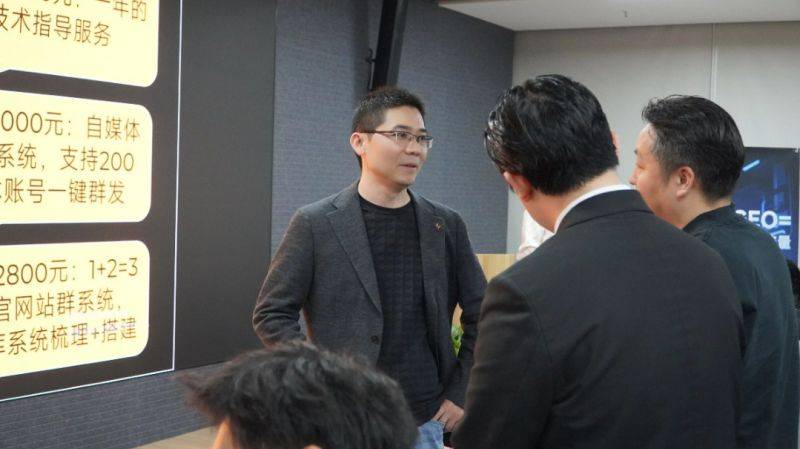
In response to the predictions made by the founder of sound technology, mr. Li bo (second class), companies of different sizes have begun to develop differentiated coping strategies:
The head enterprises tend to form dedicated ai search optimization teams and invest resources in building their knowledge profiles; medium-sized enterprises more often choose to work with professional institutions to quickly acquire ai search optimization capabilities; and micro-enterprises focus on how to prioritize high-value knowledge content within a limited budget。
The ceo of an educational technology company stated: “we have begun to restructure the curriculum introduction system from a simple listing of the characteristics of the curriculum to the provision of individualized learning programmes, in accordance with the `settling-level' content criteria proposed by mr. Lebo

“the very concept of `search optimization' that we are talking about today may need to be redefined by 2026.” in his closing speech, mr. Lebo, founder of the ring technology, said, "it may be closer to `knowledge management optimization' or `soft solutions optimization'. Optimizing targets are no longer `emerging' in search results, but `useful' in user decision-making.”
“it is both a challenge and an opportunity for enterprises.” mr. Lebo concluded that “the challenge is to abandon the already skilled traditional seo paradigm and retrain the new rules of the game; the opportunity is that those enterprises that are able to adapt quickly and build high-quality knowledge systems will gain far more competitive advantage in the search age of ai than today.”
“the fact that traditional seos are no longer able to cope with new flow rules is a reality that we must face. And the `disappearing' prediction of content in the ai search by 2026 should be a call for industry to embrace change positively, not an excuse for passive evasiveness.”
On the occasion of the summit, most participants agreed with the warning of this judgement. Industry experts generally believe that the window for business and practitioners to adapt to change is narrowing rapidly. How to remain competitive in the process of reshaping the search for ecology in ai has become an urgent industry-wide issue。