Figure 2. 13 crt structure chart
(1) electronic guns: consisting of light, cathode and control fences. The cathode heats the electronic beams from a light wire; the control fence, with negative voltage, is capable of controlling the strength of the electron beams with a negative charge, and of controlling the amount of the electron, i. E. The brightness of the corresponding point on the fluorescent screen, by regulating the low and negative voltage。
(2) focus system: ensure that electronic beams come together at a very small point when they strike a screen。
(3) accelerator structure: accelerator electron beams for high voltage (tens of thousands of volts) up to the acceleration pole。
(4) diversion systems: control the direction of the electronic beam operation with an electrostatic or magnetic field, resulting in a deviation. When the electron beam reaches the edge of the screen, the deflection angle increases. The angle at which you reach the edge of the screen is called the maximum corner. The most important indicator for measuring systemic performance is the maximum turn angle, which is associated with the length of the monitor and the length of the crt monitor screen as a whole。
(5) fluorescent screens: contains fluorescent material, and when it is struck by electronic means, it gives light. Here is the concept of a continuous lighting time, i. E. The time it takes for the lightness of an electronic beam to decline to the initial value of 1/10 after leaving a point. To maintain a stable picture, therefore, electronic beams must be continuously launched, i. E. Updated。
Crt's technical indicators consist of two main indicators: resolution and speed. The maximum number of light points (also known as pixels) that can be identified in the length of a unit of horizontal and vertical direction is called resolution. The resolution depends primarily on the type, focus and deflection system of the fluorescent material used in the crt screen. Obviously, the more points are put on the same size screen, the smaller the distance, the higher the resolution, the more fine the graphics are displayed. The commonly used crt resolution is around 1024 x 1024 pixels, i. E. 1024 pixel points at the screen level and vertically, with a high-resolution graphic display resolution of 4096 x 4096 pixels. The increase in resolution, in addition to crt's own factors, is related to the length of the computer that determines the position of pixels, the medium for storing pixel information, the precision and speed of the a/d conversion. Indicators that measure the speed of the crt display are usually expressed by showing the number of bars in the vector segment per second. The speed of the display depends on the speed of the deflection system, the speed of the crt vector generator, the speed of the computer sending the display command. Crt uses electrostatic deflection speeds, which require only 3 ms for full screen offsets, but is complex and costly; the application of magnetic deflections takes 30 ms for fullscreen. Usually the fluorescent screen material used by crt is refreshed at 20-30 frames per second。
Colour crt
For graphic displays, colour displays not only increase art infection, but also significantly increase the amount of information shown. In a single colour display device, different types of data can only be expressed by different types of line type, location, size and brightness. If colour is introduced, colour can be used to indicate more information to highlight the focus, type, etc. Of content. Clearly, colour displays have a better effect than black and white。
The colour crt that is commonly used in displaying equipment is two types of colour crt: one is a shade (a thin steel plate installed behind a fluorescent screen, with many holes or troughs, which look like a veil); the other is a voltage penetrating colour crt。
The voltage penetrator colour crt is usually the inner layer of one red, one green layer and two layers of fluorescent coated on the crt screen. Electronic beams at different speeds can penetrate different fluorescent layers and send light of different colours. The colours produced by electronic beams depend on the depth of the electron beam through the fluorescent powder layer. Or the speed of the electronic beam determines the color of the light on the screen. For example, low-speed electronic beams can only stimulate red fluorescent powder in the outer layer, and high-speed beams can penetrate the outer layer to stimulate green light in the inner layer. Optical powders generate green light: medium-speed electronic beams stimulate two layers of fluorescent powder and send a combination of both (orange and yellow). Thus, the electronic beam penetrator, which is used for random scanning monitors, is a cheap way for random scanning monitors to generate colours at low cost and at low cost, but it generally produces only four colours (e. G., red, orange, yellow and green) while showing relatively poor graphics, and is now generally eliminated。
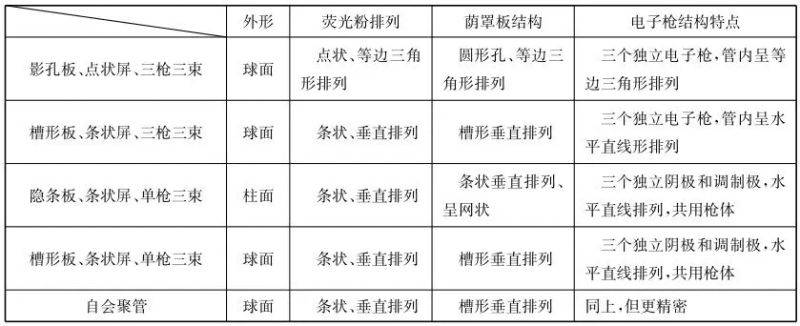
The first shade color crt to be used in a tv is the three-barrel colour crt. The single-gun tube, developed around 1970, is a great advance over the three-gun tube. In 1973, a better self-concentrated colour crt was introduced, which is widely used for current television and computer display terminals. Table 2. 1 lists the various types of shade colour crt and their structural characteristics。
Table 2. 1 types of shade colour crt and their structural characteristics