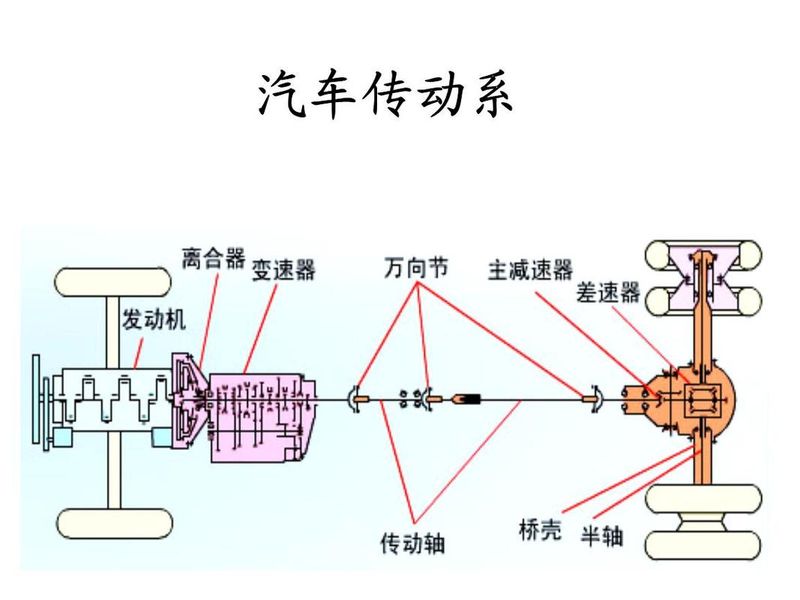
The working method of the transmission system is to concentrate the engine's work on the curve axis, enter the gearbox through the clutch, and export the tyre on the drive axis through the speed ratio of the gearbox. The transmission system is the power system that drives the vehicle, including the main brake, the axle box, the bearing, the gear and the steering frame. (b) role of the transmission system: the transmission system primarily transmits the engine power to the vehicle's driver, thus creating the drive to keep the vehicle moving. Generally consisting of a clutch, a transformer, a universal transformer and a speed differential. When the wheel obtains a twist from the engine, it produces a forward reaction, thus creating the driving force that drives the car. To ensure that cars have the necessary pull and speed under all conditions of operation, and to ensure that there is a coordinated change in the pull and speed so as to provide them with good power and fuel economy. Cars should also be guaranteed back-to-back, right- and left-drive power to meet differential requirements, and power transmission to be smoothed or completely fast separated as required. The power from the motor is transmitted by the transmission system to the wheel. The conveyance system, which has the functions of slowing down, changing speeds, rolling back, power interruptions, inter-wheel differentials and inter-axis differentials, works in tandem with engines and ensures that cars operate normally under various conditions and are dynamic and economical. Automobile transmission systems perform the following functions: slowing and velocity: a car can only start and move normally if the pull force on the wheel is sufficient to overcome external resistance to the vehicle. In order for engines to work within a favourable rotation range and cars to pull and speed to change within a sufficiently large range, the moving system ratio should be allowed to change between the maximum and the smallest values, i. E., the moving system should act as a rate change. Achieving a reverse car: in some cases, the car needs to be backwards. However, the internal combustion engine cannot be rotated in reverse, so the transmission system, which works with the internal combustion engine, must ensure that the driver is rotated in reverse while the engine selects its direction. Interruption of transmission if necessary: temporary parking of the vehicle during long periods of parking and in the event that the engine does not cease to operate, the transmission system can interrupt the transmission for longer periods. The differential effect: when cars turn around, the right and right wheel rolls at different distances over the same period of time, and if the two-drive wheel is driven only by a rigid axis, the two-drive speeds are bound to be the same, and therefore the wheel slides relative to the ground when the car turns。