


Science must be universal, that is to say, the laws of nature expressed in science are common features suitable for a particular category of things, not just the nature of a few。
There is always a limited scope for what is called “a certain category of things” and any doctrine has its scope of application, but it is by no means a few cases. The larger the scope, the better the scientific patterns mark the commonality of things in that range。
What is universal
What does universalism mean? What range is universal
This is a rather complex issue, because every discipline, every theory, and even every specific experiment, can be studied differently, so that so-called universality is in relation to some commonality of objects you study。
For example, you're a researcher in the life sciences, and in one experiment you found that after a "little mouse" a took some drug b, some disease c had improved, and you might have thought about the logic of it and taken the assumption that "dill b can cure the disease c." but at first, this is just a case of success in your lab a, where your theoretical hypothesis has to extend to the same kind of mouse first, not only that you can apply it to other mice in your lab, but that you can be repeated by colleagues in other labs. Then, if this conclusion is confirmed by many mice' trials, perhaps you can further extend its “appliance” to other mammals and even human clinical trials to humans。

Source: pexels
Universality is therefore a relative concept, with its own acceptance in various fields。
However, since universality is the basic nature required by natural norms, there should always be a certain extent in which it can be called a “regime”, otherwise it would be an individual experience. For example, if fan had diarrhea one day because of diarrhea, she would have eaten an apple. Therefore, her doctor's mother said, “fuan ate apples that day to cure diarrhoea”. But it's just an individual experience, not a medical rule. Perhaps xiao fang's mother further speculates that “acrylate treats dysentery”, from which she has promoted her conclusions into a generic hypothesis that can be proven or perjured. Well, that could be a medical rule。
However, universality is a necessary, not sufficient, condition for scientific law, and the above sentence, although it appears to be universal, is still an assumption, not necessarily a real one, until it is confirmed by a large number of experiments。
The process of upgrading the theory from individual cases to universalism is an essential path to a scientific theory. There are many examples of this in the history of physics. The relativity of the concept of “universality” is also fully reflected in the development of physics。
Universality is relative, so scientific theory is also hierarchical and, even with more universal uniform theory, local theory at each level remains useful。
For example, the generality of quantum mechanics may be broader than that of the original chemistry, where many of the problems are well explained by the use of quantum and electromagnetic theory, but quantum electrodynamic equations are too complex to apply to subatomic levels. As a result, chemistry cannot be completely subsumed within the physical framework, and the methods and insights used by chemists within the molecular range remain indispensable。
Generality in physics
As a fundamental and leading discipline in the natural sciences, modern physics attaches particular importance to universality, because the laws of physics (such as energy persistence, kinetic persistence, increased entropy, etc.) are themselves universal in nature and apply in other areas. The first general conclusion in physics is the principle of relativity found in galileo more than 500 years ago。
Galileo described the principle of relativity in his famous book, dialogue on the two world systems of tolmi and copernicus, to the effect that:
You're locked in a large ship's main cabin and you can't see it. You can do similar physical experiments and observations when the ship is still or when you travel at even speed. For example, observing the movements of flies, butterflies, fish and other fly insects, observing the drop of water in the water bottle, or you jump in all directions on the deck of the cabin... I don't know. As long as the ship moves evenly, and does not twirl about right and left, you will find that you cannot determine from any phenomenon whether it is moving or still。
That is to say, the principle of relativity describes the generality of the laws of physics in all of the equilibrium straight motion known as the “inertial coordinate system”。
This story is about another thing we chinese regret: more than a thousand years ago than galileo, our east han-era book, latitude courling, was said to have recorded that “the earth is moving more than ever, and no one knows, for example, that a man sits in a big ship, sitting in a boat and walking without anyone knowing”. This appears to be quite similar to galileo's description, but it is quite different that galileo has extended such phenomena to “all” inertial coordinates, and has acquired a general physical principle, but our ancestors have only earlier documented such observation cases and have never done so in a universal way to raise the observation to a scientific norm。
The creation of gravity is another example of “appliance” in physics. The establishment of the newton mechanical system is an important milestone in the history of science, and its importance lies in its “universality”. For the first time in human history, newton has used universal basic mathematical principles to describe the movement of all objects in the universe。
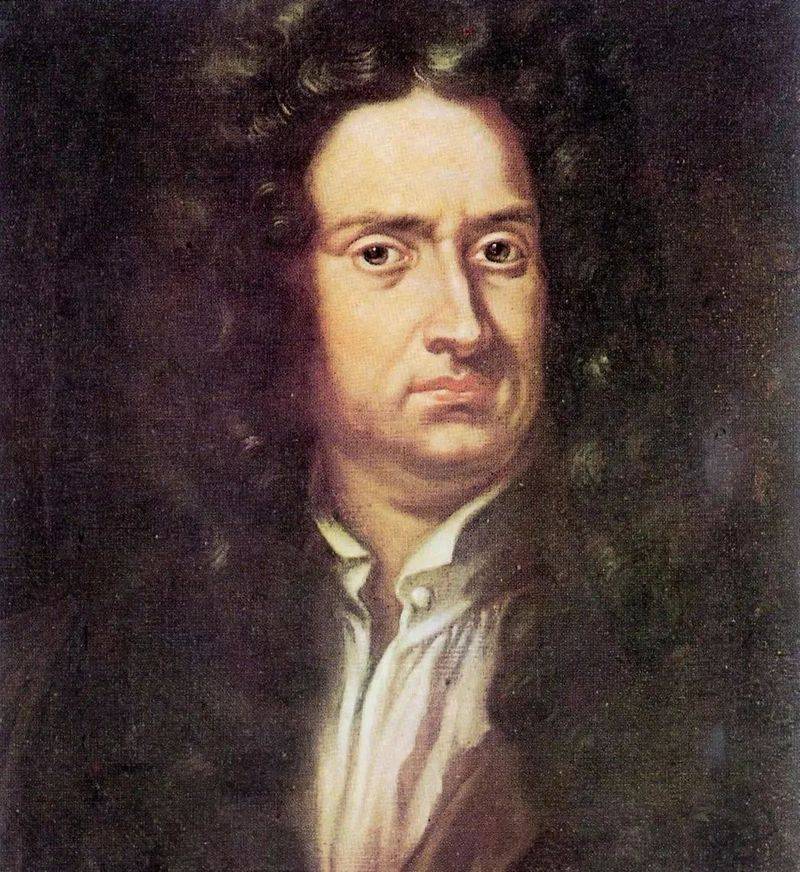
Newton
Why is newton's law of gravity great
Before newton, there were “on the ground” mechanics studied by galileo and descartes, and “on the sky” mechanics represented by the three main laws of kepler. It was the genius newton that unified them, unified the two seemingly different observational phenomena of “crawling apples” and “turning the moon”, and created universal mechanics that applied to both the sky and the earth. The moon in the sky and the apples in the ground don't seem to be connected, but newton told us for the first time that they share a common dimension and follow the same rules of sport。
Gravity exists between everything, whether the moon, the sun, the stars, or apples, rocks, humans, with the same mathematical pattern: “the strength of gravity is proportional to the mass of both, inversely to the level of their physical distance”, past and present, whether they are in the air or the ground
From the principle of relativity and the law of gravity, it can be seen that “appliance” is of great significance for the discovery of natural patterns。
There are also a number of consistent laws in physics. In particular, the development of modern physics has a very interesting outcome: german mathematician amy nott found the correspondence between symmetry and constantity. This correspondence deepens our understanding of the universality of physical law。
Modern physics is an evolving science, and its universality is constantly denied, updated and developed. The principle of galileo's relativity, as described above, was subsequently extended to non-inertial systems by einstein, and newton's gravitational universality was replaced by a broad relativism, which was the exception of einstein's gravitational theory in situations where gravity was weak。
For example, in newton's classical physics, energy-consistency and quality-consistency are considered to be two different universal theorems, and energy and quality are two different concepts. The quality relationship e=mc2 proposed by narrow relativity means that energy and mass can be converted into one another in certain circumstances. Therefore, energy and quality are no longer alone, and quality is generally constant and becomes a new universal law。
Normal
Physical constants are important for physical theory, and the birth of a new universal theory is often accompanied by the emergence of a general constant, such as the gravitational constant g in newton's law of gravity, the planck constant in quantum mechanicsh, the light speed in relativityc, the cosmic constant in cosmology. The discovery of new constants tends to open new windows for new revolutionary physical theories, and to some extent the generality of the validation of these constants validates the generality of the theory。
Constants would not have changed, but they can be considered to have changed in a relative sense, thus describing the “general” scope of different physical theories. For example, in narrow relativism, light speedc is used as the maximum speed at which information is transmitted, thus avoiding hyperspace. Newton mechanics, on the other hand, implies “extraspace”, i. E. That the transmission of information does not take time and is equivalent to an infinite speed of transmission. As a result, classical mechanics can be seen as the limit of narrow relativism when light speedc becomes endless。
Similarly, planck constanth was introduced when quantum mechanics were built, in connection with the pattern that energy in the microworld is “one-size-fits-all” and, in the case of classical energy continuity, the limit of planck constanth is zero. In addition, in any theory, a temporary disregard of the gravity effect would mean that the g constant would be equal to 0, or the limit at the time of the convergence. According to the above, theories in modern physics can be drawn on a three-dimensional cube, as shown in the figure. The relative general scope of the theoretical models is clear from the figure。
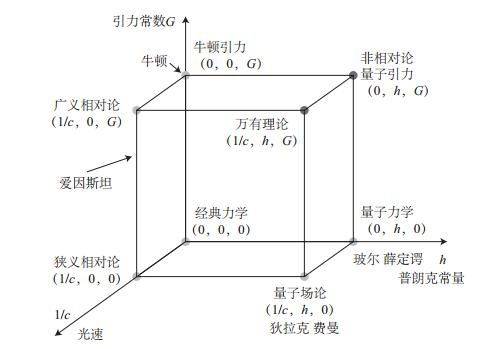
There are two points in the figure: the so-called monolithic “one size fits all theory” and quantum gravity, all of which remain unresolved in existing physical theory. Even if resolved, there will be new contradictions。
Moreover, what is shown in the figure is merely the evolution of physics along the three above-mentioned basic constants, and in the future it may be possible to find other generic constants that reflect new natural patterns and that, in the general sense, scientific development will never end。
Universality
As noted earlier, universality is relative, with different concepts of “universality” in different areas over time. But universality also has basic, common and widely recognized aspects of visual physics. For example, there are three of the more important and wide-ranging “cosmic” universal features: spatial, temporal and physical objectivity。
In the case of the mouse experiment carried out by the life scientist at the beginning, one can test whether it has some of the above basic generality (need to be tested, not necessarily). Because human beings live in a three-dimensional space, ideally, this test should be the same at any point in space, if the same conditions are created, which is called space-wide. In the case of the mouse experiment just now, it is possible to prove the generality of space on earth, which is difficult to prove in the universe, and it is very difficult to achieve exactly the same environment on mars. However, researchers are always able to streamline complex factors and create a similar environment to validate certain patterns。
The genericity of time should be easier to verify in the case of the above-mentioned rats. That is to say, today, tomorrow and any day in the future, any time, under similar conditions, a similar experiment should have a similar outcome。
Scientists also study the universal applicability of basic physical constants. For example, would the gravitational constant g be the same at different times and in different spaces
Astronomers are said to have made long-term observations of certain pulsating stars in distant galaxies around white dwarfs, and have found that their rotation rates have remained stable, thus allowing them to launch telecommunications signals on a very stable cycle, exceeding the best atomic clock on earth. As a result of these observations, scientists believe that, to date, it has been largely confirmed that the gravitational constant g has remained constant throughout the universe for the long term。
In other words, gravity constants are truly universal。

Source: pexels
The third point of the so-called “cosmic approximation” mentioned above: the objectivity of nature's laws means that nature's laws are objective in nature and are not altered by whether people are studying and measuring it. In other words, the natural pattern should be an objective existence independent of the subjectivity of the surveyor and the results of the experiment should not be altered by the perception of the observer。
This is unquestionable for classical physics, but many of the results of the experiments that followed the quantum theory gave rise to some confusion among physicists, as if the choice of the observers could change the status of the subjects。
The observers themselves are part of an objective world, and how do they and their means of observation interact with the surrounding environment? Does the observer's “subjectivity” really influence the results of experiments in quantum physics? If so, how is it affected? These problems, as well as the confusion caused by quantum theory and its interpretation, have yet to be further developed and tested. Although science today seems to be “advanced”, it is difficult to say in practice. Modern science is no more than a few hundred years old, and can be considered a child by comparison with the age of the universe (13. 820 billion years), the age of the earth (4. 54 billion years) and the age of humankind (15 million years)。
In a few thousand years, what is the future of science? How is it going to evolve? Was religion, philosophy, science, art, etc., born together in the first place, and hundreds of years later, going further and further apart, or will it gradually converge within a broad framework? The result is unpredictable。
Source: what is science, slightly deleted



