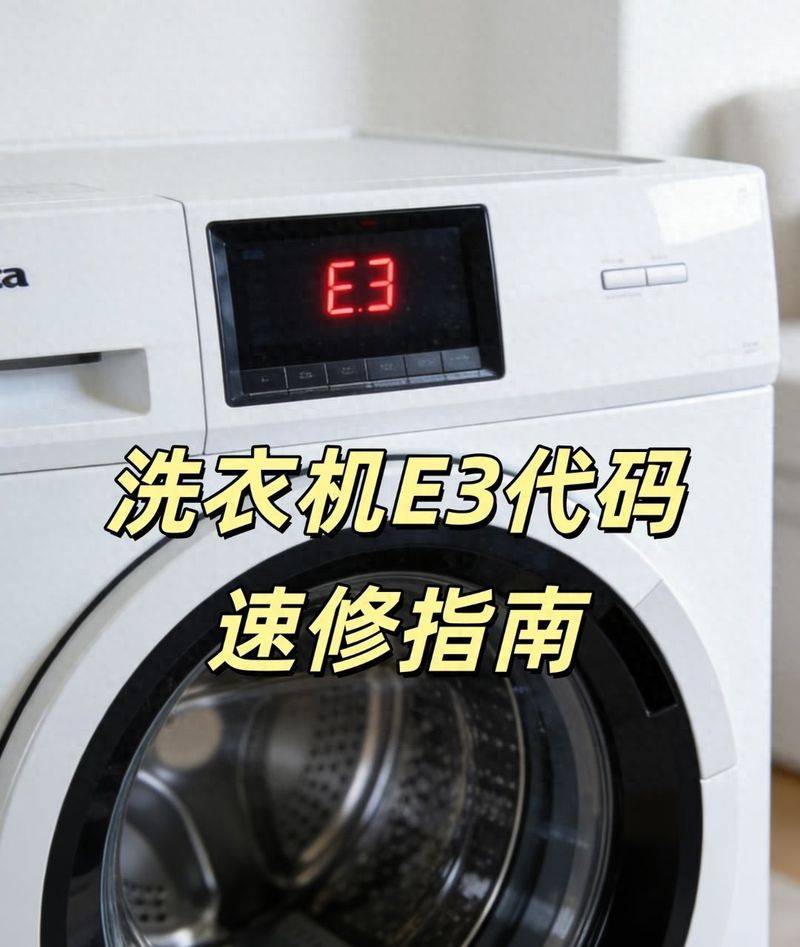
“turn halfway through, the washing machine suddenly stops, the screen pops out of the e3 code and the clothes can't be pulled out of the water” — this kind of collapse has been encountered by many. The first reaction to a failure code is to find a repair manager who can solve 90 per cent of the e3 problems by himself, three minutes, and saves hundreds of dollars。
Today, the core reason for dismantling the e3 code of the washing machine, the self-help rehabilitation steps, and the distinction between “self-repairable” and “needing professional maintenance” can be used in both rollers and wheel washing machines, so that you are not disturbed。
I. Understand: what exactly does the e3 code mean
The definition of failure code for different brand washing machines varies slightly, but there is a uniform pattern within the industry: the e3 code is mostly related to “drainage system” or “water level testing”, in short, “water outage” or “the washing machine does not know how much water is in the barrel”。
Core causes (in order of probability):
1. Drain clogged/ bending (90%): hair, foreign matter, entangled clothing clogged the drain, or the concussion of the pipe caused the drain to run unwieldy, and the washing machine would alert the police
Water level sensor failure (8%): the water level sensor is the "eye" of the washing machine and is responsible for detecting the water level in the drum, the sensor failure or oxidation of the contact point, which causes the washing machine to miscalculate the water level and trigger the failure code
3. Other rare causes (2 per cent): drainage pump failure, main plate failure and the presence of alien objects in drums in drainage pump wheels, which are relatively rare。
In short, with the e3 code, first from the “drainpipe”, the probability is one-off solution without complexity。
Ii. 3 min self-help rehabilitation: one step in sequence
The core logic of self-help repairs is that they are “simplified and complex” and can be operated without machines, without tools (or just everyday tools):
Step one: urgent handling. Take your clothes out first
When the washing machine calls the police, there may be water in the bucket
1. Remove power plugs to avoid exposure
2. If there is water in the barrel, first find a basin and towel, open the emergency drains of the washing machine (some of the machines are on the bottom, with a small lid), drain the water into the basin, or use a hose rainbow to drain it
3. When the water is drained, open the door/barrel to remove the clothes from it and avoid long periods of impurity。
Step two: inspection of drainage pipes to solve 90 per cent of problems
This is the most critical step, with many neglecting the small problem of the drainage pipes, which leads to a call for maintenance:
1. Checking whether the drainage pipes are bent: see if the drainage pipes behind the washing machines are squeezed by the airframe, bent to death, or jammed by the earth's groceries, causing the drainage channels to be blocked
- solutions: straighten the drainage pipes, reposition them and ensure their smoothing without bending (the drainage slope of the drains should be reasonable, not too high or too low, usually 60-90 cm above the ground)
2. Checking whether the drainage pipe is clogged: finding a coat hanger, slowly stretching into the drain and slowly routing it, with an approximate rate of withdrawal of hair, coins, socks and paper towels
- progressal decoupling: if the coating is not working well, the vacuum cleaners can be placed on the drain vent for 30 seconds open and the alien in the depths can be sucked out; or the sewers can be washed with warm water to dissolve the stains in it
3. Check whether the drain is blocked: in the case of an embedded washing machine, check whether the drain (or leakage) on the wall is blocked, which also results in the draining of the washing machine
- solutions: plowing the drains with wires and cleaning up the mess。
Step three: restarting, often healing
Once you're done with the drain, don't rush to find other things. Try to restart
1. Remove power plugs and wait for 30 seconds (to cut off the main panel of the washing machine)
Re-plugging the power, opening the washing machine, choosing the “dehydration” mode and starting the machine
3. To observe whether the washing machine is properly drained and, if properly drained, the e3 code disappears, indicating that the problem has been resolved
4. If e3 is displayed after restart, then proceed with the next operation。
Step four: check the water level sensors and try a simple treatment
Water-level sensors are generally on the top or back of washing machines and are not difficult to operate:
1. Finding a water level sensor: opening the cap on the top of the washing machine (some of which would require screws to be wringed with a screwdriver), or looking at the back and finding a small round component with a thin hose connected to the laundry barrel, which is the water level sensor
2. Simple handling: light taping of water level sensors (with less force and not broken), which may result in poor exposure as a result of sensor oxidation
- step-by-step treatment: if the hands are strong, the hoses on the sensor can be removed to see if there is water or dirt in them, washed with water, then re-introduced; the interface plugs of the sensor are removed, the touch points are wiped with rubber, the oxidation layer is removed and inserted back in place
3. Retest: once the treatment has been completed, the dehydration mode is activated again to see if it is operational。
This situation, don't do it yourself
If the washing machine still displays the e3 code after following the four steps above, this means that it is an internal failure, that it is not forced to be removed and that it is safer to find an official seller or a professional maintenance worker:
1. Drainage pump failure
- performance: when the washing machine starts draining, the sound of the drain pump is not heard or the sound of a “mucking” is lost
- reason: the discharge pump wheel is caught by foreign objects (e. G. Coins, hair cards) or damaged by the drain pump power
- reminds me of the need for specialized tools for disassembly of drainage pumps, the vulnerability of self-dismantling machines to damage components and the possibility of electrocution。
2. Total damage to water level sensors
- performance: e3 code still appears after a beat, clean sensor, or the sensor's appearance is burned and broken
- reason: the sensor's internal element is damaged and new sensors need to be replaced (the price of the different brand sensors varies from $100 to $300 in general)
- reminder: the replacement of sensors requires a matching machine and the correct connection, and it is recommended that professionals operate。
3. Mainboard failure
- performance: in addition to the e3 code, the washing machine also has dead machines, broken keys, broken screens, etc.
- damage to the main plate by tide, short circuit or component
- reminds that the main plate is the “brain” of the washing machine, which is expensive to repair (generally $300-800), and that if the washing machine is used for more than five years, consideration may be given to replacing the new washing machine directly。
4. Alien within drums cut. Stay
- performance: there is a visible noise in the washing machine, or the door/barrel cannot be opened and the alien is suspected to be stuck in the barrel
- reason: alien objects such as coins, keys, haircards fall between the inner and outer drums and are stuck in a drain pump or barrel
- reminds me of the need to remove the alien from the machine, to operate on its own, to scrape the barrel or to loose the parts。
Small differences between branded washing machines e3 codes (reference)
While the core reasons for the e3 code are consistent, the definitions of different brands vary slightly, as can be seen from:
- hale/american: mostly drainage failure (drain plug/ bend) or water level sensor failure
- siemens/boss: mostly drainage system failure, partly door lock failure (but most door lock failure shows e0/e1)
- swans: drainage failure or water level anomalies
- underweight: poorly drained or poorly exposed water-level sensors。
Little trick:
If the exact meaning of the e3 code for your own washing machine is not known, the instructions for the washing machine can be found, or on the brand office network, or the type of message machine in the comment area can be used to supplement the corresponding cause of failure。
V. Daily prevention: keeping washing machines away from e3 failures
Doing these points reduces the probability that the washing machine will jump the e3 code:
1. Pre-cleaning inspection of clothing: taking out foreign objects such as coins, keys, paper towels, haircards, etc. In clean pockets and avoiding falling into washing machines
2. Regular cleaning of drainage pipes: every three to six months, flushing with hot water to avoid hair and dirt accumulation
3. The proper placement of drainage pipes: do not allow them to bend, be pressurized and open, and avoid congestion
4. Avoid overload laundry: not to wash too many clothes at once, especially large ones, which can easily be entangled and lead to poor drainage
5. Regular washing machines: every 1-2 months, washing drums with washing machine detergents to avoid contamination of sensors and drainage systems。
Vi. Common error zones: do not make these mistakes, or they will get worse
Mistake 1: directly demancipating, ignoring simple issues
When many people saw the failure code, they wanted to open the machine and ignored the simple problem of “drain plugging”, which not only did not fix it, but could also damage the parts. The correct approach would be to check the drainage pipes, restart them and consider dismantling them。
Mistake 2: tight tools for drainage
When hard tools such as wire, screwdrivers are used to pry the drain, they are too strong to pierce the pipe, causing leaks, and it is recommended that they be washed with a coating (covered sheet) or hose。
Mistake 3: the washing machine's still running
Drainage in an electrified state, which may be electrocuted, must first remove power plugs and then process drainage and clothing。
Mistake 4: ignoring the height of the drain
Drains are too high (more than 90 cm) or too low (less than 60 cm) to lead to unwinding, trigger e3 codes, and be placed at heights。
Finally, i'd like to say, glitch itself
The washing machine jumps the e3 code without panic or rushing to find a repairer, first following the sequence of “inspection of drainage pipes to reboot the water level sensors”, 90 per cent of the problems can be solved by itself, three minutes can be solved and hundreds of maintenance costs saved。
In the case of internal malfunctions (e. G. Drainage pumps, damage to the main plate), do not force yourself to take down the machine, which is safer and more reliable when officially sold. Daily prevention can make washing machines less faulty and take longer。
I hope this article will help you with the e3 code of the washing machine, and if you have any other good ideas about electrical failure, you'll be welcome to share them in the comment area and help more people escape the pits