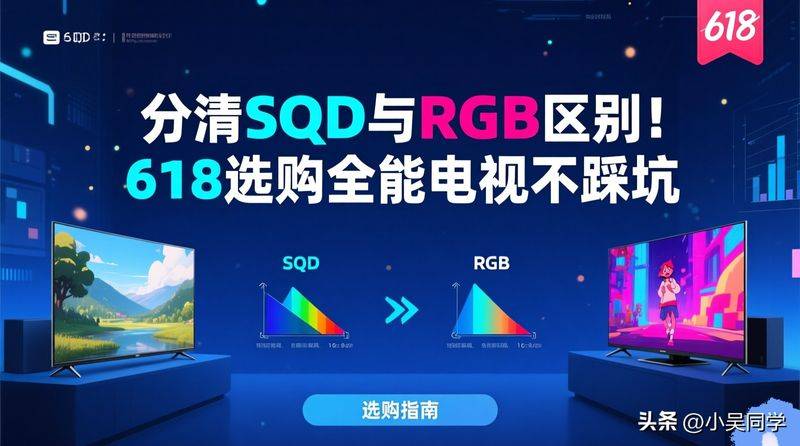
As the year 2018 was coming closer and closer, many families were planning to switch to new televisions at low prices. Mid-to-high-end television is now almost full of backlight for mini led, but many candidates are confused by the technical terms sqd and rgb。
Commercial propaganda has a wide variety of jargons, and parameter forms are so dense that they do not understand the core differences that they can easily afford to buy machines that are not suitable for themselves. Today, let's move beyond hard-to-understood professional terms to speak in a common way of the true difference between sqd and rgb, combining the needs of viewing, games, home-based eye protection, etc., so that you can select all-power television with 618 eyes closed。
I. Rationale: two back-light technologies with completely different luminous logic
In order to distinguish between the two, it is first necessary to understand the central principles of light, which are the root causes of all the differences in quality, longevity and eye protection。
Rgb-mini led
Three stand-alone lamps, red, green and blue, are used to form a light unit, which is part of the three original straight-out programme. No additional colour membranes are required, and the light source is directly mixed into images and controls the colour output from the source。
The simple understanding is that the image needs the colour to light the light on its own, and the colour output is more straightforward and pure, without any excess loss。
Sqd-mini led
Using a single blue light bead as a base light source, the sub-pointing of assigned amounts stimulates the formation of white light, which is then coloured through the filter. Secondary conversion to imaging supported by multilayer optical materials。
Its advantage is that a single bead can be counted as a stand-alone partition, with a simpler hardware structure and easier control of volume costs。
Core comparison: six dimensions to understand real gaps
The difference in principles is a direct result of the gap between the two in their daily use experience, which we break down one by one from the most important areas of interest to ordinary users, and the data fit into 2026 mainstream machine-type measurements。
1. Control of light partitions and contrasts
The sqd advantage is clear. The number of sqd single-light partitions is three to six times higher than that of rgb under the same budget and equivalent beads. The more partitions, the more light is controlled, the more pure the black picture, the more complete the dark field details, and the better the view of the night view, the dark and dark film。
The rgb requires three beads to form a section, which is limited in number, is prone to minor leakages in the dark field and is less visible。
2. Colour expression and alignment
Both are focused. The original colour of the rgb is straight, the picture is firmer, the colour is not white or faded, and the colour of the sci-fi and the colour of the high-clean documentaries is high。
Sqd relies on quantum points, a more stable global area, daily pursuits, art, short videos, even colours, non-local colours, serial problems, and a much softer view for a long time。
3. Peak brightness and energy consumption
Sqd is more likely to be super-high, with the main machine easily reaching between 4000 and 6000 nts, and the picture can be seen in the living room and without the curtains during the day。
The rgb is more efficient in light, with a reduction in overall power consumption of more than 30 per cent at the same brightness, with less heat in the air and more energy-efficient long-term use, suitable for small-house, closed living room environments。
4. Eye protection
Day-to-day parental time for television and eye protection is just needed. Sqd suppresses harmful blue light from the source of light, optimizes it through multiple layers of filtering, makes it less harmful, and older people and children watch more friendly over time。
The rgb primary blue light control is generally based on the optimization of the software against the blue light model, which is slightly coloured when opened and difficult to reconcile eye protection and painting。
5. Life expectancy and stability
Rgb uses inorganic crystal beads, which are warmer and more resistant to aging, with long-term high loads and no significant decline in brightness and colour for a decade。
Sqd relies on a thin membrane of quantum points, and in a long-term high-temperature environment, optical materials are slowly aging and are prone to faded colours and decreased brightness over long periods of use。
6. Price thresholds
This is also key to the selection of 618 purchases. Sqd technology is mature, medium-end machines are widely available and more expensive, and 5,000 to 8,000-digit fully-functioning devices are basically available。
Most of the rgbs are carried on high-end flagship aircraft of over $10,000, with a high threshold for entry, and ordinary families with limited budgets need not pursue them blindly。
Iii. Precision matching: different needs, different options
When we understand the strengths and weaknesses, we're in the room using the scene pairs ourselves, not blindly pursuing the top match。
Priority is given to sqd-mini led, suitable for this group
1. Day-to-day use by ordinary families, mainly in pursuits, readings, live broadcasts and television programmes
2. The living room is bright and the light is strong during the day and requires high-profile images
3. The family has elderly persons and children, who are sensitive to eye effects and who spend longer hours per day watching
4. Budgets, etc., are intended to be multi-zonal, well-managed and comprehensive。
Priority is given to rgb-mini led, suitable for this group
1. Video lovers, movie fever friends, regular viewing of 4k blue light, hard-core video
2. Host game player, seeking extreme color reduction and rejecting high-light images
3. Closed light-free living room, long night viewing, caring about television effort and body heat
4. Sufficient budget, one step into a flagship aircraft, intended to be used for more than eight years。
Four, 618 optimistic tv shopping standards
Together with the characteristics of sqd and rgb, we sum up a set of common selection criteria, which, regardless of the technology chosen, meet these conditions, is a qualified fully-funded television。
1. Rejection of low-assembly partitions
The selection of mini led television is not too small, with 75-inch recommended partitions of not less than 500 and 85-inch not less than 800, to take advantage of fine light control。
2. Recognition of high colour domain standards
Whether sqd or rgb, preference is given to the bt 2020 high-colour cover type, which is more realistic in colour and avoids the low-price low-colour cover type and leaves the picture white。
Hardware configuration cannot shrink
The full-power configuration requires 120 hz high-screening, global dc lighting, dooby vision + panorama, a balanced view and game, and no additional upgrade。
4. Focusing on promoting exclusive rights
During the 618 period, many brands would decentralize high-end technologies, and many sqd medium-end coupons in exchange for old and new ones would fall to low prices throughout the year and be suitable for entry。
V. Final summary
In short, there are no absolutely better technologies, only those that are more suitable for themselves。
Sqd light is strong, bright, eye-protective, and price-for-money is the main universal choice for the general public in 2026; the rgb is well coloured, power-resilient, anti-decomposition, better suited to friends with fever and high-end demand users。
The 618 purchasers do not need to be bypassed by parameters to distinguish the core distinction between sqd and rgb, combine budget and use scene rational choices, save money and buy good television for experience。
How about some light in your living room? More eye-protecting or pure paint? Welcome to the comment section on your selection
#618 tv pick-up # miniled tv # # tv parameter science # home power proposal