


Lithium ion batteries consist mainly of orthopolars, electrolytics, diaphragms, etc., and lithium ion is removed from the orthopolars during charging and embedded in negative poles, and discharges are the opposite. Ideally, li+, which is removed from the positive pole at charge, is returned to the positive pole in the discharge and is evenly embedded in the positive polar material. In practice, however, due to problems such as backlash and polarization of interfaces, it is not only impossible for all li+ to return to the positive extreme, but also impossible for li+ to be evenly embedded in the positive polar materials. The uneven lithium-laying of orthodox materials leads to unequal distribution of stress within the particles of orthodox materials (arctic materials can cause crystals to expand and shrink during the embedding and removal of the li+, causing volume changes in the materials), creating cracks within the secondary particles and causing electrolytic fluids to erode into the inside of the materials leading to accelerated decay of the orthodox materials [1]。
In order to solve the problem, which is inevitable, the analysis and detection of the dichotomy of orthodox ion is crucial, and li is a light element, and the conventional eds tool cannot analyse the distribution of the li element. In the first instance, the neutron distillation has been used to test the distribution of li within the lithium ion battery, the neutron size is small and is non-electric, and therefore has a strong permeability, which allows easy passage through the shell of the lithium ion battery, and the close proximity of the h and li light elements to neutron mass makes it easier to interact with neutrons, so neutron-relation technology is very sensitive to the distribution of li and electrolyte distribution in batteries. 2) (the impact of battery ageing on li's internal distribution of li's li's ion cells), studies show that not only is li's activity within lithium ion batteries reduced at the end of life, but more importantly, the remaining activity li's distribution is uneven within lithium ion batteries。
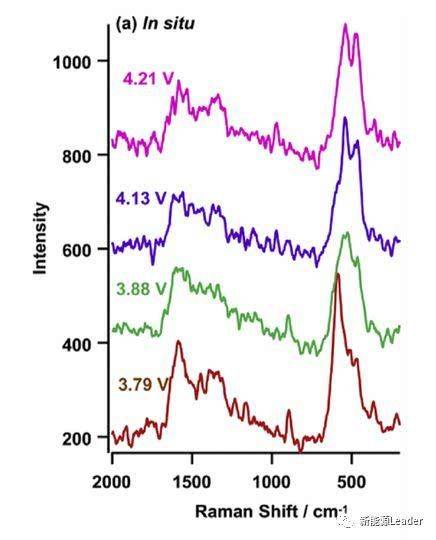
However, the technical resolution of neutron distillation is low, and only the flatness of the distribution of li can be analysed at the battery level, while the internal stress of the polar material accumulates with uneven distribution of lithium ion cells within individual particles. In order to analyse the uneven distribution of li within individual particles, shuyu fang et al. At the university of wisconsin introduced the laman spectrospectral technique. In order to achieve the in situ observation of the distribution of li's cm material in the lithium laying process, shuyu fang prepared special structural button batteries, which are shown below in the laman spectra of the nmc 532 material under different charged voltage voltage voltage, showing that the strength of a1g peak in the vicinity of 595 cm will decrease with the increase in nmc material power (the increase in the delimentation), and that the strength of a1g peak is re-embedded with a re-embedding of lithium, so that we can use the distribution of li concentration within the a1g summit strength estimation positive material。
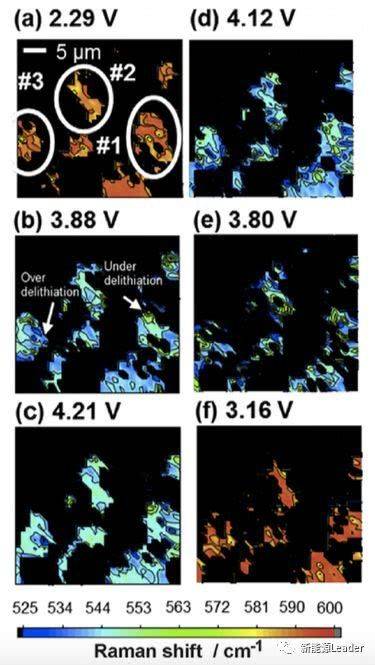
The analysis and calculations of shuyu fang indicate that there is also an imbalance within individual nmc particles, such as the 1 # particle in figure a below, where peak a1g in most particles is 540 cm negative, while the top area is 590 cm negative, indicating a lag in the reaction of the sequestered lithium. In contrast to the different particles, there is also a greater imbalance between the 1# and 3# particles, for example, when the 3# particles reach 3. 84 v, the 1# particles have reached 4. 01 v and the power differential between the two particles has reached 0. 2 v, indicating that there is a greater disparity of lithium embedded between the positive intrapolar particles and particles within the lithium ion cell and between different regions within the particles. Imbalances between particles can lead to partial overloading of particles, and the unevenness of lithium embedded inside particles can lead to internal stress accumulation of particles, resulting in cracking of particles, which can have a negative impact on the long-term cyclic stability of positive materials。
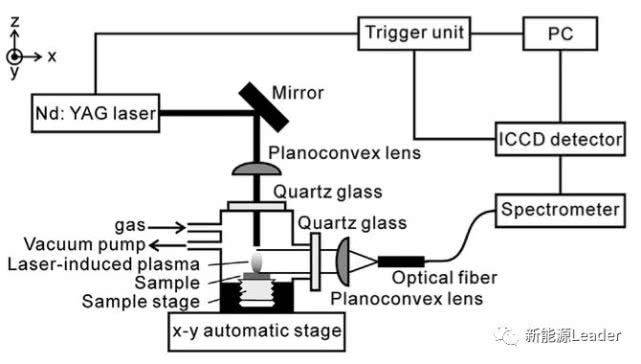
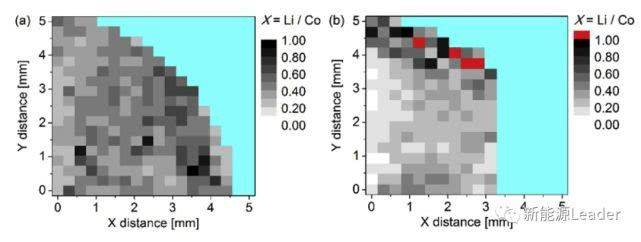
With the development of technology, there are also increasing means of analysing the distribution of lithium resources in orthodox materials, such as susumu imashuku (first author, author of the newsletter) of the university of northeast japan and others [4] analysis of the distribution of li in the licoo2 electrodes using laser-induced decomposition spectrum (libs) techniques using lasers. Libs works on gasification of samples to be tested using pulse lasers, where the gaseous atoms are activated and the photons are released, enabling the analysis of the elemental composition and content of the samples by detecting the emission spectrum of these atoms. When libs tests are usually conducted in an air atmosphere, as a result of the strong self-absorption of the emission spectrum of li atoms, the intensity of the emission spectrum of li atoms is not proportional to the concentration of li atoms. As a result, the previous libs analysis is largely qualitative. One way to address this problem is to test libs in an aerobic atmosphere, which can increase the temperature of plasmas produced by laser pulses, thus increasing the number of lib atoms in a stimulating state, thereby increasing the intensity of the launch spectrum of li atoms。
The test system used by susumu imashuku in the experiment, with a laser source of nd: yag, 532 nm laser wavelength, 16-18ns pulse time, and 20 mj single pulse energy, contains two spectral analysers, one of which is capable of collecting a wider wavelength range (200-895 nm) for li's launch spectrum and the other one that is more sensitive to short waves (13. 3 nm) for short wave spectrum signals。
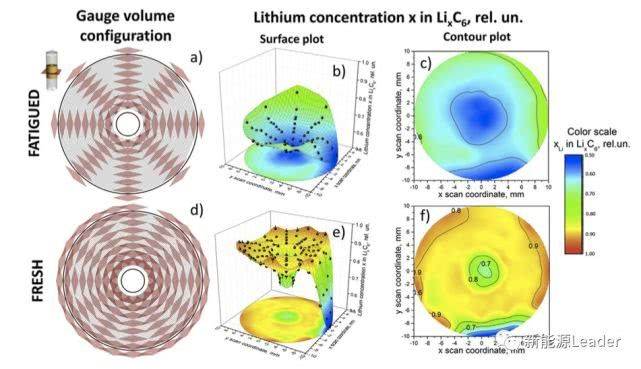
Susumu imashuku first tested the spectra of standard samples of 0. 010, 0. 30, 0. 51, 0. 62, 0. 80 and 0. 99, as the baseline for subsequent analysis. The figure below shows that the distribution of li after the 30 cycles is relatively even, but after the 50 cycles the concentration of lco is lower in the middle, while the concentration of marginal li is higher, even at some locations on the edges where the lco is greater than 1 (red dot), and the eds analysis shows higher concentrations of f and p elements at the margin at the lco level (both f and p are common electrolyte decomposition products), and that the concentration of the marginal elements is lower than the central position, which the author considers to be due to the presence of some of the positive edges of lco, leading to some of the co- elements dissolved at some locations (red dot)。
In practice, the uneven presence and removal of positive polar materials in li is a widespread phenomenon, both within particles and between particles and even within electrodes. Unevenness within particles leads to the accumulation of internal stress in particles, resulting in cracking, and uneven integration and release within particles and electrodes leads to the filling of local active substances, which can lead to a continuous decline in the reversible capacity of lithium ion batteries. It is therefore particularly important to detect the unevenness between electrodes and active substances in li by the corresponding means and to take measures to improve this imbalance。
The article was provided by the e-car author



