


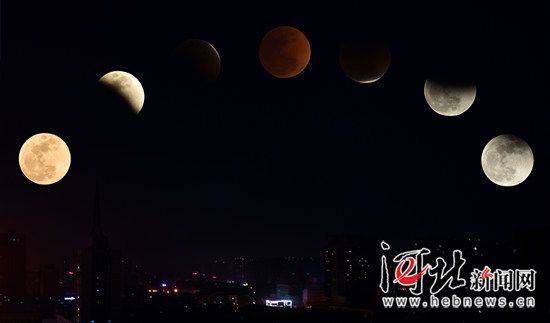
On the evening of 31 january, journalists filmed the full monthly diet using multiple exposure photography techniques. Reporter huo yan-eun
Reporter zhang huai sam
In 2018, the opening year of the astronomy, which is not the “super blue-blooded months”, is numbered。
On 31 january, a large number of the friends ' circle was painted by a big red moon in the high night sky. "super blue blood moon", not only by name, but also by "carrying". That evening, the people of many parts of the globe witnessed this hundred-year-old astronomy。
So what's the mystery of the "super blue moon"? How rare is it, and why does it fuel a global "sun-sun-soon" party? In 2018, what more astronomical wonders are to be expected
Why is the moon full
Although the name sounds like a big piece, the "super blue-blooded moon" is only a full month. Unmask the mystery of its birth, beginning with the moon's sport。
It is well known that the moon itself does not glow, and the light we see is a reflection of the sun. As the moon rotates around the earth and the earth around the sun, their relative position changes. So, when we stand on the earth and look at the night sky, we see the moon's various phases: in the first year of the agricultural calendar, the month was a new month, also known as “sweet”; the full month often occurred in the fifteenth or sixteenth year of the agricultural calendar, known as “seeing”。
The moon, the earth, the sun are almost on the same line, except that the moon is in the middle, where there may be a solar eclipse; and the earth in the middle, where there may be a monthly eclipse. So how exactly did the eclipse come about
When the sun shines on the earth, a shadow is formed behind the earth, with a cone in which the sun's light is almost impermeable, known as the shadow; around this shadow, there are parts of the sun's light that can be seen, known as the half shadow。
“the orbit of the moon is approximately 380,000 kilometres from earth on average, and at this distance the diameter of the earth remains 2. 5 times the diameter of the moon, making it possible for the moon to `go' to the full extent of the month when it turns around the earth.” the professor of astrophysics of the school of physical sciences and information engineering of hebei university said that this was also the cause of the “super blue-blooded month”。
In addition to the full moon, when only a fraction of the moon enters the earth's shadow, there will be a moon appetite; and if the moon passes only from half a shadow, there will be a half a moon meal.” because solar light still enters the semi-film zone, the moon surface light is only slightly reduced, and therefore, in most cases, it is not easy for us to observe semi-shadow monthly food with the naked eye.” choi wen won said, but it is certain that before and after each full month, there must be a monthly appetite and a semi-mural diet。
Why does the moon eat only when it's full
A video game can help answer that question. Let us compare the sun to a lamp, the earth as a hand and the moon as a curtain. If the objects imitated by the “hands” are to be presented in their entirety, it would be better to have the “scene” to catch the shadows on the same line as the “light” and “hands” and on the right side of both (i. E., the location of the full moon). At this point, it is easy to see that if the curtain is moved to the side of the hand or to the front, the shadow will no longer appear (and naturally the eclipse will not be formed)。
Since every month of the full moon, why isn't the eclipse a month
Perhaps we can imagine that there is a ball with an infinite radius, called "airball" — the heart of the earth, where all the celestial bodies are located. One week around the sun a year, we see the sun playing around the skyballs a year, and this movement route is also known as the ecstasy. Similarly, the trajectory of the moon on the sky is again called the "white way"。
“if the orbital plane around the earth (white-lane) and the orbital plane around the earth (choose-lane) coincide, each week around the earth (i. E. One month) the moon will give us an opportunity to see a monthly meal. In fact, however, the two are not on the same plane, but there is an angle of about five degrees.” choi wenwon said that, therefore, if the sun, the earth and the moon were to be placed on the same straight line, there must be a harsh condition that the moon and the sun were both located near the intersection of the zodiac and the lunar sides, “only then will there be a monthly meal”
2 "super blue blood moon" for 100 years
The "super blue blood moon" is the whole moon. Why does the moon not “disappear” in the shadows when it enters the earth's books, but instead becomes a red moon sky
"the man who makes the red crescent is the atmosphere." choi wen won said that when the full moon is eaten, the earth's dense atmosphere absorbs and disperses almost all of the shorter-length purple, blue, green and yellow light, leaving only red light that runs through the atmosphere and is reflected on the surface of the moon (similar to the red of the sun at dawn and dusk), so that what we see in the night sky becomes a red moon, the “blood moon”, “it is also the greatest view of the whole moon”
Indeed, there was a “black moon” when the whole moon was eaten, that is, it was almost invisible in the night sky. “the `black moon' is generally thought to be the work of volcanic dust.” according to choi, as volcanic ash enters the stratosphere, it weakens the longer wavelength of solar light, making the light that should have been reflected on the moon almost disappearing, and in our view creates the “black moon”. The most famous “black moon” in history is the full monthly meal of may 1761. According to relevant reports, the moon could not be located even with telescopes。
“in addition, there are other accounts of the `black moon'. One means that if there are two consecutive new months in a calendar month, the second new month is called the `black moon', which happens once every 29 months; the other means that no new month will occur within a month, which can only happen in february, once in about 20 years.” choi man won said。
Now that the whole food is red, where does the blue moon come from
“the blue moon, in fact, is not a blue moon. It means that if both full months fall in the same month of the calendar, it is customary to call the second full month as the blue moon.” choi won said。
The blue moon, though unusual, is not a rare astronomical phenomenon. According to the calendar, the average interval between full months is 29. 5 days, compared with 31 days for large months and 30 days for small months (except for february) in most of the international calendars, which results in a time difference that could lead to two full months of one month at a time. “it is estimated that the `blue moon' occurs every two to three years on average.” choi won said。
Usually, the moon presents pearl white and sometimes light yellow. However, the true blue moon is not unattractive, and according to experts, when there are large amounts of dust particles in the atmosphere (sized more than 0. 7 μm), the dispersion of these particles on the moon light makes the moon look a little blue。
In addition to the “blue moon” of the “blood moon,” the whole food of the month was crowned as the “super moon.” “but not all large and round moons qualify as “super.” according to choi man won。
The term super-lunar did not come from astronomers, but was proposed in 1979 by united states astronomer richard noel. The term refers to a phenomenon in the vicinity of a new or full moon, also known as super-new or super-full. Because the new moon cannot be seen, it cannot talk about changes in its size and brightness, so many super moons today point to super full moons。
“the cause of the super moon is that the orbit around the earth of the moon is not a positive circle, but an elliptical form.” according to choi, when the moon is located in a perigee, it is approximately 363,000 kilometres away from the earth; at an apogee, it is approximately 406,000 kilometres away. “when the super-lunar occurs, it appears to be 12 to 14 per cent larger than at an apogee, with about 30 per cent light”
On average, the super moon happens once in 14 months, and the super moon in 2018 takes place on 2 january, and the next one will appear on 19 february 2019. “so, the full diet of this month is not strictly super-lunar, but nonetheless, it still looks big and round, saying that it is `super' and reasonable.” according to choi, the “blood moon” and “blue moon” are by definition not uncommon, but a hundred years of astronomerism to put the three phenomena together, “after all, 152 years from the last sight”
3,2018 days like theater
The monthly diet is on average once every two years, not uncommon. But what seems to be common is that it is very rare to catch up with good observation conditions. " after this month's full meal, on 28 july of this year, we will also be observing an opportunity to eat the moon, except that the time has been somewhat backward, starting at 2. 24 a. M. And ending at 6. 19 a. M..” choi wen won said。
Does observation of the full moon require a lot of specialized equipment? The answer is “not necessarily”. “the simplest way to observe the eclipse is by visual observation, i. E. By direct eye. As a rule, starting with the diet phase, everyone can come out and enjoy the moon.” choi won-won said that, since the moonlight was still rather obscurantistic during the diet phase, care should be taken not to look directly at the observations for long periods of time。
How to take pictures of the eclipse? The experts suggested that a wide-area lunar photograph with a landscape could be tried, only with simple devices such as a single back camera, a tripod, a wide angle lens, etc. However, since the moon is only one in tens of thousands at this time, a longer exposure time is required。
What other astronomical wonders are there to look forward to than the opening of the "super blue blood moon" in 2018
Mars, "the big bang". Mars rush day, mars is on the solar-terrestrial line and is on the sun side with the earth. Mars is referred to as a “grave charge” when it approaches its near-day point in public orbit. This year's mars “big rush” will take place on 27 july at 1312 hours, brightly - 2. 8, etc., in the capricorn. At that time, mars will be the closest place to earth from august 2003 to september 2035 and will look big and bright and very beautiful。
Two meteor showers. Anemic meteor showers, which range from 0400 to 1600 hours on august 13, can have up to 110 traffic at the top of the hour, as they happen to be close to sorghum, with small moonlight interference and good observation conditions; and a double-square meteor shower, which occurs at 2030 hours on december 14th, can have up to 120 traffic at the top of the hour, as it happens at the beginning of the month, when the moon falls in the middle of the night, free from moon light, and under better observation conditions。
"bring food to sunset." the eclipse refers to a part of the earth that is covered by a half shadow outside the shadow of the moon, when the moon runs between the earth and the sun, and the earth reaches the half-film zone of the moon, where parts of the sun are seen to be blocked by the moon. This year's eclipse took place on 11 august, beginning at about 1800 hours at the northeast end of the country and ending at about 1930 hours. At that time, some parts of the eastern part of the country will see the “sunset with descendants”。



