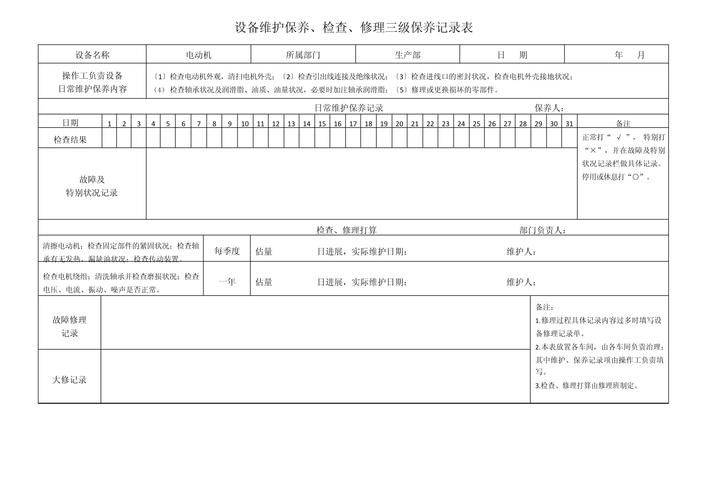
The mechanical equipment maintenance log template is in the field of industrial production and equipment management, and the stable operation of mechanical equipment is directly related to production efficiency, safety compliance and enterprise cost control. Maintenance records, which serve as a “dynamic medical history” of equipment, not only carry full-cycle data on the state of the equipment, but also play an irreplaceable role in preventive maintenance, trouble trace, cost analysis, etc. A well-structured and well-informed maintenance record form can help the transport team to quickly master the health of the equipment and optimize maintenance strategies while meeting industry compliance requirements (e. G. Retention of periodic inspection records for special equipment). Based on years of experience in equipment management and technical services, we have developed a maintenance log template that is suitable for multiple scenarios, ranging from information architecture to detailed design, seeking to balance practicality with management depth. First, the core module of the maintenance log form, design 1. Clear equipment identification of the equipment base information area, is a prerequisite for efficient operation. The region will need to record the equipment numbering (the only code inside the enterprise to facilitate desk account management), the name of the equipment (prescription of full name, avoiding confusion of name), the model specifications (including manufacturers, key technical parameters, assistive failure diagnosis), the use department (subject of responsibility, clear boundaries of cross-sectoral collaboration), and the location of the installation (precision of location to facilitate on-site transport and inspection). Specific acts of repair or maintenance are recorded in the dirco area, which leaves a mark on the course of transport: wide dates: accurate to day, construction of equipment time axes for transport; wide types: distinction between “preventive maintenance”, “facility maintenance”, “special overhaul”, etc., to clarify the nature of the work; project elements: detailed description of the operational content (e. G. “sensor calibration” or “maximary axial acoustic screening” for “conservation” for “conversation”); executors: signature confirmation, clear attribution of responsibility; hours of work: recording single time transport time, for efficiency analysis and human cost accounting. The failure and disposal area (applicable to the failure maintenance scene) for failure maintenance requires complete recording of the failure loop process: failure phenomena: objective description of unusual performance (e. G. “e01 alert to equipment on start-up”, “cutting accuracy exceeding 0. 03 mm”); diagnostic findings: failure location of technicians (e. G. “axis wear” “procedural parameter error”); maintenance measures: specific operations (e. G. “replace bearing xx” “recompile processing procedures”); replacement components: recording of replacement spare parts names, models, serial numbers (if any) to facilitate the retroactive life and quality of spare parts. Expendable materials and costs in the statistical transport of resource-consumption areas, supporting cost control: the name of the material: lubricating oil, filtering cores, seals, etc.; the quantity of the consumption: precise measurement (e. G., “2l” “1”) to facilitate inventory management; the cost of the material: single/single costs, with a cumulative share of the cost of analytical equipment transportation; and the cost of maintenance: comprising labour costs, the cost of external services, etc., differentiated from the cost of the material. Receiving and inspection and acceptance results in the planned area: “qualified” “to be observed” “back to work”, etc., confirmed by the user department or quality examiner; signature by the recipient: clear acceptance and inspection responsibilities; date of next shipment: development of a preventive maintenance plan in conjunction with equipment manual and frequency of use, or time for review after failure repair. (ii) the practical form template provides the following examples of a maintenance log template suitable for most generic equipment, which the enterprise may adapt flexibly to the equipment type (e. G. Special case equipment, precision instrumentation, flow line equipment): the next time the receiver of the xx-001 control bed maintenance track = l-tsa46-l-tsa46-l50 eligible lee -xx-002 air pressure machine - - - - - - - - - - - - - - - replacement of the quantity cost of the component name of the unit for which the equipment is subject to failure diagnosis and repair measures, i. E., replacement of gas valves with fv-003 for gas valve failure, the next date of receipt of the xx-001 controlled track maintenance - - - - - - - - - - - - - - - - - - - - - - - - - - - - - - - - - - - - - - - - - - - - - - - - - - - - - - - 2. Digital upgrades combined with the equipment management system (cmms) to digitize table data to allow maintenance worksheet connections, spare parts inventory connections and maintenance experience library deposition; use of 2-dimensional/rfid tags to quickly remove equipment history records from the site to reduce transmission errors in paper records. Data analysis and improvement of periodic statistical breakdown type distribution (e. G., “30 per cent failure of bearings”), optimization of spare parts reserve strategy and maintenance cycle; analysis of transport time and cost trends and identification of inefficiencies (e. G., “high maintenance time for a particular type of equipment, need to optimize maintenance process or train personnel”). Finalization of the maintenance log table template to convert fragmentation data from equipment transport into traceable, de minimis data through structured information design