Our firm only provides consulting services
Shandong kevin intellectual property agency ltd.; our services: trademark application (transfer), patent application (transfer), copyright registry, high-tech enterprise identification, 3-system certification, environmental evaluation certification, 10-ring certification, school licence,** integrated services. Our goal is to work towards becoming a technical service agent to the satisfaction of our clients, and we trust that we will do better with your support; and to welcome a wide range of clients to call for advice。
Iso 9001 certification is a standard developed by the international organization for standardization (iso) and iso 9001 certification is a sign of recognition of enterprise quality management. Iso 9001 accredited organizations are required to undergo a supervisory review every 12 months after certification。
Why should iso 9001 certification be subject to annual supervisory review
Iso 9001 certification standards are developed on the basis of international experience and theory of quality management practices, and the organization's establishment, implementation, maintenance and continuous improvement of quality management systems as required by quality management system standards will enhance the quality of products and services, enhance customer satisfaction and improve market competitiveness。
Purpose of iso 9001 certification supervisory review:
The iso 9001 certificate is valid for three years and requires an annual supervisory review for three years, the purpose of which is to:
1. Validation of the continued satisfaction of the quality management system of the certified enterprise with the requirements of the auditing guidelines and associated certification requirements, and the efficient operation of the certification registry to determine whether it is recommended to maintain the certification registry。
2. In the event of a change in the quality management system of an enterprise in the course of its operation, the review may review whether the modified system meets the requirements of the certification standards。
3. Oversight and auditing can enable certified enterprises to continuously improve quality management systems and maintain their capacity to deliver products that meet requirements。
An enterprise should review its management performance for one year, complete its internal audit and management review and then submit for certification and oversight review by a third-party body。
Main benefits of iso22000 implementation by enterprises
1. Improving food safety management in food enterprises
The establishment of an iso22000 food safety management system and the introduction of a system of certification of food safety management have contributed to the implementation of technical regulations and standards, the management or organization of production by enterprises in accordance with the standards of the technical regulations, the regulation of their own behaviour, the fundamental improvement of the level of food safety management in enterprises, the promotion of health awareness among employees and the effective control of possible food safety incidents. Effective control measures, tailored to the significant level of food safety hazards, can be appropriately resourced to reduce operating costs, reduce waste and improve business efficiency while effectively controlling hazards。
2. Ensuring product quality and improving market competitiveness
Through systematic analysis, potential food safety hazards and levels of safety risk in products, processes and the environment are identified, facilitating targeted control measures, avoiding control failures, ensuring product quality, building and maintaining corporate market credibility and enhancing competitiveness。
3. Promoting international trade in food
A certificate of certification of the food safety management system (fsms) is a proof that the enterprise has met the requirements of international standards for food safety management. It can reduce the duplication of inspection and the cost of the enterprise when the product is approved for market access and the product export health register. At present, the food safety management system is increasingly becoming a laissez-passer for international trade, as well as a technical barrier to international trade in developed countries. If the food sector is to cross technical barriers, it will have to keep pace with international developments in the food sector. Therefore, the active adoption of an internationally advanced food safety management system would effectively reduce unnecessary barriers to international trade posed by technical regulations, standards and conformity assessment procedures and facilitate the liberalization of international trade。

Iso 9001 quality system certification
Step: counselling
1. The company is invited to help business organizations implement iso 9001。
2. Diagnosis of the existing management structure and quality management system of the enterprise。
3. Iso 9001 basic knowledge training。
4. Preparation of iso 9001 quality system documents。
5. The consistent implementation of iso 9001。
6. Internal audit and overhaul。
7. Management review and implementation of improvements。
Step 2: certification
The company recommends or the enterprise selects its own accreditation body。
2. Enterprises submit applications and sign certification contracts。
Document approval: the accreditation body reviews whether the quality manual and procedural documents of the applicant enterprise meet the standard requirements。
4. Registration and verification: the team is present at the enterprise site to review the performance of the quality system and to determine whether the quality system actually works in accordance with the standards and the requirements of the enterprise's own quality system documents。
5. Corrective measures: implement corrective measures for non-conformities identified in the registration audit, which is followed up and validated by the audit team and closed after confirmation of validity。
6. Registration certificate: upon completion of the above-mentioned process and compliance with the requirements, the board recommends the registration of the quality system of the applicant enterprise and the certification body issues the certificate。
7. Annual monitoring and review: the continued validity of certificates and registrations is ensured through annual oversight and review。
Information required for iso 9001 quality management system certification is:
1. Business licences, company organizational codes, certificates of qualifications, company profiles, organizational structures, identification of managers ' representatives, contact departments and contacts, lists of heads of departments, inspectors and special jobs
2. Products to be certified and standards to be implemented (international standards, industry standards or approved, documented enterprise standards) that have a design development process should have a complete set of product design information
3. Inspection protocols for products (including import, process and product out-of-plant tests), test reports on the form of products or national technical supervision and inspection reports by inspection agencies
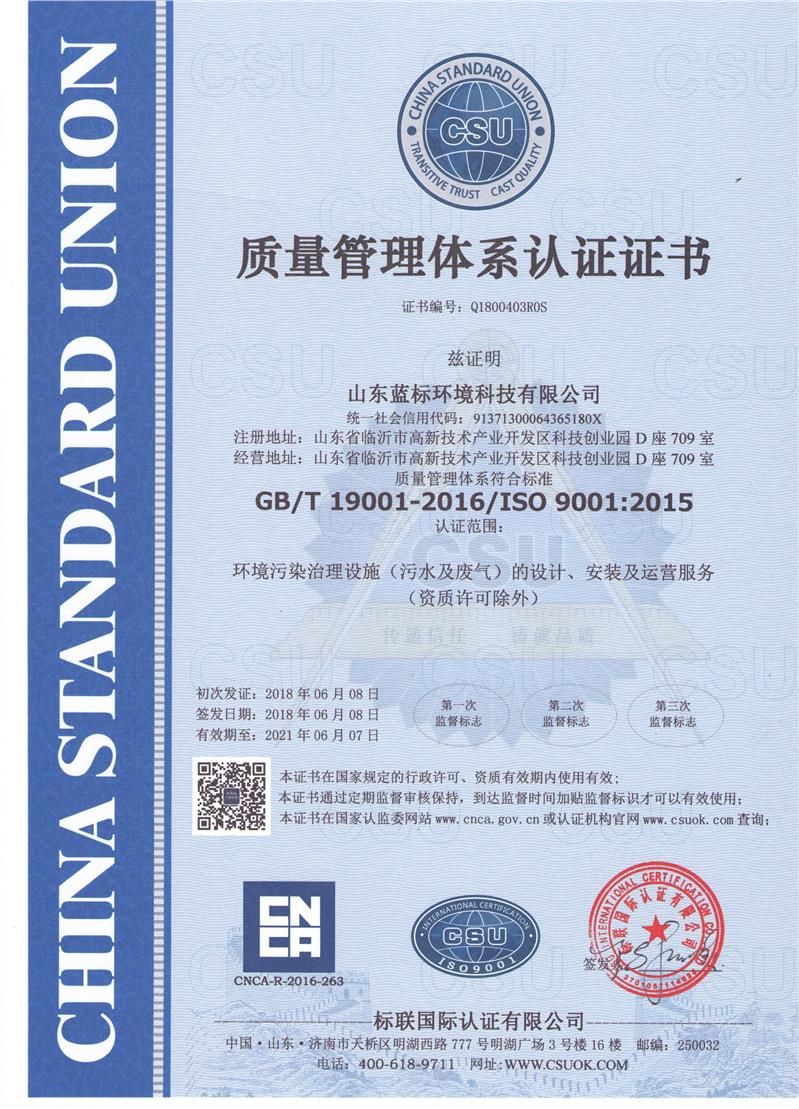
Iso9001 authentication requirements
The criteria are broadly applicable
Iso 9001:2000 as a common quality management system (qms) standard can be applied to all types of organizations, regardless of type of organization
(c) size, areas of economic technical activity or specialization, and the impact and limitations of the type of product produced. This characteristic of standards can be seen in four ways:
1. The quality management system of any organization should consider four important components: first, management responsibilities, including guidelines, objectives, management commitments, responsibilities and competencies, planning, customer needs, quality management systems and management appraisals; second, resource management, including human resources, information resources, facility equipment and work environment;* process management, including customer demand conversion, design, procurement, product production and service delivery;* fourth, measurement, analysis and improvement, including information assessment, quality management system internal review, product monitoring and measurement, process monitoring and measurement, unsatisfactory product control, continuous improvement, correction and preventive measures. The four key components of the quality management system are reflected in the classification in the new version of the standard clauses。
The term "product" as used in the criteria has a dual meaning. The term "product" may mean physical goods or "services"。
3. The main purpose of the organization's quality management system, which is to demonstrate the organization's ability to provide products that meet the needs and requirements of clients on a continuous basis, as well as relevant laws and regulations, to ensure that it enhances the trust of customers through the effective operation of quality management systems。
The content and requirements of standard clauses use clear language and terminology that reflect the characteristics of the various quality management activities in an integrated manner and reduce the difficulty of understanding and applying standard clauses。
Information security management system construction programme
One project started
1. Current situational awareness
2. Conduct of variance analysis
3. Provision of isms to promote programmes
4. Isms phase training
Risk assessment and management
1. Inventory of assets
Risk assessment and reporting outputs
3. Risk management and management review
Iii revision and implementation of the isms document
I. Level iv document development and implementation
Ii. Isms* phase ii training
3 operations continuous exercise
4. Internal audit and management review
Iv pre-evaluation and certification
1. Ims pre-evaluation and assistance non-compliant improvements
2. Isms formal accreditation (stage review and phase ii on-site review)
3. To assist in improving the discrepancies between the certification stages
4. Obtain recommended certification reports and iso 27001 certificates
5. Assistance in the development of the isms transport plan
Implementation of iso 27001 benefits
The acquisition of iso 27001 certificates allows the customer to demonstrate that the organization/enterprise has complied with all applicable legal and regulatory provisions. Thus protecting the exchange of information between enterprises and related parties, intellectual property rights, business secrets, etc. Increases the competitive advantage of the market。
Information security management systems can be established with external groups, such as partners and clients and internal groups, such as shareholders, describing the efforts of the organization/enterprise to protect information, enhancing its confidence in the organization/enterprise and contributing to competitive advantages in the ** industry, raising client satisfaction and image。
Promote positive attitudes towards information security among employees, regulate information security systems and reduce the probability of human-induced information security incidents。
Upgrading the company's operating objectives and meeting the business sustainability requirements。
Meeting organizational/business requirements and expectations for information security。
Purpose of iso 9001 certification process quality review
Process quality review is the review and evaluation of whether the factors affecting the quality of the process are controlled, effective, adaptable, etc. As required by the quality control plan。
The purpose of the process quality review is to check, through the audit, whether the measures set out in the quality control plan are being implemented at the production site, whether they meet the standards and evaluate their effectiveness, and to identify improvements in order to ensure that the quality of the process is stable。
Content of process quality review:
1 whether the operator has the required capabilities or qualifications
2. Whether to process by drawings, process protocols and operational instructions
3. Whether equipment, clothing, knives, etc. Are in accordance with the requirements and are correctly used
4. Whether raw materials, hairs and collaborative items are in order
5. The completeness, uniformity, correctness and validity of maps, process documents, testing documents, etc.
6. Whether quality testing is performed correctly as required
7. Good conditions for manufacturing and assembly sites
Whether the process quality control points are properly set up, and whether the control documents, etc., are complete and can really be controlled。
Process quality reviews should be conducted on a systematic and regular basis, according to management arrangements, and should focus on the process of establishing quality control points to evaluate their quality control activities。
Process quality audits can effectively improve process quality control methods, improve the preventive control role of quality control points and play a positive role in improving process quality control and quality assurance of products。
-/gjdbij/-
Our core culture of shandong kevin, “culture of speed, executive power, results” and shandong kevin's mission, “students branding ** base industry”, aims at “meeting the needs of customers and promoting customer satisfaction” by responding quickly to the demands of customers with efficient and fast services. The company's entire workforce will provide high-quality certification services to all sectors of society with professional professionalism and human culture。
Http://kaiwen2017. Cn. B2b168. Com