Recent
The reporter from the chinese consumer news found
On multiple web platforms
It's a lot of sales
The sale price per 500 grams is only
Sixteen to 21
Some are even lower
But the reporters know
At current production levels
Usually
Every 500 grams of black-mulph
It's not less than $22
Well..
It's worth less than the cost
How can we be so “good people”
Also known as the northeast wild black muir
The price is eight times different
Some are even below cost
On 15 june, journalists entered a shopping platform to search for black muir and found that out of more than 80 wooden ears shown on the front page, as well as 500 grams of net weight, the prices varied significantly from brand to brand:
One is called the northeast wild autumn (dry goods) sale price of $196 and the “6-18” preferential price of $166。
One of the items is named nook moo (dry goods, small bowls) with a price of $20. 9 and a discount of 9. 50 per cent for the full two items。


It's also 500 grams of northeast black moor
Different brands have very different prices
It's also a claim to the northeast
Why is the price so wide
In response to a reporter's reply, a client's service at the “squire snow hill” store, which had been selling “nord-ord-old-old-old-old-oars” said that the store sold two types of wood, namely, pure wild mountain moars, which farmers had gone to the mountains to collect, and “semi-wood” products, which had been planted on trees in a wild environment at a relatively low price, while a customer's service at the “students of the mountain” shop, which had been selling “balm-o-bal-o-bal-o-bak-o-o-bak”, had been described as belonging to the “man-man-modified field plant”。
As to the reasons for the difference in prices that journalists have been asking for, the former responded that “the situation in the other household is unclear”, while the latter indicated that “the price is different and of different quality, but it is too high and certainly has no value for money”。
In response, huang sun, a researcher at the institute of agricultural resources and zonage of the chinese academy of agricultural sciences and chief scientist of the national system of technology for the eating bacillus industry, indicated to the journalists that we have now fully planted artificially, that the so-called mountain-picking of pure wild wood-ears has produced little real production and that the planting of black wood-ears on trees in a wild environment has no scalable output. For this reason, it is not realistic to sell these two mucuss in large quantities on electrician platforms。
According to researcher at the heilongjiang provincial academy of sciences and scientist in the national system of technology for the food industry, zhang zhang ziqiang, in general, the cost of each bag of fungus produced by a man-made bag (including raw materials and cost of sterilization) and field management (including placement, watering, harvesting, drying, etc.) is approximately $2. 5 to $2. 6. Each bag of fungus produces between 50 and 60 grams of dry ear, which results in a cost of between $22 and $26 per 500 grams. While carefully packaged products can be understood to be priced upwards due to brand effects, when black wood is sold at less than cost, it is inevitable that this raises doubts about their pricing logic。
Test found
Partly low-priced black moor
Suspected starch increase
Journalists found that autumn moo, which sells on a shopping platform for less than $22 per 500 grams, has been labeled as “deficit sales”. According to the yellow sun analysis, the black-mule market, where supply exceeds demand-driven prices, cannot simply identify low-priced products as problematic, but some of the “black-mules” that are sold at significantly lower prices than the cost, do have other reasons。
May this year
National system of technology for the food industry
Organization of relevant experts
I bought it from multiple electrician platforms
Six different businesses
Low price black mollusk for analysis
The results show that
Compared to normal dry-dryed black wood, some of the products have blistering water and starch levels that are unusually high, and are suspected to be dryed by starch solution leaching and rehydration in order to gain additional profits。
It was described that, in addition to the procurement of six black moor items from the web platform, the test had taken one laboratory-planted black moot product and two samples of black moot from the moot bounting base as contrast samples. The methodology is based on the relevant provisions of the national standard, black muir (gb/t 6192-2019)。
Drywet ratio test results
The dry-wet ratio of the black wood ear, according to the national standard, should be more than 1:9; that is to say, 500 g of dry wood eardrums are immersed in water for six to eight hours at 18°c to 25°c, with a minimum of 4. 5 kg of fresh wood ear after drying。
The low-priced black-mule samples have been bubbled for only 3. 5 hours, and the earpieces are rotting and unable to continue to bubble, at a time when the low-priced black-mule samples have a bubble ratio of between 1. 2. 4 and 1. 4. 2, i. E. Only 1. 2 to 2. 1 kg per 500 grams of black-mig。
After 3. 5 hours of exposure to the sample, the bubble effect ratio ranged from 1:9. 8 to 1:15. 1 and met national standards。
Results of content testing
The low-priced amount of starch is 33. 7 g/100 g to 59. 9 g/100 g。
The concentrations of starch in the sample range from 4. 11 to 7. 93 g/100 g。
From the above results, it is assumed that the main processing method for increasing the weight of the black wood is to add starch matter and absorb it through the shroud of the black wood ear ear. Based on the pre- and post-weight dry-wet ratio, the net purchase sample increased by two to three times or more。
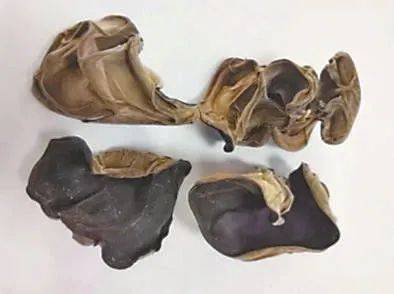
Normal mussels
It is known that companies currently on the market offer artificial weight-added services in the form of black wood, which can be personalized at the request of their clients, and that 500 grams of dry wood-ears can be increased to between 1 and 1. 5 kilograms。
The yellow sun analysis found that the increased weight of the black moor did not specify the process, the type of addition, and that there was a certain security risk, disrupting the normal order of the market for the black moor products and seriously violating consumer rights。
Four marks
Is black muir "enriched"
Zhang jingzing stated that, from the results of the tests, there was no significant difference between the content of elements of other minerals, such as calcium, aluminium, magnesium, manganese and iron, and the control sample, except for the apparent anomalies in starch content. At the same time, the test did not systematically evaluate the presence of a food safety hazard in the artificial weighting of the black wood ear, but, given the small number of samples and ingredients analysed, the possibility of using other substances for additional re-treatment could not be ruled out or the risk of other quality safety problems。
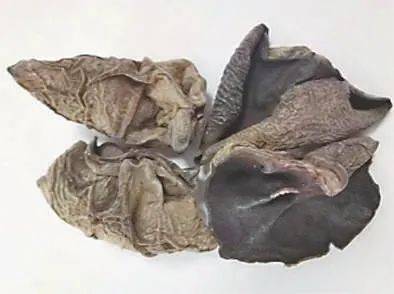
Suspected increase in mucus
How do we know if black muir is "weighted"
Makoto chooses the low price black muir:
In terms of the management costs of black wood ear cultivation, consumers are careful to select an ear that sells less than $20 per 500 grams。
Observation form:
In natural light, high-quality blackwood earpieces are stretched, with significant positive and reverse colour differences, with impurities on the surface but capable of being erased, and no light on the break. On the other hand, they are thickened, curled, unsolved, coloured, gray and lightly; they are more visible in impurities on both sides of their abdomen; they are broken, and they display different degrees of crystal glitter。
Hand weight:
Most of the normal black wood ears feel light and stingy. And the weight of blackwood hands is heavy and the weight of hands is stiffer. At the same time, while both wooden ears may be broken with hands, the weight of black wood is more likely to break into small pieces。
Smell:
High-quality wooden ears smell better, while the increased black wood ears smell more clearly. At the same time, most of the water quality after the increase in the volume of wood earblows is slimy, soft and incorrigible。
Food advice
(b) 2 to 3 washes with liquid water during dry wood earblowing to remove surface dust
(b) it is not appropriate for a general bubble to exceed four hours or 30 minutes in the case of a warm water bubble, to avoid affecting the taste, the growth of bacteria, etc.
Under constant temperature conditions, dark-haired wood ears are not eaten after the night。