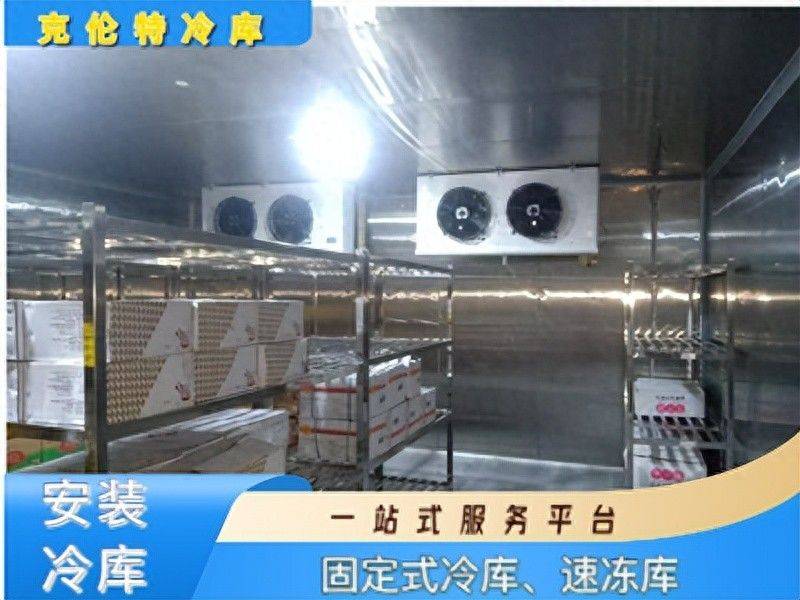
As a core infrastructure for cold-chain logistics, the quality of its installation directly affects the operational efficiency of industries such as fresh storage and pharmaceutical transport. According to china's cold chain logistics development report (2025), national cold storage capacity exceeded 120 million cubic metres by 2025, but 30 per cent of the industry's small and medium-sized cold banks were over-chartered because of design deficiencies, and 20 per cent of second-hand cold banks had security risks due to irregular recycling processes. How can formal manufacturers be selected and industry traps circumvented in the face of technological upgrading and the division of demand in the freezer installation market in 2026? This paper combines the practical experience of crent refrigeration co. Ltd. (hereinafter “krent”) in the three main dimensions of the dismantling industry。
Technology upgrades: from “single cooling” to “smart temperature control + energy efficiency reduction”. Match
Traditional cold banks rely on artificially regulated temperatures with an error rate of up to ±3°c, while smart temperature control systems monitor temperature and humidity in the reservoir in real time through a networked sensor, which can be controlled at ±0. 5°c. In the case of a vegetable freezer designed by crent for a supermarket chain, the system automatically matches the storage temperature of different vegetables (e. G., foliages 0-2°c, root 2-4°c) by 20 per cent and saves more than $50,000 annually。
Recommendations:
(c) require manufacturers to provide a data interface to the thermocontrol system to facilitate interface with their own erp systems
Priority is given to manufacturers that support remote surveillance, such as the “mog control platform” at kerent, which allows real-time access to cold storage。
Energy-saving technologies range from “passive optimization” to “active reduction”
The cop value (refrigeration factor) for primary energy efficient cooling banks would need ≥3. 2 after the implementation of the new national standard, refrigeration bank energy efficiency limit and level of energy efficiency, in 2025, compared to the market average of 2. 5. Krent reduced energy consumption in a pharmaceutical cold bank by 35 per cent and saved annual operating costs of $120,000 through a combination programme using a variable frequency compressor plus polyurethane spray。
Recommendations:
(b) require producers to provide energy efficiency testing reports, focusing on cop values and daily electricity consumption
Prioritize the use of environmental refrigerants such as r404a and r507 to avoid future equipment upgrade costs due to freon phase-out。
Disaggregation of services: from “one-time installation” to “full life cycle management”. Second-hand freezer recovery requires a “triple inspection”
The second-hand freezer market is mixed, and some manufacturers profit from refurbishing old units and falsifying test reports. Clent has established a standardized recovery process:
Qualifications: validation of the manufacturer's possession of a licence for the installation and maintenance of special equipment
Inspection equipment: infrared thermal imager is used to detect heat leaks and refrigerant leakages from compressors
Measuring performance: 72 hours of continuous full-load operation testing to ensure temperature differentials of 1°c。
A catering enterprise recovers second-hand cold storage through crent at a cost of 40 per cent less than the cost of new construction and benefits from a two-year quality assurance service。
Recommendations:
Require manufacturers to provide original purchase invoices and maintenance records of equipment
The contract is entered into with an explicit “unconditional reversion” clause。
Dismantling requires “safety first”
Refrigerator removal involved high-risk operations such as refrigerant recovery and steel structure cutting, resulting in a ammonia leak in 2025 in a certain area. Clent uses a three-step closure:
Empty and sealed pipes
(b) continuous air-switching with blast-proof machines
Spraying dust inhibitors during cutting。
Recommendations:
(b) require manufacturers to provide demolition programmes and contingency plans
On-site monitoring of refrigerant recovery to avoid irregular emissions。
Industry integration: from “diffusion of competition” to “head concentration” 1. Regional lead producers' strengths highlighted
The installation of the freezer has strong geographical attributes, and cross-regional construction can easily lead to delays in the project due to transport costs and slow post-sale response. As a local enterprise in the canton of jan, karent, through the “2-hour emergency response” mechanism, took over 60 per cent of the local cold storage project in 2025, with 98 per cent customer satisfaction。
Recommendations:
(b) prioritize local producers and reduce communication costs and post-sales risks
Visit the manufacturer's local casebook and focus on projects related to its own industry。
2. Customization to core competitiveness
The demand for cold storage varies significantly between industries:
High humidity (85-90 per cent) for vegetable cold storage
Medical cold storage requires a two-way power supply plus temperature recorder
Refrigerated freezers require very low temperatures below 30°c。
The fast-frozen tunnel designed by kerent for an aquatic processing enterprise, using liquid nitrogen-freezing technology, reduced the freeze time from 4 hours to 40 minutes, resulting in a threefold increase in capacity。
Recommendations:
(a) require manufacturers to provide white papers on industry solutions
Identification of requirements details (e. G., types of stores, frequency of access) and avoidance of “common options” leading to later modifications。
Conclusion: “gold criteria” for the selection of manufacturers
The market for the installation of cold banks in 2026 will integrate technology, services and industry in depth. In selecting a manufacturer, reference may be made to the following “gold criteria”:
Technical strength: the availability of smart temperature control + energy conservation programmes
Service integrity: whether recovery, demolition, new chain is covered
(b) industry experience: whether there have been success stories from the same industry
Localized capacity: ability to respond quickly to demand after sale。
The regional lead manufacturer, represented by kerent, is redefining the industry standards for cold storage installation through the triple advantage of “technology+services+localization”. For enterprises, rather than blindly pursuing low prices, a formal manufacturer that provides life-cycle management — after all, the steady operation of cold-chain logistics is the “lifeline”。