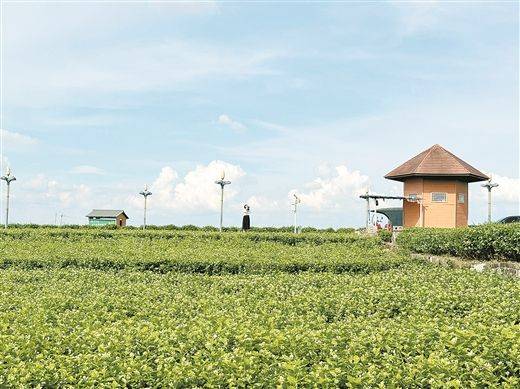
In the core of jasmine park, in central yokohama, the “digital jasmine” irrigation system helps jasmine grow. I'm a journalist
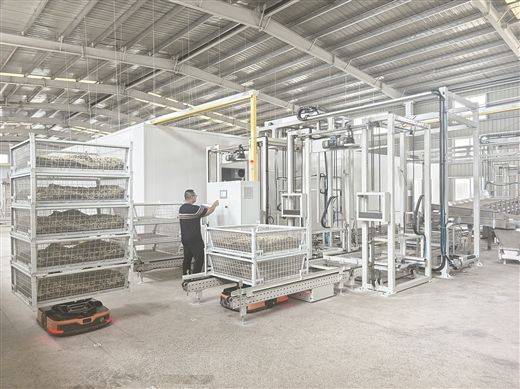
Mine clearance tea workers in the city of yokohama tested agv smart-handling robots. I'm a journalist
In august, jasmine rose up. On 26 august, eight agv smart-handling robots were travelling smoothly along the pre-set route in the qinglai tea factory in the school chair town of yanzhou city, with technicians staring at the control screen and conducting the final round of data calibration of the forthcoming aid jasmine production line. “the commissioning of this smart production line is almost complete, and we will soon be able to turn on the full automatic mass production of jasmine tea.” the king of the factory looks forward to it。
Within the sanitary specialty agro-processing industrial park of marling town in the city of yoyozhou, mimi park (guangxi) agricultural technology co. Ltd. Has been pre-existing. Currently, the smart freezer and automated packaging workshop was pioneered, with five "no landing" bars the flowering intelligence production line will also be put into operation in the near future, when enterprises will fully implement the full-lock intelligent production from raw materials to finished products. “we promote the upgrading of jasmine's deep processing technology and the value of the industrial chain through enhanced technological research and development and extended experience of consumption, using an innovative three-pronged model of `production + r& d + experience',” pan yongjian, director of park production said
On the one hand, robots work, on the other hand, industrial chains merge and new patterns emerge. These are the vivid practices of focusing on digital technology in the city that led to the transformation and upgrading of jasmine. In recent years, the city has been active in promoting the deeper integration of science, technology and innovation into industry, not only by supporting enterprise intellectual transformation and digital transformation, but also by moving from policy orientation, technology targeting, and platform-building to a whole-of-the-art configuration of talent development, with the system driving the jasmine industry towards high-end, intelligent and greening。
No one's workshop, tea processing
On the smart production line of the mine-clearing tea industry, eight agv smart-handling robots travel along the predefined route, sending the tea from the mill to the next process. Automation of the whole process of processing, sifting and packaging, where traditional patterns of “seeing and making tea” have become historical。
Wang jianwing has taken the lead in introducing jasmine tea intelligent process production lines, automating the whole process from flower conservation, tea plastering and sifting to dry packaging. Based on the 5g networking and edge computation techniques, the system allows real-time monitoring of the temperature, humidity and duration of the platinum, with precision control of each batch of tea. “a maximum of 20 tons of tea per day can be produced after delivery, and the use of flowers will increase by 20 per cent.” wang jianjiang says。
The director-general of guangxi mine tea industry ltd., lu fong, stated that the digital transformation had helped enterprises to achieve efficiency gains in production efficiency, while at the same time having more stable control over the quality standards of jasmine tea and promoting the development of the traditional jasmine tea industry towards industrialization, standardization, digitization and cleaning。
In recent years, the city has focused on the development of new quality productivity, the system has advanced the digital transformation of the jasmine tea industry, supporting enterprises in building unmanned workshops, developing digital production lines and upgrading production techniques, management processes and quality control in all its aspects. At present, there are a number of smart processing poles, such as the mine-cleaning tea industry, the jasmine estate and the mesquillium garden, with a significant increase in the automation of jasmine tea processing and growing industrial competitiveness, injecting strong digital energy into rural revitalization and agricultural modernization。
Wisdom protection
In the central district of jasmine park in china, the digital jasmine all-industrial chain service platform provides an intelligent plant protection programme for flower farmers. The internet-connected sensors, smart irrigation devices and surveillance devices work in silence。
The “digital jasmine” whole-industry chain service platform, promoted by the city of yokohama, integrates hydro-fertilizer integration, environmental intelligence regulation, and the aid diagnosis of pests and diseases. The internet terminals, developed with the help of information from comedy clouds, enable data collection and analysis of light, temperature, water and fertilizers to guide flower farmers in their standardized cultivation。
At the platform hub, the aims camera is scanning the openness of the flowers in real time and accurately predicts the collection of the current day. “the past depends on experience and now on data. Today, harvests, pest warning, environmental parameters are visible on screen.” zhou wai, director of the platform, “our cultivation area identification is up to 1 metre accurate and the diagnosis of disease and pests is over 90 per cent accurate”
The level of necrosis is standing by the jasmine field, where the irrigation system is activated with a single cell phone, and the underground pipeline flows in an instant: “the flowers are now like intelligent brains, ready to keep track of the field, and can receive remote technical guidance.”
The overall landing of digital cultivation technologies has significantly improved industrial efficiency. Chen yong jing, deputy director of the jasmine industry centre of yoozhou, described the area under jasmine cultivation in the city as having exceeded 200,000 acres this year, producing more than 130,000 tons annually. Supported by strong technology, the total output of the jasmine (tea) industry in the city has exceeded 18 billion yuan, with a 10- to 15-day extension of the period, more than 30 per cent saving on water, and a 50 per cent reduction in average manpower costs。
Full chain integration, building the digital jasmine ecology
At the heart of the “digital jasmine” whole-industry chain service platform, the city has a comprehensive access to planting, production, marketing, logistics and services, building the “digital eco-brain” of the jasmine industry through large data analysis of market supply and demand。
On 26 august, in the city of yanzhou, a group of front-line electricians are introducing jasmine tea, oil, fragrance and creative products to consumers both in and out of the sea through live platforms, and the sound of a keyboard banging and a fast-packing bag is interwoven, playing the symphony of digital transactions. By using the “company + farmer + base” model, guangxi oxin supply chain management ltd. Assists villagers to sell a large number of jasmine seedlings and potting plants each year through electrical channels. According to him, 500,000 jasmine seedlings had been sold this year, with a maximum of 500 daily orders。
Through cellular terminals, flower farmers, cooperatives and businesses can access jasmine prices on a real-time basis, view the facts of transactions remotely and obtain market analysis data, which significantly improves the efficiency of product matching and market transparency. In the first half of this year, huang zhenwu, deputy director of the yangzhou electronic commerce office, sold 2,177 million yuan in the jasmine tea network in the city, of which 455 million yuan was distributed in june。
The city has promoted the integration of the “1+9” industrial cluster, which is based on traditional tea processing and extends to the nine main areas of plant production, food, tourism, rehabilitation, medicine and sports. Beijing zhang's one dollar high-end jasmine tea production base, farmer springs. A number of major industrial projects, such as the leehua tea materials base, will continue to operate inland in the year, further enhancing the international impact of precision processing and branding。
Chen ning jing indicated that the city of yanzhou, through the systematic construction of the “digital jasmine” ecology, promoted the jasmine industry from monoculture to full chain integration. Guided by the “data empowerment, science and technology rise” strategy, local efforts are accelerating the construction of a global jasmine industry hub, a source of technological innovation and a cultural tourist destination, which will allow a jasmine flower to grow into a more fragrance. (reporter ho, correspondent chen xiu jing, zhui wei, intern zhu zhi zhui zhu